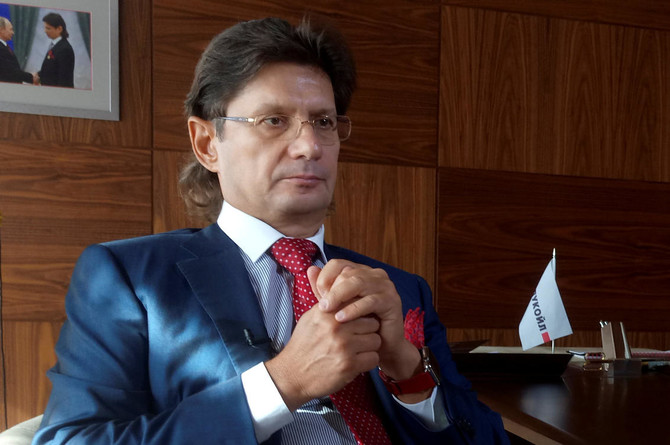
JARKUDUK, Uzbekistan: Lukoil plans to keep pumping 100 million tons of oil per year between 2018 and 2027 with projects outside Russia and will keep annual investment at $8 billion (SR30 billion)-$8.5 billion, the chief executive said on Saturday.
Lukoil, Russia’s No. 2 oil producer which has suffered from sluggish output from its Western Siberia fields, has kept production steady by focusing on growth in new regions, such as the Caspian Sea and Iraq. It is also looking at Iran and Mexico.
Lukoil Chief Executive Vagit Alekperov announced details of company’s 2018-2027 strategy to reporters at the launch of the firm’s gas facilities in Uzbekistan. He said details would be discussed by the board in December.
Under the new strategy, Lukoil planned to add 1.1 billion-1.2 billion tons of hydrocarbon to reserves while its gas output would reach to 35-40 billion cubic meters (bcm) per year by 2027, he said.
The 2018-2010 budget would be based on an oil price of $50 per barrel and a rouble rate of 62-64 roubles to the dollar, said Alekperov, who is also a major Lukoil shareholder.
Lukoil, a big oil products importer on the European market, would continue working on European projects and would keep its retail net in Turkey, the CEO said, despite new US sanctions imposed on Moscow this year.
Regarding other projects, Alekperov said he would meet Iranian oil minister Bijan Zanganeh in Moscow on October 3. Tehran has said earlier it expected to sign deals in the next five to six months with Russian firms, such as Lukoil, on developing of Iranian oil and gas resources.
Lukoil has been in talks with the National Iranian Oil Company (NIOC) on taking part in development of the Abe Timur and Mansuri fields in central-western Iran.
“We are very close, we have some disagreements which are not crucial, regarding output volumes and the pace of coming to any given levels,” Alekperov said, adding he was confident the differences could be resolved.
He also said the firm was also talking to Italy’s ENI on joint projects in Mexico.
In Uzbekistan, Alekperov said Lukoil would invest $3 billion in gas projects by 2021-2022.
Uzbekistan aimed to add output of 1.5 bcm in 2017 to the 2016 level of 55 bcm, Uzbekneftegaz head Alisher Sultanov said, adding that the country consumed up to 30 bcm per year.
Sultanov said Tashkent had contracts for exporting up to 6 bcm to Russia and up to 10 bcm to China.

Lukoil to maintain oil production, investments outside Russia
Profit scents lure new investors into Saudi perfume market
RIYADH: In Saudi Arabia’s perfume market, which at first glance appears saturated with local and global brands, new investors are still entering the sector with fresh labels, indicating that domestic demand can accommodate new competitors.
Speaking to Al-Eqtisadiah at the Blue Oud and International Perfumes Exhibition in Riyadh, Badr Al-Sayyed, owner of the “Amour” perfume brand, said launching his brand cost SR250,000 ($66,660), with retail prices set at around SR249 per bottle, citing the quality and purity of the essential oils used.
Al-Sayyed added that the brand was launched in September 2025, initially through an online store, with plans to expand physically in the Eastern Province within the next two years.
High profit margins
He noted that the online store receives more than 7,000 visits a month from customers across the Gulf region, with sales growth of between 5 percent and 8 percent from September to December 2025.
He emphasized that Saudi Arabia leads the region in sales, followed by the UAE, Oman and Bahrain, describing profit margins in the perfume sector as excellent.
Naif Al-Juwair, a procurement representative at Oud Al-Edan, said the company’s most popular oud types are Moroccan Live and Moroccan Dead oud, with the latter in higher demand.
He explained that the difference lies in the extraction location on the tree and its condition, with Dead oud known for its classic, cool and long-lasting incense aroma.
Al-Juwair added that the company operates five offices outside Saudi Arabia and works with oud manufacturers in Indonesia and Vietnam.
Gulf markets support domestic demand
Al-Juwair said online sales account for 10 to 15 percent of total sales, while overall company sales grew by up to 70 percent last year.
He stressed that maintaining quality is essential to balancing profit margins and customer trust, describing the Saudi oud market as strong, with Kuwait ranking second in purchasing power.
Abdulrahman Baraka, a marketer for the Vanilla perfume brand, said Saudi Arabia accounts for 80 to 90 percent of the brand’s total sales, followed by the UAE at 7 percent and Qatar.
He said the average bottle sells for around SR300, with the brand focusing on exhibition participation, where sales often outperform traditional stores, generating profits of between SR50,000 and SR100,000 over the 10-day exhibition period.
He added that the most active consumer group is aged 20 to 30, of both genders, with essential oils imported from Turkiye and perfumes manufactured in Saudi Arabia. He emphasized that all fragrances are proprietary creations, including a recent cola-scented perfume.
Seasonal trends shape fragrance preferences
Al-Sayyed explained that fragrance notes vary by taste, individual preference and season, noting that citrus notes such as lemon and bergamot remain popular year-round.
Summer fragrances, he added, emphasize light, refreshing fruit and herbal notes, while winter scents favor warm, deep notes such as wood, leather, oud and amber. He said men’s perfumes generally lean toward citrus notes, while women’s fragrances focus more on floral accords.
The perfumer emphasized that he does not seek to compete with others, noting that quality is the core principle and source of strength at every stage of his work.
He added that essential oils are imported from Grasse, France — renowned worldwide for perfume production — in addition to relying on high-quality perfume factories in Italy, the UK and Switzerland.