SEOUL/NEW YORK: North Korean leader Kim Jong Un blasted US President Donald Trump as “mentally deranged” on Friday and vowed to make him pay dearly for threatening to destroy his country, hours after Trump ordered fresh sanctions over Pyongyang’s weapons programs.
Tensions have risen as North Korea has resisted intense international pressure to halt its nuclear and missile programs, with Trump and Kim exchanging ever-more threatening rhetoric.
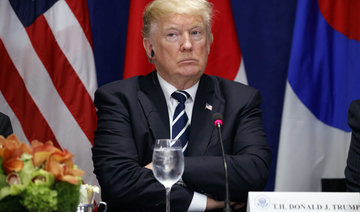
The US president said in his first address to the United Nations on Tuesday he would “totally destroy” the country of 26 million people if the North threatened the United States and its allies, and called Kim a “rocket man” on a suicide mission.
Kim said the North would consider the “highest level of hard-line countermeasure in history” against the United States and that Trump’s comments had confirmed his nuclear program was “the correct path.”
Pyongyang conducted its sixth and largest nuclear test on Sept. 3 and has launched dozens of missiles this year as it accelerates a program aimed at enabling it to target the United States with a nuclear-tipped missile.
Kim said Trump would face “results beyond his expectation,” without specifying what action North Korea would take next.
“I will surely and definitely tame the mentally deranged US dotard with fire,” Kim said in the rare direct statement carried by the KCNA state news agency, referring to Trump.
North Korean Foreign Minister Ri Yong Ho was asked what Kim might do and said Pyongyang could consider a hydrogen bomb test on the Pacific Ocean of an unprecedented scale, South Korea’s Yonhap news agency reported.
Ri, who was talking to reporters in New York, however said he did not know Kim’s exact thoughts, according to the report.
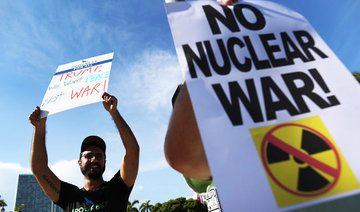
The escalating rhetoric came even as UN Secretary-General Antonio Guterres called for statesmanship to avoid “sleepwalking” into a war.
South Korea, Russia and China all urged calm.
However, the rhetoric was starting to rattle some in the international community. French Sports Minister Laura Flessel said France’s team would not travel to the 2018 Winter Olympic Games in South Korea if its security cannot be guaranteed.
The 2018 Games are to be staged in Pyeongchang, just 80 km (50 miles) from the demilitarised zone between North and South Korea, the world’s most heavily armed border.
More sanctions
In his sanctions announcement on Thursday, Trump stopped short of going after Pyongyang’s biggest trading partner, China, praising as “tremendous” a move by its central bank ordering Chinese banks to stop doing business with North Korea.
The additional sanctions on Pyongyang, including on its shipping and trade networks, showed that Trump was giving more time for economic pressures to weigh on North Korea after warning about the possibility of military action on Tuesday.
Asked ahead of a lunch meeting with the leaders of Japan and South Korea if diplomacy was still possible, Trump nodded and said: “Why not?“
Trump said the new executive order on sanctions gives further authorities to target individual companies and institutions that finance and facilitate trade with North Korea.
It “will cut off sources of revenue that fund North Korea’s efforts to develop the deadliest weapons known to humankind,” Trump said.
The US Treasury Department now had authority to target those that conduct “significant trade in goods, services or technology with North Korea.”
Trump did not mention Pyongyang’s oil trade.
The White House said North Korea’s energy, medical, mining, textiles, and transportation industries were among those targeted and that the US Treasury could sanction anyone who owns, controls or operates a port of entry in North Korea.
US Treasury Secretary Steven Mnuchin said banks doing business in North Korea would not be allowed to also operate in the United States.
“Foreign financial institutions are now on notice that going forward they can choose to do business with the United States or with North Korea, but not both,” Mnuchin said.
The UN Security Council has unanimously imposed nine rounds of sanctions on North Korea since 2006, the latest this month capping fuel supplies to the isolated state.
On Wednesday, US Secretary of State Rex Tillerson said there were “some indications” that sanctions were beginning to cause fuel shortages in North Korea.
Trump’s UN address was the most direct military threat to attack North Korea and his latest expression of concern about Pyongyang’s repeated launching of missiles over Japan and underground nuclear tests.
European Union ambassadors reached initial agreement to impose more sanctions on North Korea, going beyond the latest UN measures, officials and diplomats said.
“Dangerous direction“
South Korean President Moon Jae-in, who met Trump on Thursday and addressed the UN General Assembly, said sanctions were needed to bring Pyongyang to the negotiating table, but Seoul was not seeking North Korea’s collapse.
“All of our endeavours are to prevent war from breaking out and maintain peace,” Moon said in his speech. He warned the nuclear issue had to be managed stably so that “accidental military clashes will not destroy peace.”
Chinese Foreign Minister Wang Yi urged North Korea not to go further in a “dangerous direction” with its nuclear program.
“There is still hope for peace and we must not give up. Negotiation is the only way out ... Parties should meet each other half way, by addressing each other’s legitimate concerns,” Wang said.
Russian Foreign Minister Sergei Lavrov condemned Pyongyang’s missile and nuclear “adventures” but warned “military hysteria is not just an impasse, it’s a disaster.”
The United States and South Korea are technically still at war with North Korea because the 1950-53 Korean conflict ended with a truce and not a peace treaty.
The North accuses the United States, which has 28,500 troops in South Korea, of planning to invade and regularly threatens to destroy it and its Asian allies.