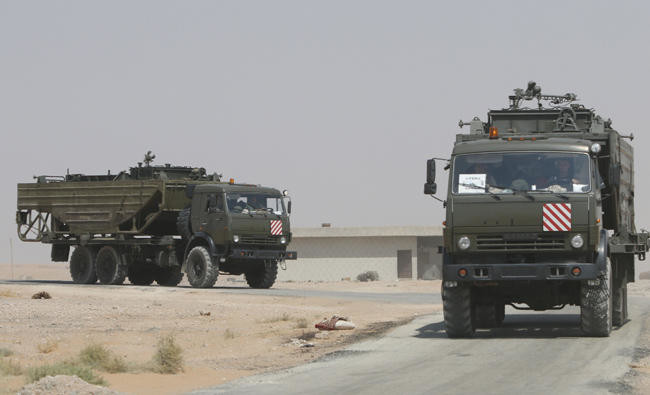
MOSCOW: Russia on Thursday issued a stern warning to US forces and their allies in Syria, saying it has deployed Russian special forces alongside Syrian regime troops in the battle for the oil-rich Deir Ezzor province and that Moscow would retaliate if the Russians come under fire.
The Russian Ministry of Defense said the US-backed Syrian Democratic Forces (SDF) have already shelled Syrian regime positions outside of Deir Ezzor twice in recent days.
The Russian special forces’ deployment raises the specter of a direct confrontation on the ground between Russian forces and pro-Syrian troops they back on one side, and the US-supported Kurdish-led Syrian forces on the other. US special forces are also operating with the SDF, providing artillery and other support.
“Syrian forces have twice come under massive mortar and rocket artillery fire coming from the areas on the eastern bank of the Euphrates where SDF fighters and US special forces are deployed,” Russian Defense Ministry spokesman Maj. Gen. Igor Konashenkov said in a statement.
Konashenkov said the warning was delivered to the US military command. Russian special forces have been deployed to help Syrian regime forces fighting Daesh outside Deir Ezzor, he also said Thursday.
“Attempts to open fire from SDF-controlled areas would be immediately met with retaliation,” he said. “The firing positions in those areas will be immediately destroyed with all the arsenal at our disposal.”
However, a Syrian commander with the US-backed SDF denied Russian accusations of shelling, saying at least 7 km of Daesh-held territory separates them from the Syrian regime troops.
The SDF has already accused Russia of targeting its troops in Deir Ezzor in an airstrike last week, a claim Moscow denied.
The campaign in Deir Ezzor, Syria’s oil-rich eastern province, is caught up in a race between the Russian-backed regime troops and the US-backed SDF.
Both sides are seeking to expand their control of the province bordering Iraq. Many oil fields, including Al-Omar, Syria’s largest, are scattered on the eastern bank of the Euphrates River. The Russian-backed campaign has so far been to recapture the city and provincial capital, also called Deir Ezzor.
The US-backed offensive is focused on the Iraq border area, which is still controlled by Daesh.


![]()
![]()
Russia threatens US in race to capture key Syria town

Russia threatens US in race to capture key Syria town
Latest updates




Recommended


© 2026 SAUDI RESEARCH & PUBLISHING COMPANY, All Rights Reserved And subject to Terms of Use Agreement.