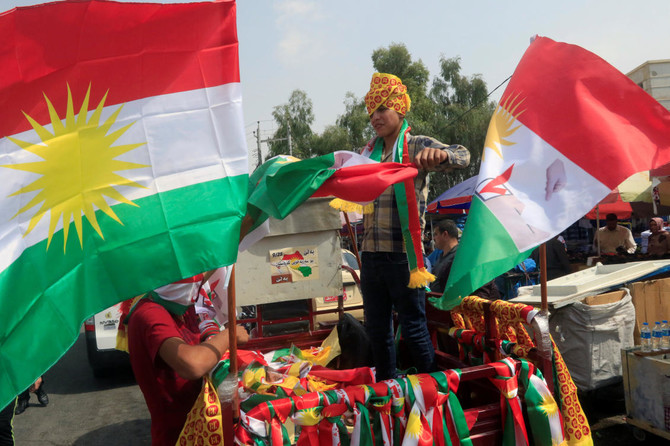
ISTANBUL: Turkey, which staunchly opposes Kurdish statehood, is far from alone in its rejection of an independence referendum in northern Iraq but it is unclear if Ankara is prepared to risk concrete reprisals.
Ankara’s displeasure over the planned September 25 referendum is shared not only by the government in Baghdad but also by its sometimes prickly neighbor Iran, not to mention Turkey’s Western allies in NATO.
Turkey, which has built close economic ties with the Iraqi Kurdistan Regional Government (KRG) in the last few years, has evoked possible sanctions over the non-binding vote but without specifying what these might involve.
After a rare trilateral meeting in New York, the foreign ministers of Iran, Iraq and Turkey warned of coordinated “counter-measures,” again without giving further details.
The idea of a Kurdish state — even one outside Turkey’s borders — is anathema to Turkish nationalists, religious conservatives and the secular opposition.
They fear fully-fledged independence for the Kurds of northern Iraq could embolden Turkey’s own Kurdish minority, estimated to make up a quarter of its population of nearly 80 million.
Left without a state of their own in the collapse of the Ottoman Empire after World War I, the Kurds see themselves as the world’s largest stateless people straddled between Iran, Iraq, Turkey and Syria.
By far the biggest population is in Turkey, which since 1984 has waged a campaign to defeat the outlawed Kurdistan Workers’ Party (PKK), which initially sought to create a breakaway state.
Millions of Kurds also live in Iran — which itself fought sporadic insurgent actions by groups like the Party of Free Life of Kurdistan (PJAK). Tehran and Ankara have often cooperated to stem the rise of Kurdish nationalism.
After an unprecedented visit to Ankara earlier this month by Iran’s chief of staff, President Recep Tayyip Erdogan said the two sides could launch joint operations against Kurdish militants although this was denied by Tehran.
Ali Vaez, senior Iran analyst at the International Crisis Group, said Tehran and Ankara had a shared interest in preserving Iraq’s territorial integrity.
But while mainly Shiite Iran and Sunni Turkey had the capability to jointly pressure the Iraqi Kurds, this risks being impeded by a regional rivalry dating back to their imperial eras.
“Though both have attempted to build on common concerns, deep suspicions about the other’s ambitions to benefit from the chaos have stopped them from reaching an arrangement that could lower the region’s flames,” Vaez told AFP.
Despite Turkey’s anger over the presence of PKK bases in northern Iraq, Ankara has formed a close economic relationship with the KRG in recent years, giving it immense potential leverage over Irbil.
Iraqi Kurdistan has become one of Turkey’s largest export markets, with prominent Turkish consumer goods and furniture brands ubiquitous on the streets of its major cities.
Turkey provides the sole transit link for crude oil exports from the KRG through a pipeline via its southern port of Ceyhan.
“Turkey is in a position to inflict significant damage to the Iraqi Kurds if it wants to,” said David Romano, professor of Middle East politics at Missouri State University.
But he said cutting economic ties with the Iraq Kurds would risk some $10 billion a year in trade, oil and gas imports and transit fees which are crucial to Turkey’s own Kurdish-dominated southeast.
“Turkey makes a lot of noises against the referendum, but it’s mainly to assuage the Turkish nationalist component of the ruling party’s base,” he argued.
With conspicuous timing, Turkey this week launched war games next to its border with the KRG but has made no concrete threat of military intervention.
While Russia has been notably circumspect, the only clear backing for the referendum has come from Israel, a longstanding if low-key backer of Kurdish ambitions as a non-Arab buffer against Iran.
Gulf kingpin Saudi Arabia on Wednesday urged the KRG leadership to scrap the plan, warning it risked sparking further regional crises.
According to some analysts, rising Kurdish nationalism could even prompt Turkey to find common cause with its prime foe of the last half decade, the Syrian regime of President Bashar Assad.
Both Ankara and Damascus want to head off the prospect of an autonomous Kurdish region in northern Syria run by the Peoples’ Protection Units (YPG) — a Kurdish militia Turkey sees as a terror group and a branch of the PKK.
Aaron Stein, resident senior fellow at the Atlantic Council’s Rafik Hariri Center, said Ankara had “de-prioritized” the issue of Assad “in favor of efforts to keep Syria united.”
Turkey has now found “common ground” with the Assad regime in countering the YPG, said Gonul Tol, director of the Middle East Institute’s Center for Turkish Studies.


![]()
Turkey rallies rivals, friends to oppose Kurdish state
Turkey rallies rivals, friends to oppose Kurdish state

Latest updates


© 2026 SAUDI RESEARCH & PUBLISHING COMPANY, All Rights Reserved And subject to Terms of Use Agreement.