BERLIN: The Alternative for Germany (AfD), which rails against immigration and Islam, is set to become the country’s first hard-right nationalist party to clear the five-percent hurdle and enter parliament in the post-war era.
Close to France’s National Front and the UK Independence Party, the AfD is an anti-establishment party that harnesses xenophobia and popular discontent about what it labels unaccountable political and media elites.
The AfD is dominated by white men, is strongest in Germany’s poorer ex-communist east, and has flirted with far-right groups, breaking a taboo in post-Holocaust Germany.
Its leaders have sparked outrage by saying German border guards should as a last resort open fire on illegal immigrants, calling Berlin’s Holocaust memorial a “monument of shame” and suggesting a Turkish-born German politician be “disposed of in Anatolia”.
The AfD is shunned as a radical fringe group by all mainstream parties, but its rise further fragments the political landscape and will complicate coalition-building efforts by the likely election winner, Chancellor Angela Merkel.
The AfD was founded during the eurozone debt crisis in April 2013 when it labeled the single currency “a historic mistake” and campaigned against bailouts for crisis-hit southern economies.
It narrowly missed the five-percent hurdle for entry into parliament in elections four years ago but then notched up wins in several regional votes and, in 2014, won seven seats in the European Parliament.
The right-winger Frauke Petry in 2015 toppled the AfD’s founder, economics professor Bernd Lucke, who quit the party.
The mass influx to Germany of mostly Muslim refugees and migrants in mid-2015 revived the AfD’s flagging fortunes as it angrily attacked Merkel’s open-door policy.
Like the far-right PEGIDA protest movement, the AfD accused her of “treason” and linked her immigration policies to jihadist attacks in Europe and sexual attacks by North African migrants in Cologne on New Year’s Eve 2015-16.
After a series of regional election wins, it now sits on the opposition benches of 13 of Germany’s 16 state assemblies.
The AfD holds that “Islam does not belong to Germany,” a country with 4.5 million Muslims, and campaigns with slogans such as “bikinis not burkas”.
It wants more law and order and promotes traditional, conservative “family values”, urging ethnic German women to have more babies.
The AfD demands the rolling back of European integration and promotes pro-market economic policies, putting it at odds with the anti-globalization National Front of France.
It disputes man-made climate change and has called the VW diesel emissions scandal a “witchhunt”.
The party wants to “return power to citizens”, including through Swiss-style referendums.
In foreign policy, like some other European protest parties, it advocates closer ties with Russia.
Poll support has dropped back from a peak of 16 percent at the height of the migrant influx to 8-12 percent now.
“The refugee issue has lost some of its immediacy,” said political scientist Hans Virchow, adding that many voters had also been turned off by inflammatory comments on German wartime guilt by far-right AfD member Bjoern Hoecke.
After new bouts of party infighting, members voted against making Petry their top election candidate, and the AfD entered the race with an unlikely duo.
One top candidate is Alice Weidel, 38, a Goldman Sachs economist who with her partner, a Sri Lankan-born woman, has adopted two children.
The other is Alexander Gauland, 76, who has repeatedly sparked outrage with racist comments, once claiming that Germans would “not want as a neighbor” a football star with a Ghana-born father.
He also recently questioned Germany’s obligation to atone for its Nazi past.
At the international level, the AfD has established contacts with France’s Marine Le Pen, UKIP and Dutch anti-Islam politician Geert Wilders, while voicing support for US President Donald Trump — a stance that could become a liability.
For now the Trump election and Brexit have “acted as a vaccine against the seemingly unstoppable rise of far-right populism in Europe,” argued Joerg Forbrig from the German Marshall Fund.


![]()
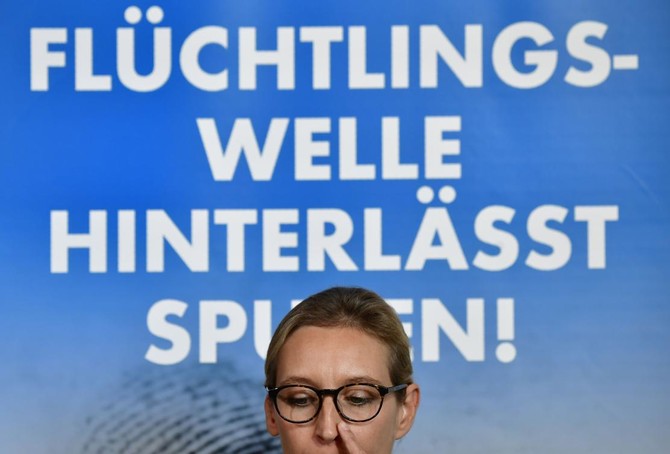
Germany: Anti-migrant, anti-Muslim, anti-Merkel nationalist party rises
Germany: Anti-migrant, anti-Muslim, anti-Merkel nationalist party rises


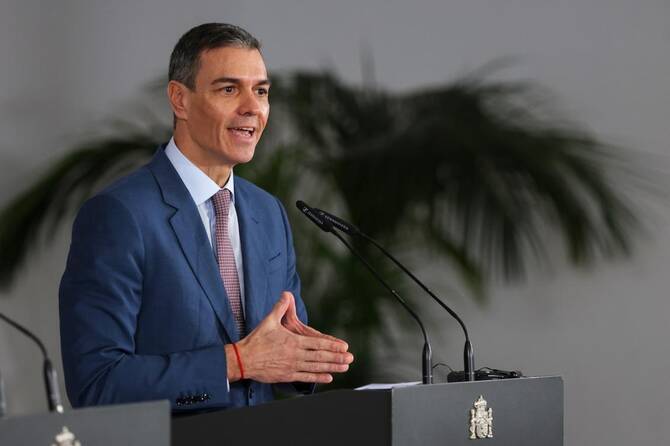
Spanish PM Sanchez says US invasion of Greenland ‘would make Putin happiest man on earth’
- Sanchez said any military action by the US against Denmark’s vast Arctic island would damage NATO and legitimize the invasion of Ukraine by Russia
MADRID: Spanish Prime Minister Pedro Sanchez said a US invasion of Greenland “would make Putin the happiest man on earth” in a newspaper interview published on Sunday.
Sanchez said any military action by the US against Denmark’s vast Arctic island would damage NATO and legitimize the invasion of Ukraine by Russia.
“If we focus on Greenland, I have to say that a US invasion of that territory would make Vladimir Putin the happiest man in the world. Why? Because it would legitimize his attempted invasion of Ukraine,” he said in an interview in La Vanguardia newspaper.
“If the United States were to use force, it would be the death knell for NATO. Putin would be doubly happy.”
President Donald Trump on Saturday appeared to change tack over Greenland by vowing to implement a wave of increasing tariffs on European allies until the United States is allowed to buy Greenland.
In a post on Truth Social, Trump said additional 10 percent import tariffs would take effect on February 1 on goods from Denmark, Norway, Sweden, France, Germany, the Netherlands, Finland and Great Britain — all already subject to tariffs imposed by Trump.
Those tariffs would increase to 25 percent on June 1 and would continue until a deal was reached for the US to purchase Greenland, Trump wrote.
Trump has repeatedly insisted he will settle for nothing less than ownership of Greenland, an autonomous territory of Denmark. Leaders of both Denmark and Greenland have insisted the island is not for sale and does not want to be part of the United States.
Sanchez said any military action by the US against Denmark’s vast Arctic island would damage NATO and legitimize the invasion of Ukraine by Russia.
“If we focus on Greenland, I have to say that a US invasion of that territory would make Vladimir Putin the happiest man in the world. Why? Because it would legitimize his attempted invasion of Ukraine,” he said in an interview in La Vanguardia newspaper.
“If the United States were to use force, it would be the death knell for NATO. Putin would be doubly happy.”
President Donald Trump on Saturday appeared to change tack over Greenland by vowing to implement a wave of increasing tariffs on European allies until the United States is allowed to buy Greenland.
In a post on Truth Social, Trump said additional 10 percent import tariffs would take effect on February 1 on goods from Denmark, Norway, Sweden, France, Germany, the Netherlands, Finland and Great Britain — all already subject to tariffs imposed by Trump.
Those tariffs would increase to 25 percent on June 1 and would continue until a deal was reached for the US to purchase Greenland, Trump wrote.
Trump has repeatedly insisted he will settle for nothing less than ownership of Greenland, an autonomous territory of Denmark. Leaders of both Denmark and Greenland have insisted the island is not for sale and does not want to be part of the United States.
Latest updates


© 2026 SAUDI RESEARCH & PUBLISHING COMPANY, All Rights Reserved And subject to Terms of Use Agreement.