Trump signaled dislike, but not demise of Iran deal — envoy

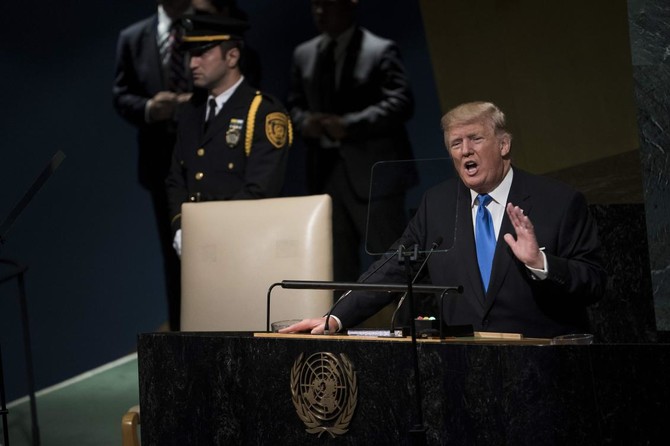
US President Donald Trump addresses the 72nd Annual UN General Assembly in New York on September 19, 2017. (File photo by AFP)
Updated 20 September 2017
Follow

Trump signaled dislike, but not demise of Iran deal — envoy

UNITED NATIONS: US President Donald Trump is unhappy with the Iran nuclear deal but has not signaled he will abandon it, the US ambassador to the United Nations said on Wednesday.
“It’s not a clear signal that he plans to withdraw. What it is, is a clear signal that he’s not happy with the deal,” the envoy, Nikki Haley, told CBS News of Trump’s pugnacious speech to the UN General Assembly on Tuesday in which he called the 2015 international accord “an embarrassment.”
Trump hinted in his speech to the annual gathering of world leaders that he may not recertify the agreement, negotiated by his predecessor, Barack Obama. “I don’t think you’ve heard the last of it,” he said.
The US president must decide by Oct. 15 whether to certify that Iran is complying with the pact, a decision that could sink the deal. If he does not, the US Congress has 60 days to decide whether to reimpose sanctions waived under the accord.
Under the agreement between Iran and six major powers — Britain, China, France, Germany, Russia and the United States — the Iranian government agreed to restrict its nuclear program in return for western countries loosening economic sanctions.
Haley spoke ahead of Iranian President Hassan Rouhani’s UN speech in which he is expected to respond to Trump’s accusations that Iran exports “violence, bloodshed and chaos.”
The head of Iran’s Revolutionary Guards said the United States should experience “painful responses” following Trump’s harsh criticism.
“Taking a definitive stand against Trump is only the beginning of the path,” said General Mohammad Ali Jafari, according to Sepah News, the news site of the Revolutionary Guards. “What is strategically important is that America witnesses more painful responses in the actions, behavior and decisions that Iran takes in the coming months.”
The prospect of Washington reneging on the agreement has worried some US partners that helped negotiate it, especially as the world grapples with another nuclear crisis, North Korea’s nuclear and ballistic missile development.
Russia is concerned by Trump questioning the Iran nuclear deal, Foreign Minister Sergei Lavrov told Russian reporters at the United Nations in comments published by his ministry on Wednesday.
“It’s extremely worrying,” Lavrov said. “We will defend this document, this consensus, which was met with relief by the entire international community and genuinely strengthened both regional and international security.”
Lavrov, referring to Trump’s speech, said that “if you simply condemn and threaten, then we’re going to antagonize countries over whom we want to exert influence.”


Bangladesh’s Yunus announces resignation, end of interim govt

Bangladesh’s interim leader Muhammad Yunus stepped down on February 16, 2026 in a farewell broadcast to the nation.
Updated 7 sec ago
Follow

Bangladesh’s Yunus announces resignation, end of interim govt

  • Yunus handed over power after congratulating the Bangladesh Nationalist Party and its leader Tarique Rahman

DHAKA: Bangladesh’s interim leader Muhammad Yunus stepped down on Monday in a farewell broadcast to the nation before handing over to an elected government.
“Today, the interim government is stepping down,” the 85-year-old Nobel Peace Prize winner said.
“But let the practice of democracy, freedom of speech, and fundamental rights that has begun not be halted.”
Yunus returned from self-imposed exile in August 2024, days after the iron-fisted government of Sheikh Hasina was overthrown by a student-led uprising and she fled by helicopter to India.
“That was the day of great liberation,” he said. “What a day of joy it was! Bangladeshis across the world shed tears of happiness. The youth of our country freed it from the grip of a demon.”
He has led Bangladesh as its “chief adviser” since, and now hands over power after congratulating the Bangladesh Nationalist Party (BNP) and its leader Tarique Rahman on a “landslide victory” in elections last week.
“The people, voters, political parties, and stakeholder institutions linked to the election have set a commendable example,” Yunus said.
“This election has set a benchmark for future elections.”
Rahman, 60, chief of the BNP and scion of one of the country’s most powerful political dynasties, will lead the South Asian nation of 170 million.
Rebuilt institutions’
Bangladeshi voters endorsed sweeping democratic reforms in a national referendum, a key pillar of Yunus’s post-uprising transition agenda, on the same day as the elections.
The lengthy document, known as the “July Charter” after the month when the uprising that toppled Hasina began, proposes term limits for prime ministers, the creation of an upper house of parliament, stronger presidential powers and greater judicial independence.
“We did not start from zero — we started from a deficit,” he said.
“Sweeping away the ruins, we rebuilt institutions and set the course for reforms.”
The referendum noted that approval would make the charter “binding on the parties that win” the election, obliging them to endorse it.
However, several parties raised questions before the vote, and the reforms will still require ratification by the new parliament.
The BNP alliance won 212 seats, compared with 77 for the Jamaat-e-Islami-led alliance, according to the Election Commission.
Jamaat chief Shafiqur Rahman conceded on Saturday, saying his Islamist party would “serve as a vigilant, principled, and peaceful opposition.”
Newly elected lawmakers are expected to be sworn in on Tuesday, after which Tarique Rahman is set to become Bangladesh’s next prime minister.
Police records show that political clashes during the campaign period killed five people and injured more than 600.
However, despite weeks of turbulence ahead of the polls, voting day passed without major unrest and the country has responded to the results with relative calm.