BARCELONA: Spanish police detained 13 Catalan government officials Wednesday as they crack down on preparations for an independence referendum in the region which Madrid says is illegal, sparking angry protests in Barcelona.
The police raids came amid mounting tensions as Catalan leaders press ahead with preparations for the Oct. 1 vote despite Madrid’s ban and a court ruling deeming it unconstitutional.
Among those arrested by Spain’s Guardia Civil police force was Josep Maria Jove, secretary general of economic affairs and the deputy of Catalonia’s vice president Oriol Junqueras, a regional government spokesman said.
The others work in various Catalan government departments, including its economic and budget affairs departments, a local Guardia Civil spokesman said.
The reasons for the arrests were not immediately clear, but Spain’s central government has warned that officials who help stage the referendum could face criminal charges.
Police said they were carrying out a total of 22 searches as part of the operation.
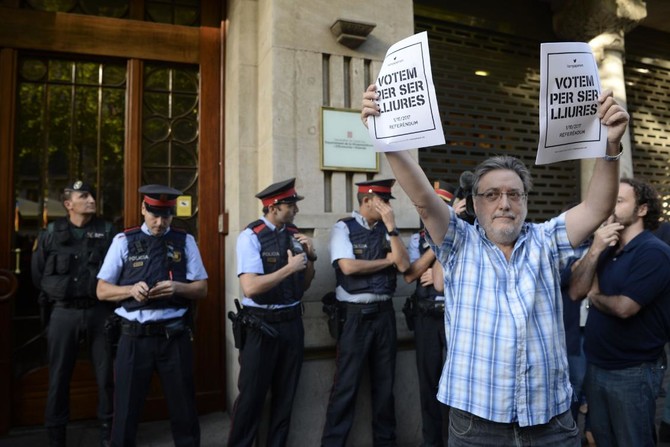
Hundreds of protesters gathered outside near Jove’s office in central Barcelona, chanting “Independence” and “We will vote.” Many were drapped in red and yellow Catalan flags.
Anna Sola, an unemployed 45-year-old, said she rushed to Jove’s office after hearing of his arrest on the news and through text messages from friends.
“They are attacking our institutions, those that we voted for, just for simply doing what the people want, and without any respect,” she said.
“It is shameful what is happening in Catalonia, there are no words for it.”
The police operation comes a day after officers seized a trove of documents related to the independence referendum from the offices of Unipost, a private delivery company, in Terrassa, a city near Barcelona.
Police said they confiscated over 45,000 notifications which were about to be sent to Catalans selected to staff polling stations for the vote, representing 80 percent of the numbers necessary to ensure the stations were adequately staffed.
Police scuffled with dozens of pro-secession protesters who gathered outside the Unipost office to try to keep officers from entering the building.
The protesters placed flowers on police vehicles and sat on the street to block access to the site.
Madrid has taken several other steps to prevent the Catalan referendum from going forward, including threatening to arrest mayors who facilitate the vote, seizing posters and fliers that promote the plebiscite and tightening control over the region’s finances.
It says the country’s constitution stipulates that a Spanish region does not have the right to call a referendum.
Tensions have also spilled over to Spain’s parliament in Madrid, where Gabriel Rufian, a lawmaker for the pro-separatist Catalan Republican Left (ERC), on Wednesday told Prime Minister Mariano Rajoy to take his “dirty hands off Catalan institutions.”
“The will of the Catalan people cannot be stopped. And now we will leave to support our friends,” he added before he and his fellow ERC lawmakers stormed out of the assembly.
Rajoy defended his government’s actions, saying that it was “fulfilling its obligation.”
“The rule of law works,” he said.
Spain’s Foreign Minister Alfonso Dastis has accused Catalan separatists of using “Nazi” tactics to intimidate their opponents before the referendum.
“Referendums are a weapon of choice of dictators,” he added during an interview broadcast Tuesday with Bloomberg television in New York.
Pro-separatist parties captured 47.6 percent of the vote in a September 2015 regional election in Catalonia which was billed as a proxy vote on independence, giving them a narrow majority of 72 seats in the 135-seat Catalan parliament.
But opinion polls show that Catalonia’s roughly 7.5 million residents are deeply divided on independence.
A survey commissioned by the regional government in July showed that 49.4 percent of Catalans were against independence while 41.1 percent were in favor.
But more than 70 percent of Catalans said they wanted a referendum on independence to settle the issue.
Catalonia, a wealthy region which accounts for about one-fifth of Spain’s economic output, already has significant powers over matters such as education and health care.
But Spain’s economic worries, coupled with a perception that Catalonia pays more in taxes than it receives in investments and transfers from Madrid, have helped push the cause of secession.


![]()
Spanish police detain Catalan official in referendum row
Spanish police detain Catalan official in referendum row

Latest updates


Recommended


© 2026 SAUDI RESEARCH & PUBLISHING COMPANY, All Rights Reserved And subject to Terms of Use Agreement.