SINGAPORE: Hundreds of Singaporeans, most dressed in black, held a silent protest on Saturday against an uncontested presidential election this week in which applications from four candidates were rejected.
Political protests are rare in the wealthy city-state but the election of Halimah Yacob, a former speaker of parliament, as the country’s first woman president had led to some dismay over how other prospective candidates were rejected.
“ROBBED OF AN ELECTION #NotMyPresident,” read a banner at the entrance to the park where the protest was held, a venue called Speakers’ Corner, which has been designated as the site in the city for people to air their views.
“We care about the country and where it’s heading toward,” said 22-year-old Anna, who declined to give her last name.
“This is an issue that I feel especially strongly about,” she said, adding that the power of authorities “had gone unchecked.” She said it was the first time she had attended a protest.
If the election had been held, all citizens above the age of 21 would have been eligible to vote.
Aiming to strengthen a sense of inclusivity, multicultural Singapore had decreed the presidency, a largely ceremonial six-year post, would be reserved for candidates from the minority Malay community this time.
Of the four other applicants for the presidency, two were not Malays and two were not qualified to contest, the elections department said on Monday. Halimah had automatically qualified because she held a senior public post for over three years and was declared elected after nominations closed on Wednesday.
The stringent eligibility rules include a stipulation that a candidate from the private sector should have headed a company with paid-up capital of at least S$500 million ($370 million).
Organizers of Saturday’s protest said it was silent as speeches that touched on race and religion would have needed a police permit.
Tan Cheng Bock, who lost the previous presidential election in 2011, said in a Facebook post: “It is not President Halimah as a person that Singaporeans are unhappy about. It is about the way our government has conducted this whole walkover presidential election.”
Displays of dissent are unusual in Singapore, one of the richest and most politically stable countries in the world. It has been ruled by the People’s Action Party (PAP) since independence in 1965 and the current prime minister, Lee Hsien Loong, is the son of the country’s founding father Lee Kuan Yew.
In the 2015 general election — held months after the death of Lee Kuan Yew — the PAP won almost 70 percent of the popular vote and swept all but six of parliament’s 89 seats.
But it was the third gathering of so many people at the Speakers’ Corner since the beginning of July.
The annual Pink Dot gay pride rally drew thousands of people to the site on July 1.
And in mid-July, a protest was held at the venue calling for an independent inquiry into whether Lee abused his power in a battle with his siblings over what to do with their late father’s house.


![]()
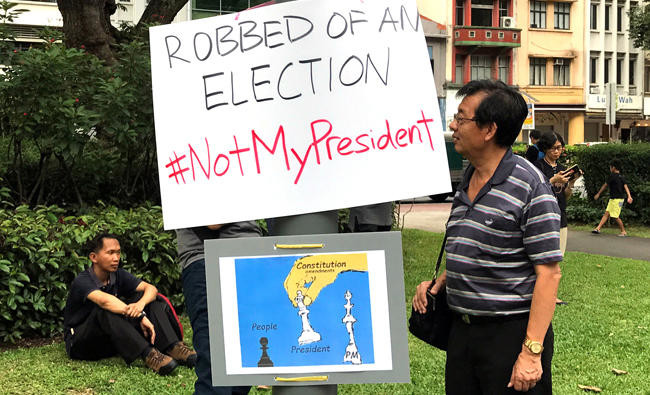

Singaporeans protest against uncontested presidential election
Singaporeans protest against uncontested presidential election


In South Africa’s affluent Western Cape, farmers lose cattle to drought
- Drought in country’s south follows flooding in north
- Farmers try to adapt but lose livestock
KNYSNA: In South Africa’s most visited and affluent province, Western Cape, one of the worst droughts in living memory is drying up dams, scorching grass and killing livestock, prompting the government to declare a national emergency this month.
Scientists say climate change is causing worsening droughts in the province, which draws tourists to its vineyards, beaches and the lush slopes of Table Mountain above Cape Town, but lies on the edge of the advancing semi-desert Karoo. In 2015, a drought almost dried up the taps in the city; farmers say this one has been even more brutal than a decade ago.
Over the weekend, mixed-race couple Christian and Ilze Pienaar were distributing feed to keep their hungry cattle alive. One cow had recently starved to death, its bones visible through its skin.
“The drought before wasn’t this bad because there was still ... grazing,” Ilze, 40, told Reuters. “Now there’s nothing, the dams are dry ... (and) we’re spending all our money on feed.”
She said she’d lost 16 cattle and 13 sheep since January alone.
The drought, which has also ravaged parts of Eastern Cape and Northern Cape, comes weeks after floods blamed on climate change and cyclical La Niña weather washed out the northeastern part of South Africa and killed 200 people across the region.
“The intensity and duration of both droughts and floods in this corner of the world is increasing,” Anton Cartwright, an economist with the African Center for Cities, said.
“Farmers (here) are very good at adapting to weather (but) ... the weather is just becoming much less predictable,” he said. “Seasons aren’t occurring, starting, ending at the same time of the year. It’s probably going to get worse.”
(Writing by Tim Cocks; editing by Philippa Fletcher)
Scientists say climate change is causing worsening droughts in the province, which draws tourists to its vineyards, beaches and the lush slopes of Table Mountain above Cape Town, but lies on the edge of the advancing semi-desert Karoo. In 2015, a drought almost dried up the taps in the city; farmers say this one has been even more brutal than a decade ago.
Over the weekend, mixed-race couple Christian and Ilze Pienaar were distributing feed to keep their hungry cattle alive. One cow had recently starved to death, its bones visible through its skin.
“The drought before wasn’t this bad because there was still ... grazing,” Ilze, 40, told Reuters. “Now there’s nothing, the dams are dry ... (and) we’re spending all our money on feed.”
She said she’d lost 16 cattle and 13 sheep since January alone.
The drought, which has also ravaged parts of Eastern Cape and Northern Cape, comes weeks after floods blamed on climate change and cyclical La Niña weather washed out the northeastern part of South Africa and killed 200 people across the region.
“The intensity and duration of both droughts and floods in this corner of the world is increasing,” Anton Cartwright, an economist with the African Center for Cities, said.
“Farmers (here) are very good at adapting to weather (but) ... the weather is just becoming much less predictable,” he said. “Seasons aren’t occurring, starting, ending at the same time of the year. It’s probably going to get worse.”
(Writing by Tim Cocks; editing by Philippa Fletcher)
Latest updates


Recommended


© 2026 SAUDI RESEARCH & PUBLISHING COMPANY, All Rights Reserved And subject to Terms of Use Agreement.