TOKYO: Take cover in a sturdy building or get underground.
That’s the emergency advice given to the Japanese people in the event of a North Korean missile strike.
But there are two big problems: most Japanese homes are made of wood and lack a basement. In the countryside, there is often no building made of concrete.
And with only a matter of minutes from launch to impact, there’s simply no time to take cover.
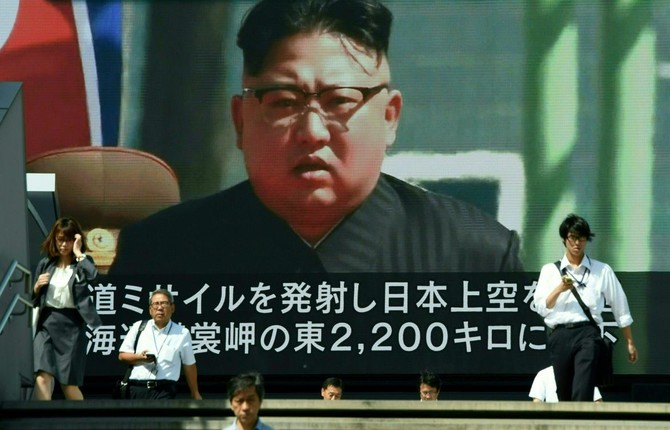
As North Korea this week fired its second missile over Japan in less than a month and threatened to “sink” the country into the sea with nuclear weapons, many Japanese feel a sense of helplessness in the face of the threat from Pyongyang.
Sushi chef Isamu Oya, 67, who runs a restaurant in the small fishing town of Erimo, right under the flightpath of Friday’s missile, summed up the feelings of many.
“The government told us to take cover in a stable building or underground, but there isn’t one here. We have no choice but just do nothing.
“Scary? Yes, but we can’t help it.”
Japan is one of the most seismically active countries in the world and also prone to extreme weather events, so citizens are well-drilled in emergency evacuation, and the authorities have a slick — if not infallible — warning system in place.
When the missile was detected, the J-Alert system immediately kicked in, warnings blared from loudspeakers, regular TV programming was interrupted and text messages sent to every mobile phone.
Local authorities and schools regularly stage drills to prepare residents in the event of a big earthquake and this year many exercises included practicing how to take cover if a missile is launched.
South Koreans have lived under the threat of attack from the North for decades, and are renowned for their phlegmatic attitude to its provocations.
When Seoul holds its regular civil defense exercises, officials often struggle to usher citizens into the underground shelters that are spread throughout the country.
Life carried on as usual in Seoul on Friday, and while the stock market initially fell on news of the missile test, within a few hours it was in positive territory.
“For me, it’s just business as usual,” said former businessman Noh Suk-Won, 60. “The North is flexing its military muscle to force the US to engage in negotiations. It’s not going to throw missiles on our heads.”
But polls show the Japanese are far from blase about the threat.
In a survey published last week by the NHK channel, more than half (52 percent) said they were “very worried” and around one third said they were “worried to some extent.”
Only two percent of those polled said they were “not worried at all.”
Machiko Watanabe, 66, a former office worker, said she was “scared about it every day.”
“I don’t think there is any way to protect yourself. The government and experts say ‘curl yourself in a ball’ and things like that. But there’s no way you can survive.”
With the threat growing and missiles becoming an all-too-frequent wake-up call, Japan is seeking to beef up its defenses.
Japan’s defense ministry has requested its largest-ever annual budget, seeking to develop systems to intercept simultaneous missile launches and to add a land-based Aegis missile defense scheme to complement its sea-based system.
But some are taking matters into their own hands.
Shelter maker Oribe Seiki Seisakusho, based in the western city of Kobe, has reported a healthy increase in demand given the recent tensions on the Korean peninsula.
“With the North Korean situation as it is, and with the J-alert ringing, people don’t know where to escape to,” Nobuko Oribe, an executive at the firm, told AFP.
Demand is mainly coming from “families who are building new houses and small business owners who want to build shelters for their employees near their factories or offices.”
However, a shelter is not an option for the masses. It takes four months to build and costs a hefty 25 million yen ($226,000) for a unit to keep 13 people safe.
On the streets of Tokyo, some were carrying on regardless.
Ken Tanaka, a 21-year-old freelance web designer, said he “didn’t care” about the launch, believing that the Japanese capital and its 14 million people would be safe in the event of a North Korean attack.
“I don’t think North Korea would dare to attack Tokyo and the capital area. I’m not thinking about it very much as a Tokyo resident,” he told AFP.
“I’m 21 years old and it doesn’t seem real to me.”


![]()

‘Take cover’ — but where? Japanese helpless over North Korea threat
‘Take cover’ — but where? Japanese helpless over North Korea threat
US moves to counter China in Bangladesh, plans to pitch defense alternatives
DHAKA: The United States is concerned about China’s expanding presence in South Asia and is planning to offer Bangladesh’s next government US and allied defense systems as alternatives to Chinese hardware, Washington’s ambassador to Dhaka told Reuters. Bangladesh votes in a general election on Thursday after a Gen Z-led uprising toppled India-allied premier Sheikh Hasina in August 2024. She has since taken refuge in New Delhi, allowing China to deepen its influence in Bangladesh as India’s presence wanes. China recently signed a defense agreement with Bangladesh to build a drone factory near the India border, worrying foreign diplomats. Bangladesh is also in talks with Pakistan to buy JF-17 Thunder fighter jets, a multi-role combat aircraft jointly developed with China.
“The United States is concerned about growing Chinese influence in South Asia and is committed to working closely with the Bangladeshi government to clearly communicate the risks of certain types of engagement with China,” US Ambassador Brent T. Christensen said in an interview on Tuesday.
“The US offers a range of options to help Bangladesh meet its military capability needs, including US systems and those from allied partners, to provide alternatives to Chinese systems,” he said without offering further details.
The Chinese foreign ministry did not immediately respond to a request for comment.
Christensen also said that President Donald Trump’s administration would “like to see a good relationship between Bangladesh and India to support stability in the region.” New Delhi-Dhaka relations have nosedived since Hasina fled, badly affecting visa services and cricket ties between the two neighbors.
COMMERCIAL DIPLOMACY IS PRIORITY
Christensen said many US businesses were looking at potentially investing in Bangladesh but would want the next government to show early and clear signs that it is “open for business.”
“Commercial diplomacy is one of our top priorities, and we look forward to working with the new government to build on progress made with the interim government, particularly in strengthening commercial, economic, and security ties,” he said.
Energy producer Chevron has been in Bangladesh for decades but not many other US companies are visible in the densely populated country of 175 million people, as high taxes and difficulties repatriating profits have created some hurdles.
There are no Starbucks or McDonald’s outlets in Bangladesh.
The envoy said Washington would work with “whichever government is elected by the Bangladeshi people.” The race is between two coalitions led by former allies, the Bangladesh Nationalist Party (BNP) and the Islamist Jamaat-e-Islami, with opinion polls suggesting the BNP holds an advantage.
AID FOR ROHINGYA REFUGEES
Regarding the 1.2 million Rohingya refugees sheltered in Bangladesh, the ambassador said the United States remained the largest contributor to humanitarian operations.
“The US remains the largest contributor to the Rohingya refugee response and continues robust health programming in Bangladesh,” he said, noting a recent $2 billion worldwide funding framework signed with the United Nations to improve the effectiveness of such assistance, including in Bangladesh.
He urged other international donors to take on a greater share of the burden.
“The US cannot sustain the bulk of the effort alone. International partners need to increase their support for the Rohingya response,” he said. In recent years, the UN refugee agency has been struggling to raise sufficient funds to support the Rohingya community, leading to cuts in their rations and the closure of some schools for them.
“The United States is concerned about growing Chinese influence in South Asia and is committed to working closely with the Bangladeshi government to clearly communicate the risks of certain types of engagement with China,” US Ambassador Brent T. Christensen said in an interview on Tuesday.
“The US offers a range of options to help Bangladesh meet its military capability needs, including US systems and those from allied partners, to provide alternatives to Chinese systems,” he said without offering further details.
The Chinese foreign ministry did not immediately respond to a request for comment.
Christensen also said that President Donald Trump’s administration would “like to see a good relationship between Bangladesh and India to support stability in the region.” New Delhi-Dhaka relations have nosedived since Hasina fled, badly affecting visa services and cricket ties between the two neighbors.
COMMERCIAL DIPLOMACY IS PRIORITY
Christensen said many US businesses were looking at potentially investing in Bangladesh but would want the next government to show early and clear signs that it is “open for business.”
“Commercial diplomacy is one of our top priorities, and we look forward to working with the new government to build on progress made with the interim government, particularly in strengthening commercial, economic, and security ties,” he said.
Energy producer Chevron has been in Bangladesh for decades but not many other US companies are visible in the densely populated country of 175 million people, as high taxes and difficulties repatriating profits have created some hurdles.
There are no Starbucks or McDonald’s outlets in Bangladesh.
The envoy said Washington would work with “whichever government is elected by the Bangladeshi people.” The race is between two coalitions led by former allies, the Bangladesh Nationalist Party (BNP) and the Islamist Jamaat-e-Islami, with opinion polls suggesting the BNP holds an advantage.
AID FOR ROHINGYA REFUGEES
Regarding the 1.2 million Rohingya refugees sheltered in Bangladesh, the ambassador said the United States remained the largest contributor to humanitarian operations.
“The US remains the largest contributor to the Rohingya refugee response and continues robust health programming in Bangladesh,” he said, noting a recent $2 billion worldwide funding framework signed with the United Nations to improve the effectiveness of such assistance, including in Bangladesh.
He urged other international donors to take on a greater share of the burden.
“The US cannot sustain the bulk of the effort alone. International partners need to increase their support for the Rohingya response,” he said. In recent years, the UN refugee agency has been struggling to raise sufficient funds to support the Rohingya community, leading to cuts in their rations and the closure of some schools for them.
Latest updates


Recommended


© 2026 SAUDI RESEARCH & PUBLISHING COMPANY, All Rights Reserved And subject to Terms of Use Agreement.