LONDON: A terror attack targeting a busy commuter train in London on Friday was an “amateur” attempt, analysts said, but drew warnings that other plots could be fast-tracked as security forces hunt for the perpetrators.
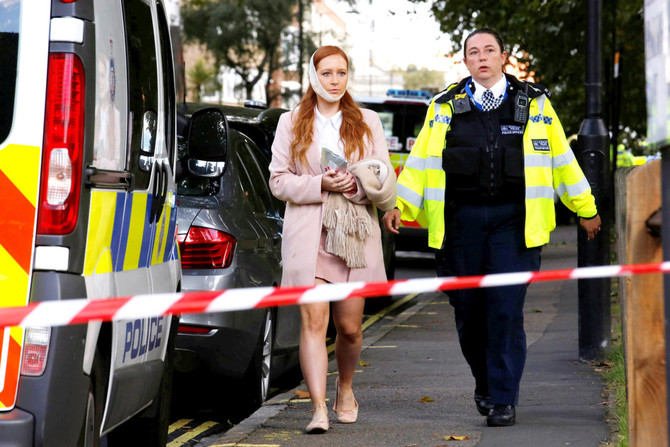
Witnesses described scenes of chaos after an improvised explosive device was detonated on a busy commuter train as it pulled into Parsons Green Station in west London during rush hour.
At least 29 people were wounded but none killed, authorities said.
Britain raised its national threat level to maximum on Friday. Prime Minister Theresa May said troops would be deployed to key locations.
The terror threat has been raised from “severe” to “critical,” meaning an attack is expected imminently, she announced.
She called the attack “cowardly” and said the device “was intended to cause significant harm.”
Daesh claimed responsibility for the bomb attack. “The bombing on a metro in London was carried out by a detachment of Daesh,” it said in a statement published by its Amaq propaganda agency.
Pictures posted on Twitter shortly after the incident showed wires dangling from a bucket inside a charred carrier bag on the train, which showed minimal signs of damage, despite reports of a “wall of fire” ripping through the carriage.
“By the looks of things the device didn’t fully explode which suggests it was supposed to have a greater impact than it did,” said Tahir Abbas, a senior research fellow specializing in ethnic relations, Islamophobia and radicalization at RUSI, a London-based think tank.
BBC Security Correspondent Frank Gardner described the device as “relatively small and relatively amateur,” adding that he believed the attacker probably intended to inflict a lot more casualties.
Many of the injuries were caused by the crush of people trying to escape the small overground station on the outer reaches of London’s District Line.
“I imagine the number of those injured from the stampede alone would’ve been higher had it detonated at an underground rather than overground station,” said Abdullah Khaled Al-Saud, a visiting fellow at the International Center for the Study of Radicalization and Political Violence (ICSR) at King’s College London.
“Everything about this incident so far indicates that it’s an amateur attack, from the makeshift nature of the bomb, to its placement toward the rear of the train, to the time of its detonation,” he added.
“Although reports are suggesting that the bomb detonated early at Parsons Green.”
Speculation surrounding the nature of the incident referenced previous terror attacks on London’s transport network, including the July 2005 bombing when suicide bombers blew themselves up on three trains and a bus, killing 52 people. Four bombers attempted to carry out a similar attack a fortnight later but their devices failed to detonate.
“Previous militant … attacks, including the July 7, 2005 attacks on the London Underground, the Nov. 13, 2015 attacks in Paris, the March 22, 2016 attacks in Brussels, and the May 22, 2017 attack in Manchester have predominantly utilized the explosive triacetone triperoxide (TATP), which is highly unstable and prone to failure,” said Otso Iho, senior analyst at IHS Markit.
“Though the Metropolitan Police did not provide any details of suspects or indications of a wider network involved in the plot, failed or disrupted attacks have previously acted as catalysts for subsequent attacks.
“A failed plot which draws the attention of law enforcement to an existing network can accelerate pre-existing plots, or prompt the militants to conduct a less sophisticated impromptu attack.”
London Mayor Sadiq Khan urged Londoners to remain calm and vigilant.
“Our city utterly condemns the hideous individuals who attempt to use terror to harm us and destroy our way of life,” he said in a statement.
“As London has proven again and again, we will never be intimidated or defeated by terrorism.”


‘Amateur’ London attack claims no lives, but threat remains
‘Amateur’ London attack claims no lives, but threat remains




French-Israeli activists hit out at ‘complicity in genocide’ case
- Israel’s retaliation flattened much of Gaza and left more than 71,800 people dead, according to the health ministry, whose figures are considered reliable by the United Nations
NETANUA, Israel: Two French-Israeli activists facing legal summons in France for “complicity in genocide” denounced on Sunday what they described as a political trial.
The summons were issued in July last year for lawyer Nili Kupfer-Naouri of the Israel is Forever group and Rachel Touitou of the Tsav 9 group over protests in 2024 and 2025 in which trucks carrying humanitarian aid for Gaza were blocked at checkpoints.
The summons call for the two to appear before an investigating magistrate but not for their detention.
Speaking at an event in Netanya in central Israel, Kupfer-Naouri asserted that “this is not an individual case, this is a state matter... this is a political trial.”
Touitou told AFP that she had “protested peacefully, my only ‘weapon’ was an Israeli flag,” adding she had been motivated by accusations of Hamas looting aid while hostages were “rotting” in militants’ hands.
“International law cannot be hijacked and instrumentalized for political ends,” she added.
Kupfer-Naouri, who has filed a slander complaint in France against organizations involved in the case, said: “You cannot be accused of complicity in genocide when no court, either French or international, has ruled that there is a genocide in Gaza.”
The Gaza war was sparked by Hamas’s October 7, 2023 attack on Israel, which resulted in the deaths of 1,221 people, according to an AFP tally based on official Israeli figures.
Israel’s retaliation flattened much of Gaza and left more than 71,800 people dead, according to the health ministry, whose figures are considered reliable by the United Nations.
A ceasefire has been in place since October 10, though both sides have repeatedly accused each other of violations.


