London stocks slide as pound soars to highest level since Brexit

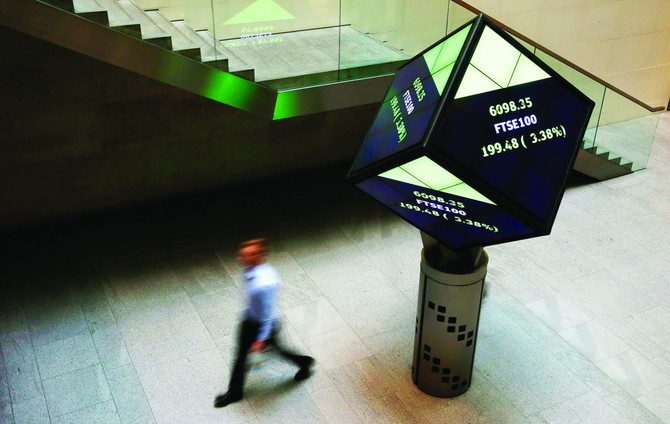
Shares listed on the London Stock Exchange fell on Friday. (Reuters)
Updated 16 September 2017
Follow

London stocks slide as pound soars to highest level since Brexit

LONDON: The London stock market slid Friday as investors shrugged off news of a terror attack in the British capital and instead took their cue from the surging pound.
Sterling shot up after a Bank of England policymaker signalled a rate hike for “the coming months,” after UK borrowing costs were this week left on hold at a record-low 0.25 percent.
Comments from BoE policymaker Gertjan Vlieghe echoed the central bank’s signal this week that the first rate increase in a decade could come in “coming months,” pushing the pound past the $1.36 mark for the first time since Britain voted to leave the EU.
That left it up over 1.5 percent and a full two cents above the $1.34 it touched after Thursday’s BoE policy decision, and it put sterling on track for a 3.3 percent weekly gain on a trade-weighted basis — its best performance since February 2009.
Markets reacted little meanwhile to an attack on a London Underground train at Parsons Green, southwest London, which police are treating as a terrorist incident after a number of people were injured.
“Londoners and markets alike take these sorts of incidents in their stride,” ETX Capital analyst Neil Wilson told AFP.
“The FTSE’s drop today is by and large about the pound’s rally, as that depresses the foreign earnings of lots of the big blue chips.”
In late morning deals, the British capital’s FTSE 100 index of top companies slid 1.1 percent as sterling rebounded.
“The FTSE is suffering at the hands of a rampant pound,” added IG analyst Joshua Mahony.
Euro zone trading was muted on Friday with Frankfurt and Paris stocks holding steady ahead of the weekend pause.


UNCTAD, Social Development Bank launch fellowship to power Saudi entrepreneurs

Updated 23 December 2025
Follow

UNCTAD, Social Development Bank launch fellowship to power Saudi entrepreneurs

RIYADH: The Social Development Bank has signed a memorandum of understanding with UN Trade and Development to launch the “Empretec Saudi Fellowship,” a new initiative aimed at equipping high-potential Saudi entrepreneurs with advanced training and tools to scale their ventures.

The agreement was signed on the sidelines of the second edition of the DeveGo 2025 forum, held on Dec. 21–22 at the King Abdulaziz International Conference Center in Riyadh. The event brought together entrepreneurs, policymakers, and representatives from regional and international organizations, alongside public and private sector leaders.

Featuring more than 150 exhibitors, 85 speakers, and 45 workshops, the forum focused on sharing local and global best practices and strengthening the Kingdom’s entrepreneurial ecosystem.

The Empretec Saudi Fellowship is part of UNCTAD’s flagship capacity-building program to promote entrepreneurship and support micro, small, and medium-sized enterprises and startups. Active in more than 40 countries, the program seeks to develop personal entrepreneurial behaviors through intensive training, access to international experts, and technical tools that help transform promising ideas into scalable, high-impact businesses.

Rebeca Grynspan, UNCTAD secretary-general, said Saudi Arabia offers fertile ground for entrepreneurial growth.

“Saudi Arabia has a wonderful platform to bring everybody up, and the entrepreneurs here are so eager. They have ideas, creativity, and energy,” she told Arab News. “If they come through our program with the Social Development Bank, which does a wonderful job, they will be more successful — because that’s what we want.”

In his opening remarks, Saudi Minister of Human Resources and Social Development Ahmed Al-Rajhi, who also chairs the SDB board, highlighted the rapid evolution of the Kingdom’s startup landscape.

“The Kingdom is witnessing a qualitative transformation in the entrepreneurship and freelance ecosystem, enabling young men and women to enter new promising sectors such as artificial intelligence, renewable energy, advanced technologies, and venture capital,” he said. “This provides broader opportunities to contribute to innovation, expansion, and global competitiveness.”

During a tour of the exhibition alongside Al-Rajhi, Grynspan met a wide range of small and medium-sized businesses and handicraft makers, praising the depth of local talent. She noted that participants spanned the full spectrum of enterprises — from early-stage ventures to more established and sophisticated companies — reflecting a rich diversity of experience.

Al-Rajhi said the Social Development Bank invests more than SR8 billion annually to support enterprises and entrepreneurs, helping raise employment in bank-financed businesses from about 12,000 in 2021 to more than 140,000 in 2025.

Beyond financing, the bank runs several non-financial programs, including the Jada 30 business communities, which have incubated more than 4,300 enterprises across 13 cities, and the Dulani Business Center, which has delivered over 67,000 consultations benefiting more than 150,000 male and female entrepreneurs.

Speaking on the broader economic outlook, Grynspan added: “This is a wonderful place to come. Now is an economy that is thriving, is a population that is hopeful. And you have these young, talented people that are only waiting for an opportunity to make it happen for everybody.”

During the forum, the bank also signed multiple cooperation agreements spanning key sectors such as finance, education, energy, healthcare, heritage, the nonprofit sector, and freelance work. The partnerships align with SDB’s strategy to build an integrated system of financial and non-financial empowerment tailored to the needs of entrepreneurs, startups, and micro-enterprises.