British PM says speculation ‘not helpful’ after Trump tweets on London attacks

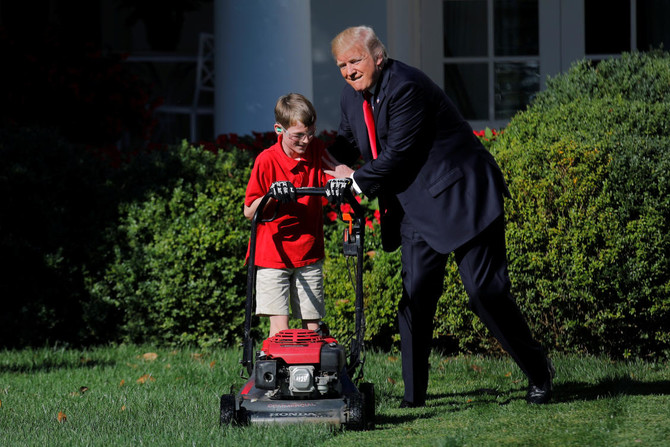
US President Donald Trump welcomes 11-years-old Frank Giaccio as he cuts the Rose Garden grass at the White House in Washington on Friday (Reuters)
Updated 15 September 2017
Follow

British PM says speculation ‘not helpful’ after Trump tweets on London attacks

DUBAI: British Prime Minister Theresa May said on Friday it was not helpful for people to speculate on any investigation after US President Donald Trump tweeted that the culprits behind a bombing on a train were in the sights of the police.

Asked about Trumps’ tweet saying that those responsible for the bomb in London which injured 22 people were “in the sights of Scotland Yard,” May said: “I never think it’s helpful for anybody to speculate on what is an ongoing investigation.”

She also said that the police and security services were doing all they could to identify those responsible for the “cowardly attack.”
Trump had earlier taken to Twitter to blast the “loser terrorists” behind the attack.

“Another attack in London by a loser terrorist,” he tweeted.
“These are sick and demented people who were in the sights of Scotland Yard. Must be proactive!” he added in what appeared to be criticism of how the British police are handling terrorism on its shores

It was not immediately clear if the people behind the bomb attack on Friday were indeed previously known to British law enforcement.

But if it were the case, then Trump has apparently revealed the detail before authorities in Britain made the information public themselves.

Trump’s comment was also described as “unhelpful speculation” by London’s Metropolitan Police.

And Nick Timothy, former chief of staff to British Prime Minister Theresa May also branded the US leader’s tweet “unhelpful.”

“True or not – and I’m sure he doesn’t know – this is so unhelpful from leader of our ally and intelligence partner,” he wrote on Twitter.

(With wires)


Meta to charge Arab advertisers extra fee for reaching European audiences

Updated 11 March 2026
Follow

Meta to charge Arab advertisers extra fee for reaching European audiences

  • US tech giant told advertisers it will add fees ranging from 2 to 5 percent on image and video ads delivered on its platforms to offset digital service taxes
  • Charges are determined by where the audience is located, not where the advertiser is based

LONDON: Meta will from July 1 impose location-based surcharges on advertisers targeting audiences in six European countries, a move that will directly affect Arab businesses that run campaigns across the continent.

The US tech giant announced it will add fees ranging from 2 to 5 percent on image and video ads delivered on its platforms, including Facebook, Instagram and WhatsApp, to offset digital service taxes imposed by individual governments.

Crucially, the charges are determined by where the audience is located, not where the advertiser is based.

That means Saudi, Emirati, Egyptian or other Arab companies paying to reach consumers in the UK, France or Italy will face the additional costs regardless of their own country’s tax arrangements with Meta.

Fees will apply at 2 percent for ads reaching UK audiences, 3 percent for France, Italy and Spain, and 5 percent for Austria and Turkiye.

“If you deliver $100 in ads to Italy, where there is a 3% location fee, you will be charged $100 (ad delivery), plus $3 (location fee), for $103 total,” the company wrote in an email to an advertiser initially reported by Bloomberg. “Note that any applicable VAT will be calculated on top of the total amount.”

The taxes have been introduced at different points, starting with France in 2019, though not the EU as a bloc.

Many tech companies report substantial sales in Europe and millions of users but pay minimal tax on profits. The goal is to claw back locally derived economic value, Bloomberg reported.

The move follows similar decisions by Google and Amazon, which have also begun passing European digital tax costs on to advertisers.

For Arab brands with growing European footprints, particularly in fashion, travel, hospitality and media, the new fees add another layer of cost to campaigns already subject to currency and targeting complexities.

Digital services taxes, levied as a percentage of revenues earned by major tech platforms in individual countries, have drawn criticism from Washington, which argues they unfairly target US companies.

Meta has been reached for comments.