NEW YORK: Business owners who are trying to get back on track after hurricanes Harvey and Irma now face a different sort of challenge: trying to recoup lost income from their insurers.
Exclusions in the fine print of policies, along with waiting periods and disagreements over how to measure a company’s lost income, make business interruption claims among the trickiest in an industry renowned for complexity.
“I think the whole thing is a rip-off,” said Thomas Arnold, an optometrist in Sugar Land, Texas. He said his business, Today’s Vision, was shuttered for almost five days after Hurricane Harvey struck because nearby flooding kept employees and patients from getting there.
Arnold says he pays $1,083 per month for coverage. But after he filed a claim, he said the US unit of Zurich Insurance Group, rejected it because his business was not physically damaged.
Zurich does not comment about specific claims, the company said in a statement. It added that business interruption coverage generally requires “direct physical damage” to a property for a payout.
It was Arnold’s second disappointing experience with business interruption coverage. He said another insurer denied his claim in 2008 after a nine-day power outage from Hurricane Ike.
Devastating storms are hitting the US with increasing frequency. Risk modeling firm AIR Worldwide predicts losses to all properties from the flooding in Texas alone will be $65 billion to $75 billion, regardless of whether they are insured.
The income lost by shuttered firms makes up a significant chunk of overall losses from a natural disaster and can hobble the pace of a community’s economic and social recovery.
Hurricane Katrina in 2005, for example, caused about $25 billion in insured commercial losses, of which $6 billion to $9 billion has been attributed to business interruption, according to information posted on AIR’s website.
The National Flood Insurance Program does not offer a business interruption component. The program is largely used by homeowners, but it also covers commercial structures for up to $500,000 in damage, with another $500,000 for the contents.
That is why companies able to afford the additional protection of business interruption insurance, usually large and medium-sized firms, often purchase it despite the potential for unsuccessful and drawn-out claims.
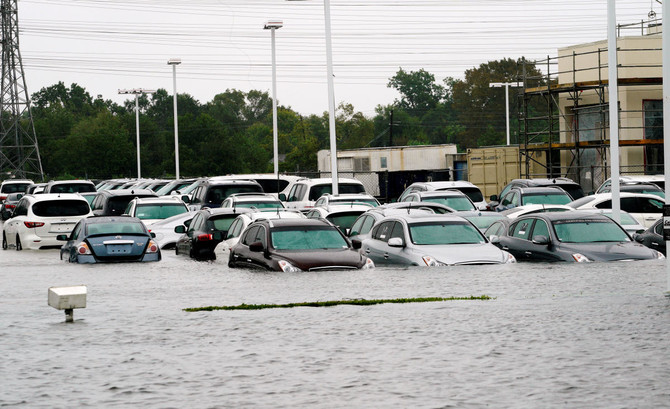
Big Star Honda, a car dealership in Houston, lost 600 vehicles – 95 percent of its inventory – and was shut for five days after Harvey.
Its managers are now girding themselves for a potentially long slog with the firm’s insurance company as the dealership prepares to make a claim on its business interruption policy.
“We’re collecting every single invoice that pertains to the hurricane,” said Allen Paul, Houston regional vice president of Ken Garff Automotive Group, which owns the dealership.
“I’m really curious to see how that goes,” he said.

Hurricane-damaged US firms dig in for insurance fight
US Justice Department official eyes cases against Cuba leaders as Trump floats ‘friendly takeover’
- “Working group” formed to build cases against people connected to the Cuban government
- Trump’s has increasingly displayed aggressive stance against Cuba’s communist leadership
MIAMI: The top Justice Department prosecutor in Miami is considering criminal investigations of Cuban government officials, according to people familiar with the matter. The inquiry comes as President Donald Trump has raised the possibility of a “friendly takeover” of the communist-run island.
Jason Reding Quiñones, the US attorney for the Southern District of Florida, has created a “working group” that includes federal prosecutors and officials from the Drug Enforcement Administration and other agencies to try to build cases against people connected to the Cuban government and its Communist Party, according to one of the people. They spoke on the condition of anonymity because they were not authorized to publicly discuss the effort.
It was not immediately clear which Cuban officials the office is targeting or what criminal charges prosecutors may be looking to bring.
The Justice Department said in a statement Friday that “federal prosecutors from across the country work every day to pursue justice, which includes efforts to combat transnational crime.”
The effort is taking place against the backdrop of Trump’s increasingly aggressive stance against Cuba’s communist leadership.
Emboldened by the US capture of Cuba’s close ally, Venezuelan President Nicolás Maduro, Trump last month said his administration was in high-level talks with officials in Havana to pursue “a friendly takeover” of the country. He repeated those claims this week, saying his attention would turn back to Cuba once the war with Iran winds down.
“They want to make a deal so bad,” Trump said of Cuba’s leadership.
While Cuba has faded from Washington’s radar as a major national security threat in recent decades, it remains a priority in the US Attorney’s office in Miami, whose political, economic and cultural life is dominated by Cuban-American exiles.
The FBI field office has a dedicated Cuba group that in 2024 was instrumental in the arrest of former US Ambassador Victor Manuel Rocha on charges of serving as a secret agent of Cuba stretching back to the 1970s.
In recent weeks, several Miami Republicans, in addition to Florida Sen. Rick Scott, have called on the Trump administration to reopen its criminal investigation into the 1996 shootdown of four planes operated by anti-communist exiles.
In a letter to Trump on Feb. 13, lawmakers including Reps. Maria Elvira Salazar and Carlos Gimenez highlighted decades-old news reports indicating that former President Raúl Castro — the head of Cuba’s military at the time — gave the order to shoot down the unarmed Cessna aircraft.
“We believe unequivocally that Raúl Castro is responsible for this heinous crime,” lawmakers wrote. “It is time for him to be brought to justice.”
While no indictment against Castro has been announced, Florida’s attorney general said this week that he would open a state-level investigation into the crime.
The Trump administration has also accused Cuba of not cooperating with American counterterrorism efforts, adding it alongside North Korea and Iran to a select few nations the US considers state sponsors of terrorism.
The designation stems from Cuba’s harboring of US fugitives and its refusal to extradite several Colombian rebel leaders while they were engaged in peace talks with the South American nation.