

Houthis threaten Saudi, UAE civilian targets

1 / 2
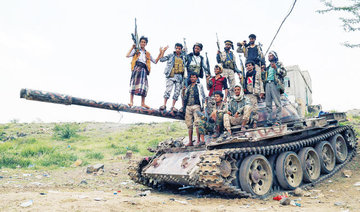
Followers of the Shi'ite Houthi movement perform the traditional Baraa dance during a ceremony in Sanaa, Yemen, on September 9, 2017. (REUTERS/Khaled Abdullah file photo)
2 / 2
Followers of the Shi'ite Houthi movement arrive to a ceremony in Sanaa, Yemen on September 9, 2017. (REUTERS/Khaled Abdullah)
Updated 15 September 2017
Follow

Houthis threaten Saudi, UAE civilian targets

DUBAI: Houthi insurgents on Thursday threatened to attack civilian targets in Saudi Arabia and the UAE in response to Riyadh’s call to put Yemen’s Al-Hodeida port under UN administration.
In a televised speech, Houthi leader Abdel-Malek Al-Houthi said his militia’s ballistic missiles were capable of reaching the United Arab Emirates' capital of Abu Dhabi and anywhere inside Saudi Arabia.
"Today the port of Hodeidah is being threatened and we cannot turn a blind eye to that," Abdel-Malek said.
"If the Saudi regime and with a green light from the US attack Hodeidah then we have to take steps that we haven't taken before,” he said.
The Iran-backed Houthi rebels had repeatedly launched missiles and rockets toward targets in Saudi Arabia, including two that Saudi security officials had said were aimed at the holy city of Makkah. In both instances, the missiles were shot down by Saudi Air Defenses Forces before they could cause any damage.
A number of rocket attacks aimed at targets across Saudi Arabia’s southern border with Yemen had resulted in deaths and injuries, both involving military and civilians.
Abdel Malek also said that his group had successfully test fired a missile toward Abu Dhabi earlier this month and said the UAE was no longer a safe country.
He gave no further details and there has been no acknowledgement by the UAE of any missiles landing on their territory.
But hours after the threat UAE Minister of State for Foreign Affairs Anwar Gargash took to Twitter to issue a defiant response to the threats, saying that the UAE was not intimidated.
“Al Houthis’ comments threatening the UAE and its capital are tangible proof of the need for the Decisive Storm (operation),” Gargash tweeted.
“Iran’s militias have vile objectives and represent a real threat,” he added.
Gargash went on to add: “We are not afraid of the Houthi threats and stupidity. It reveals the desperation of those who defend fragmented illusions, and it certainly reveals the intentions for the Arabian Gulf region security and stability.”

Yemen President Abed Rabbo Mansour Hadi's government, backed by a Saudi-led coalition, is fighting to drive the Houthis out of cities they seized in 2014 and 2015 in a rapid rise to national power.
The United Nations had proposed that the Red Sea port of Hodeidah, where 80 percent of Yemen’s food imports arrive, should be handed to a neutral party, to smoothen the flow of humanitarian relief and prevent the port from being engulfed by Yemen's two-year-old war.
The government of President Mansour Hadi has accused the Houthis of using the port to smuggle weapons and of collecting customs duties on goods, the proceeds of which they use to finance the war. The Houthis deny this.
Trump says Iran government change ‘best thing that could happen’

Updated 9 min 9 sec ago
Follow

Trump says Iran government change ‘best thing that could happen’

  • US president's comments come after he ordered a second aircraft carrier to head to the Middle East

FORT BRAGG, United States: US President Donald Trump said a change of government in Iran would be the “best thing that could happen,” as he ordered a second aircraft carrier to head to the Middle East.
“Seems like that would be the best thing that could happen,” Trump told reporters at the Fort Bragg military base in North Carolina when a journalist asked if he wanted “regime change” in Iran.
“For 47 years, they’ve been talking and talking and talking. In the meantime, we’ve lost a lot of lives while they talk,” he told reporters.

Trump declined to say who he would want to take over in Iran from supreme leader Ayatollah Ali Khamenei, but he added that “there are people.”
He has previously backed off full-throated calls for a change of government in Iran, warning that it could cause chaos, although he has made threats toward Khamenei in the past.
Speaking earlier at the White House, Trump said that the USS Gerald R. Ford — the world’s largest warship — would be “leaving very soon” for the Middle East to up the pressure on Iran.
“In case we don’t make a deal, we’ll need it,” Trump said.
The giant vessel is currently in the Caribbean following the US overthrow of Venezuela’s Nicolas Maduro. Another carrier, the USS Abraham Lincoln, is one of 12 US ships already in the Middle East.

When Iran began its crackdown on protests last month — which rights groups say killed thousands — Trump initially said that the United States was “locked and loaded” to help demonstrators.
But he has recently focused his military threats on Tehran’s nuclear program, which US forces struck last July during Israel’s unprecedented 12-day war with Iran.
The protests have subsided for now but US-based Reza Pahlavi, the son of Iran’s last shah, urged international intervention to support the Iranian people.
“We are asking for a humanitarian intervention to prevent more innocent lives being killed in the process,” he told the Munich Security Conference.
It followed a call by the opposition leader, who has not returned to his country since before the revolution, for Iranians at home and abroad to continue demonstrations this weekend.
Iran and the United States, who have had no diplomatic relations since shortly after the revolution, held talks on the nuclear issue last week in Oman. No dates have been set for new talks yet.
The West fears the program is aimed at making a bomb, which Tehran denies.
The head of the UN nuclear watchdog, Rafael Grossi, said Friday that reaching an accord with Iran on inspections of its processing facilities was possible but “terribly difficult.”

Trump said after talks with Israeli Prime Minister Benjamin Netanyahu earlier this week that he wanted to continue talks with Iran, defying pressure from his key ally for a tougher stance.
The Israeli prime minister himself expressed skepticism at the quality of any agreement if it didn’t also cover Iran’s ballistic missiles and support for regional proxies.
According to the US-based Human Rights Activists News Agency, 7,008 people, mostly protesters, were killed in the recent crackdown, although rights groups warn the toll is likely far higher.
More than 53,000 people have also been arrested, it added.
The Norway-based Iran Human Rights (IHR) NGO said “hundreds” of people were facing charges linked to the protests that could see them sentenced to death.
Figures working within the Iranian system have also been arrested, with three politicians detained this week from the so-called reformist wing of Iranian politics supportive of President Masoud Pezeshkian.
The three — Azar Mansouri, Javad Emam and Ebrahim Asgharzadeh — were released on bail Thursday and Friday, their lawyer Hojjat Kermani told the ISNA news agency.