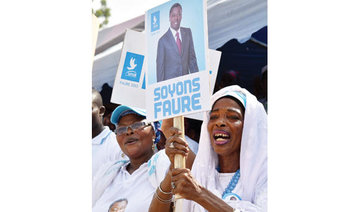
LAGOS: His family has ruled Togo for more than 50 years but President Faure Gnassingbe has in the last week faced unprecedented public pressure to step down.
He and his country stand alone in West Africa in resisting calls for constitutional reform, even as Parliament begins to look again at the issue.
“Togo is the only ECOWAS country never to have seen any real democratic change,” said political analyst Gilles Yabi, referring to the West African regional bloc.
“The current regime is carrying on the one before it, which was one of the most brutal Africa had ever known,” he told AFP.
“Beyond (constitutional) reform, the Togolese people want real change.”
Faure Gnassingbe took over as Togo’s president in 2005 after the death of his father, Gnassingbe Eyadema, who ruled the French-speaking nation for 38 years with army support.
Bloody riots followed elections that year, which the opposition disputed. Faure was re-elected in 2010 and 2015.
With The Gambia, Togo was the only ECOWAS member to reject a proposal to limit the number of presidential terms across the region, during a summit in Accra in May 2015.
After peaceful changes in power in Benin and Ghana, popular uprisings in Burkina Faso, Togo and The Gambia won them a “bad boy” reputation in a region often cited as an example in a continent where many leaders cling to power.
The fate of Gambian President Yahya Jammeh was sealed in December 2016 after his refusal to recognize defeat at the polls.
ECOWAS sent troops to ensure he left office after 22 years.
In Togo, human rights organizations have criticized cases of torture, arbitrary detention, as well as the muzzling of both the press and the opposition.
But unlike Gambia’s Jammeh, Gnassingbe, who currently holds the rotating presidency of ECOWAS, is not an isolated figure, experts say, noting that he enjoys the support of his counterparts.
Last Wednesday, Marcel de Souza, president of the ECOWAS commission, made an unannounced visit to Lome to meet the opposition as protesters demanded Gnassingbe’s resignation.
Apart from a handful of former heads of state, such as Nigeria’s Olusegun Obasanjo and Ghana’s Jerry Rawlings, who backed Togo’s people, West Africa has been largely silent over the protests.
“We shouldn’t expect any strong reaction,” said Yabi.
“Like France and the European Union, they are partners that value stability above everything.”
Comi Toulabor, head of research at the Institute of Political Studies in Bordeaux, described the lack of reaction as “radio silence.”
Togo’s neighbors “close their eyes because, for many of them, security problems and the terrorist risk have become more important than everything else,” he added.
Toulabor said Togo’s regime had this time bowed to pressure by allowing last week’s protests to take place.
In 2005, the authorities cracked down on dissent, leaving at least 500 dead following a wave of post-election violence, UN figures show.
Gnassingbe has also made apparent overtures to his detractors by proposing a bill to limit the number of presidential mandates to two five-year terms and introduce two-round voting.
As such, he was “trying to make people forget the barely democratic nature of his regime and show himself to be very active on the international diplomatic front,” said Yabi.
The country has hosted a number of international summits, such as the African Union meeting on maritime security in October 2016.
Last month it held the annual African Growth and Opportunity Act (AGOA) forum and had been due to host the Africa-Israel summit in October before it was postponed this week.
Lome, with its deep-water port and new international airport, wants to become a regional hub and is wooing foreign investors.
Economic growth is at 5.0 percent a year and the country has long been calm, despite high unemployment among young people and widespread poverty.
Former colonial power France has made no comment since the start of the protests.
Asked about the events, a Foreign Ministry spokesman said only that France had “followed the events of recent weeks closely.”
“France calls for responsibility and consensus to begin constitutional change.”

Togo bucks trend of political reform in W. Africa
‘No to the war’: Spain digs in as rift with US deepens
- Pedro Sanchez: ‘We will not be complicit in something that is harmful to the world and contrary to our values and interests’
- US forces use the Rota naval base and Moron air base in southern Spain under an agreement signed in 1953 under the dictatorship of General Francisco Franco
MADRID: Spain’s prime minister defiantly posted “No to the war” on Wednesday, deepening a rift with the United States after Madrid refused the use of its bases to attack Iran and Washington threatened trade reprisals.
Spain’s Socialist Prime Minister Pedro Sanchez had already angered US President Donald Trump with a series of other policies.
Sanchez has refused to join NATO allies in a pledge to boost defense spending to five percent of GDP as demanded by Trump, and has fiercely criticized Israel’s war in Gaza.
Trump lashed out at Sanchez’s government on Tuesday, calling Spain a “terrible” ally and threatening to sever all trade with Spain.
Sanchez defended his position on Wednesday, saying his government’s position “can be summed up in four words: no to the war.”
“We will not be complicit in something that is harmful to the world and contrary to our values and interests, simply out of fear of retaliation,” he added in a televised address.
Spain is part of the European Union, which allows goods to move freely between its 27 countries. This would complicate any bid to impose trade restrictions on a single member state.
“Trump’s words don’t always become policy. We will have to see if he follows through, and how,” said Angel Saz Carranza, director of the Esade Center for Global Economy and Geopolitics, a Spanish think tank.
European Council chief Antonio Costa wrote on X that he had called Sanchez to “express the EU’s full solidarity with Spain.”
“The EU will always ensure that the interests of its member states are fully protected,” Costa said.
French President Emmanuel Macron also called to “express France’s European solidarity in response to the recent threats of economic coercion targeting Spain,” his office said.
‘Oppose this disaster’
US forces use the Rota naval base and Moron air base in southern Spain under an agreement signed in 1953 under the dictatorship of General Francisco Franco.
During the 2003 invasion of Iraq, Spain, then led by conservative prime minister Jose Maria Aznar, staunchly backed the United States by sending troops.
Spain’s participation in the Iraq war sparked huge street demonstrations and many Spaniards blame it for the March 11, 2004 Madrid train bombings that killed nearly 200 people.
A branch of Al-Qaeda claimed responsibility for the attacks and called for the withdrawal of Spanish forces from Iraq.
Sanchez on Wednesday compared the Iran attacks to the Iraq war, which he said increased terrorism, increased energy prices and led to a less secure world.
“We oppose this disaster,” he said in reference to the Iran war.
In contrast, neighboring Portugal authorized the United States to “conditionally” use an air base on the Azores archipelago in the Atlantic Ocean for the Iran strikes, Prime Minister Luis Montenegro told parliament on Wednesday.
The authorization was granted as long as “these operations are defensive or retaliatory, are necessary and proportionate, and exclusively target military objectives,” Montenegro said.
The conservative leader said those conditions were “aligned with international law,” but he declined to openly support Sanchez or take a stance on the US-Israeli strikes on Iran.
Rally his base
The Spanish prime minister has emerged as a prominent figure for Europe’s disillusioned progressives, who see him as one of the few remaining openly leftist voices in a continent increasingly dominated by right-wing politics.
His opposition to the use of the bases is seen by some analysts as an attempt to rally his supporters around an issue that unites the Spanish left.
Sanchez, in power since 2018, heads a minority coalition government that struggles to pass legislation.
The popularity of his Socialist party has taken a hit from a string of sexual harassment and graft scandals ahead of the next general election due in 2027.
Many on Spain’s right consider Sanchez’s opposition to Trump as motivated more by domestic politics than by a moral compass.
The head of the main opposition conservative Popular Party which tops opinion polls, Alberto Nunez Feijoo, accused Sanchez on X of using foreign policy for “partisan” purposes.
Left-leaning daily newspaper El Pais urged Sanchez in an editorial on Wednesday to “resist the temptation” to “exploit widespread hostility toward Trump in Spanish society to boost his popularity.”