DUBAI: As the glitzy fashionistas of this world flit between New York, London and Paris during the ongoing fashion week season, some critics in the Middle East are zeroing in on the apparent lack of diversity when it comes to the models who grace the region’s magazine covers.
Some of the Middle East’s most coveted fashion glossies have come under fire online, with social media users kicking up a fuss over what they claim is a lack of Arab representation.
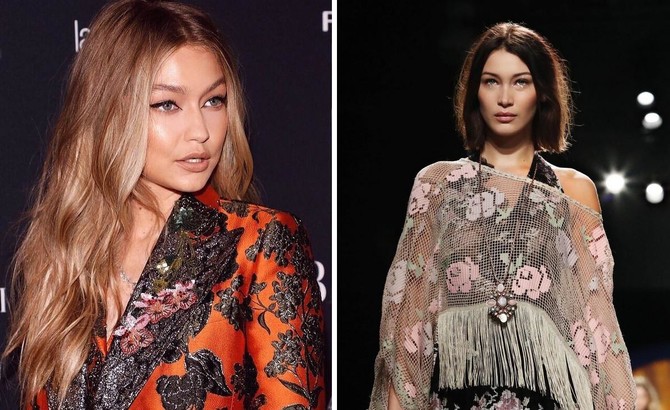
With the launch of Vogue Arabia in March, the cover seemed like a slam dunk, with the magazine scoring US model Gigi Hadid as its first-ever cover star. Even though Hadid herself proudly shared the cover photo on Instagram, saying: “I think the beautiful thing about there being international Vogue (editions) is that, as a fashion community, we are able to celebrate, and share with the world, different cultures,” not all responses were positive. The issue was exacerbated when, in September, the magazine chose to feature Gigi’s sister Bella on the cover, which sparked backlash again. Similarly, when Kim Kardashian West graced the cover of Harper’s Bazaar Arabia in September, some fans were not happy.
Social media users took to Twitter to share their thoughts on the various covers, asking magazine editors why foreign stars were chosen for the high-impact cover shoots.
“Why don’t (you) photograph actual Arab models instead! There are so many beautiful young Arab women that deserve to be on this,” one user commented on Facebook, in reference to the Harper’s Bazaar Arabia cover.
Back in March, many asked why Gigi, who is in fact half-Palestinian, was on the cover instead of an Arab model from the region. In response to the controversy, Vogue Arabia’s Special Projects Director Mohieb Dahabieh explained the importance of the magazine cover in an editorial piece.
“The time has come to open our eyes and embrace our own ancestry and let go of a hindering common approach that praises the foreign and ignores the home-grown. This cover is the first step on that journey,” Dahabieh wrote.
Similarly, Vogue Arabia’s Editor-in-Chief Manuel Arnaut defended the choice of Bella as the magazine’s September cover star in an interview with The New York Times.
“Bella Hadid is one of the most celebrated models of the time, plus she has a link with the region, being half-Palestinian (and) also a Muslim,” he said.
The struggle for fashion magazines in the region is to balance the popularity of well-known Western celebrities, who can guarantee sales, with more bespoke regional models who are well-known for their contributions to Muslim and regional fashion, style and progress. Although the Hadid sisters claim to be proud of their Palestinian heritage, it must be said that the trend of American models gracing Arab magazine covers could lead to the promotion of purely Western beauty ideals in a region that has its own heritage, culture and beauty standards.
Sarah Williams, deputy editor of Dubai-based La Femme Magazine, agrees that representation is critical. “I think it’s really important in today’s very polarized political climate for Muslims to be well-represented in fashion, film and the public eye.”
The larger question for these models relates to the price of fame. Do these young stars suddenly end up on a platform, having to be a spokesperson for a religion or culture they never sought to represent? “Young Muslims like Gigi and Bella Hadid and Zayn Malik have kept (largely) quiet about their faith — maybe because they don’t particularly practice, or possibly because it simply hasn’t occurred to them, at their tender age, that they (are) representatives of the faith and culture. I’m not sure. (However), both Bella and Zayn have recently been open in interviews about their faith. While Zayn says he is not practicing and doesn’t want to be judged by his cultural or religious background, he is, at the same time… very proud of his background,” Williams said.
For her part, Bella recently opened up to US-based Porter magazine, saying: “I am proud to be a Muslim.”
From the perspective of fashion magazine editors, the benefits of portraying diverse models include more than just the issue of representation — the Muslim population’s expenditure on beauty and fashion is significant. According to Forbes Magazine, “Muslim consumers spent an estimated $243 billion on clothing in 2015. Modest fashion purchases by Muslim women were estimated at $44 billion that year, which was approximately 18 percent of the total. Muslim consumer spending on clothing is expected to reach $368 billion by 2021, which would be a 51 percent increase from 2015.” The power of the young millennial Muslim consumer would be foolish to underestimate. According to Allure magazine, in Saudi Arabia alone, the spend on cosmetics has almost doubled in the last 10 years, from $280 million in 2005 to $535 million in 2015 and “the average employed woman in the Kingdom spends between 70 to 80 percent of her earnings on beauty products.”
But even with this financial incentive, the controversy on representation remains. However, with this backlash and buzz comes increased exposure and platforms for Muslim youth. It is the conversation sparked by the first cover of Vogue Arabia that was an impetus for the diverse coverage that the magazine is now setting as standard.
As Landon Peoples, fashion writer for Refinery 29, noted: “It’s worth mentioning that Vogue Arabia has done a better job at diversifying its cover talent than most international editions of the publishing monolith. In its short existence, it’s featured the two American-Palestinian sisters, Dutch model Iman Hamaam, Indian model Pooja Mor, Muslim-American model Halima Aden and Jourdan Dunn (the magazine’s first Black British model). It goes without saying that all of these women come from different geographical and cultural backgrounds and hold their own when it comes to representing the widespread diversity of the magazine’s circulation, which spans across 22 countries.”
Representation as a trend is slow but definitely on the up and up. The battle is making diversity more than a trend — it has to be the norm. The responsibility for that lies with the gatekeepers to fashion’s most public platforms — the editors and journalists who are curating the faces and features that will define the next generation.
Williams shared her thoughts on the burden of responsibility placed upon fashion journals. “As a journalist and a fashion editor, it’s my responsibility to make sure that my readers feel represented, whether they’re Asian, European, African or Catholic, Hindu, Buddhist or Muslim. I think we as fashion editors need to be open to feedback… I think editors here are particularly well-placed to tell the truth about our Muslim fellow humans and to make sure that we spread the word that, at the end of the day, we’re all much more alike than we think we are.”


![]()
The battle for diversity on the Mideast fashion scene
The battle for diversity on the Mideast fashion scene
Latest updates


© 2026 SAUDI RESEARCH & PUBLISHING COMPANY, All Rights Reserved And subject to Terms of Use Agreement.