Jimmy Carter to Trump: ‘Keep the peace ... tell the truth’

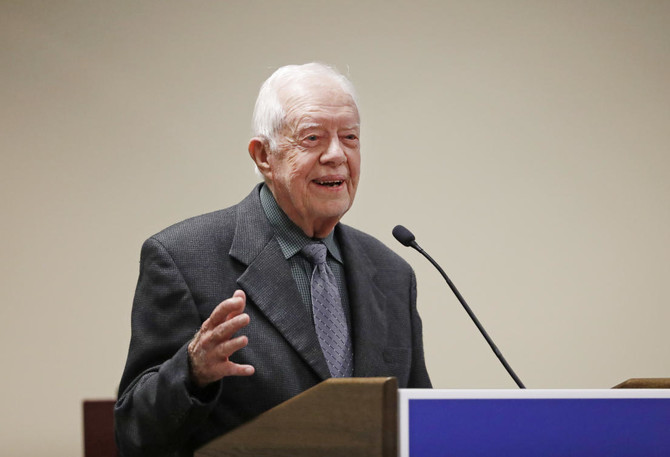
Former US President Jimmy Carter. (AP)
Updated 13 September 2017
Follow

Jimmy Carter to Trump: ‘Keep the peace ... tell the truth’

ATLANTA: Former President Jimmy Carter offered a damning indictment of US foreign policy and domestic affairs Tuesday, saying money in politics makes the nation more like an “oligarchy than a democracy” and casting President Donald Trump as a disappointment on the world stage.
Carter’s criticisms, offered at his annual presentation to backers of his post-presidency Carter Center in Atlanta, went beyond Trump, but he was particularly critical of the nation’s direction under the Republican president’s leadership.
The 39th president, a Democrat, offered this advice to the 45th: “Keep the peace, promote human rights and tell the truth.”
Carter, 92, did not mention explicitly Trump’s threatening exchanges this summer with North Korean dictator Kim Jong-un, but the former president said the US should engage directly with the insular leader and discuss a peace treaty to replace the cease fire that ended the Korean War in 1953.
“I would send my top person to Pyongyang immediately, if I didn’t go myself,” Carter said, noting that he’s been three times to the country, even as successive US administrations have refused to deal with the regime.
The North Koreans, Carter said, want a treaty that guarantees the US will not attack unless North Korea attacks the US or an ally, particularly South Korea. “Until we talk to them and treat them with respect — as human beings, which they are — I don’t think we’re going to make any progress,” Carter said.
He also dismissed Trump’s optimism that he can engineer Middle East peace. Trump has tasked his son-in-law, Jared Kushner, with handling the issue that has vexed US administrations for generations, but the president notably backed off the long-held US position calling for a two-state solution between Israel and the Palestinians.
Carter said he is “practically hopeless” that anything Trump comes up with would give “justice to the Palestinians.”
“I don’t think Trump or his family members are making any process in that respect,” he said. Carter criticized both Israeli and Palestinian leaders for a lack of flexibility, but he singled out Israeli Prime Minister Benjamin Netenyahu, a Trump ally, for having “no intention at all of having a two-state solution.”
The former president and his wife, Rosalynn, largely steer clear of partisan politics, long having yielded any active role in the Democratic Party. But they maintain their high-profile advocacy through the Carter Center, which focuses on human rights, public health and democratic elections.
Carter on Tuesday defended the center’s role in monitoring the August presidential elections in Kenya that the country’s Supreme Court later discarded. The court has ordered a new election.
The Carter Center’s monitoring team, led by former Secretary of State John Kerry, said days after the vote that the process of casting paper ballots was fair, but that the electronic tabulations were “unreliable.” Carter said Tuesday that international monitors were not allowed to observe the counting process.
The center also remains engaged in trying to end the Syrian civil war, Carter said. He noted that he and others from the center have engaged Russian President Vladimir Putin and others trying to broker peace.
Carter touted a program at his center that tracks social media usage in the war-torn nation. By identifying the locations of individual posters with known political and military affiliations, Carter said, analysts can discern which factions control various cities and provinces. Carter said the center shares that intelligence with the Pentagon, the State Department, various media outlets and foreign allies of the US
Carter made no mention of ongoing inquiries into Russian interference in the 2016 US presidential campaign or potential ties between Russia and the Trump campaign.
At 92, Carter is second eldest living US president and fourth longest-lived president in history. His birthday is Oct. 1. George H.W. Bush, the eldest living president, turned 93 on June 12, putting him 92 days into his 94th year. Ronald Reagan was 120 days beyond his 93rd birthday when he died in 2004. Gerald Ford died two years later, having lived 165 days beyond his 93rd birthday.
Carter already has the longest post-presidency, having been out of office for 36 years and almost 8 months.


Bangladesh votes in its first election since the 2024 Gen Z uprising that ousted Hasina

Updated 5 sec ago
Follow

Bangladesh votes in its first election since the 2024 Gen Z uprising that ousted Hasina

DHAKA, Bangladesh: Bangladesh on Thursday held its first election since 2024 mass protests toppled Sheikh Hasina’s government with balloting being largely peaceful in a vote seen as a test of the country’s democracy after years of political turmoil.
A projection showed that an alliance led by the Bangladesh Nationalist Party, or BNP, took the lead with 127 seats, while its main challenger, an 11-party alliance led by the Jamaat-e-Islami party, garnered 32 seats and three seats by others, according to Dhaka-based Jamuna TV.
Official results were expected on Friday. Bangladesh is a parliamentary democracy in which 300 lawmakers are elected through direct voting.
After a slow start, crowds converged on polling stations in the capital, Dhaka, and elsewhere later in the day. By 2 p.m., more than 47 percent voters had cast their ballots, the Election Commission said.
At one Dhaka polling station, poll officials manually counted the paper ballots and checked each for validity before tabulating the results. Political party representatives were present as election observers, and security officials kept a close watch on Thursday evening.
More than 127 million people were eligible to vote in the country’s first election since Hasina’s ouster after weeks of mass protests, dubbed by many as a Generation Z uprising. Hasina fled the country and is living in India in exile, while her party was barred from the polls.
As the voting closed, Hasina’s Awami League party, which was barred from the election, rejected Thursday’s election.
“Today’s so-called election by Yunus, who seized power illegally and unconstitutionally, was essentially a well-planned farce,” the former governing party said in a statement on X. “The people’s voting rights, democratic values, and the spirit of the constitution were completely disregarded in this deceptive, voter-less election conducted without the Awami League,” it said.
‘Birthday of a new Bangladesh’
The BNP’s Tarique Rahman is a leading contender to form the next government. He’s the son of former Prime Minister Khaleda Zia and returned to Bangladesh in December, after 17 years in self-exile in London. Rahman has pledged to rebuild democratic institutions, restore the rule of law and revive the struggling economy.
Television stations reported late Thursday that Rahman won in two constituencies, one in Dhaka and another in his northern ancestral home.
Challenging the BNP is an 11-party alliance led by Jamaat-e-Islami, the country’s largest Islamist party, which was banned under Hasina but has gained prominence since her removal.
The conservative religious group’s growing influence has fueled concern, particularly among women and minority communities, that social freedoms could come under pressure, if they come to power. Bangladesh is more than 90 percent Muslim, while around 8 percent are Hindu.
Jamaat-e-Islami leader Shafiqur Rahman expressed optimism after casting his vote at a polling station.
The election “is a turning point,” he told The Associated Press. “People demand change. They desire change. We also desire the change.”
Bangladesh’s interim leader, Muhammad Yunus, was upbeat about the election.
“This is a day of great joy. Today is the birthday of a new Bangladesh,” Yunus told reporters.
Election follows turbulent period
Yunus, a Nobel Peace Prize laureate, has said the interim government was committed to delivering a credible and transparent election. As part of that effort, around 500 international observers and foreign journalists were present, including delegations from the European Union and the Commonwealth, to which Bangladesh belongs.
Bangladesh’s Parliament has 350 seats, including 300 elected directly from single-member constituencies and 50 reserved for women. Lawmakers are chosen by plurality and the parliament serves a five-year term. The Election Commission recently postponed voting in one constituency after a candidate died.
The election follows a turbulent period marked by mob violence, attacks on Hindu minorities and the media, the growing influence of Islamists and weakening of the rule of law.
It could reshape the domestic stability of Bangladesh, a country whose post-1971 history since gaining independence from Pakistan has been marked by entrenched political parties, military coups and allegations of vote rigging. Young voters, many of whom played a central role in the 2024 uprising, are expected to be influential. Around 5 million first-time voters are eligible.
“I think it is a very crucial election, because this is the first time we can show our opinion with freedom,” said Ikram ul Haque, 28, adding that past elections were far from fair.
“We are celebrating the election. It is like a festival here,” he said.
Referendum for reforms
Thursday’s election is a critical test not just of leadership, but of trust in Bangladesh’s democratic future. Voters can say “Yes” to endorse major reform proposals that stemmed from a national charter signed by major political parties last year.
Yunus was also enthusiastic about the referendum.
“Voting for a candidate is important, but the referendum is very important. The whole of Bangladesh will change,” he said.
If a majority of voters favor the referendum, the newly elected parliament could form a constitutional reform council to make the changes with 180 working days from its first session. The proposals include the creation of new constitutional bodies and changing parliament from a single body to a bicameral legislature with an upper house empowered to amend the constitution by a majority vote.
The BNP and Jamaat-e-Islami both signed the document with some changes after initially expressing some dissent.
Hasina’s Awami League party — still a major party in Bangladesh though banned from the polls — and some of its former allies were excluded from the discussion. From exile, Hasina denounced the election for excluding her party.
Some critics have also said that the referendum has limited the options put before voters.