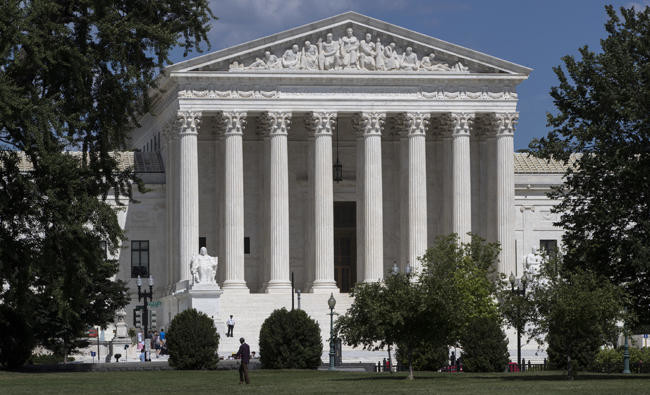
WASHINGTON: The US Supreme Court is allowing the Trump administration to maintain its restrictive policy on refugees.
The justices on Tuesday agreed to an administration request to block a lower court ruling that would have eased the refugee ban and allowed up to 24,000 refugees to enter the country before the end of October.
The order was not the court’s last word on the travel policy that President Donald Trump first rolled out in January. The justices are scheduled to hear arguments on Oct. 10 on the legality of the bans on travelers from six mostly Muslim countries and refugees anywhere in the world.
It’s unclear, though, what will be left for the court to decide. The 90-day travel ban lapses in late September and the 120-day refugee ban will expire a month later.
The administration has yet to say whether it will seek to renew the bans, make them permanent or expand the travel ban to other countries.
Lower courts have ruled that the bans violate the Constitution and federal immigration law. The high court has agreed to review those rulings. Its intervention so far has been to evaluate what parts of the policy can take effect in the meantime.
The justices said in June that the administration could not enforce the bans against people who have a “bona fide” relationship with people or entities in the United States. The justices declined to define the required relationships more precisely.
A panel of the San Francisco-based 9th US Circuit Court of Appeals upheld a district judge’s order that would have allowed refugees to enter the United States if a resettlement agency in the US had agreed to take them in.
The administration objected, saying the relationship between refugees and resettlement agencies shouldn’t count. The high court’s unsigned, one-sentence order agreed with the administration, at least for now.
The appeals court also upheld another part of the judge’s ruling that applies to the ban on visitors from Iran, Libya, Somalia, Sudan, Syria and Yemen.
Grandparents and cousins of people already in the US can’t be excluded from the country under the travel ban, as the Trump administration had wanted. The administration did not ask the Supreme Court to block that part of the ruling.

US Supreme Court allows Trump administration ban on most refugees

Trump administration labels 3 Muslim Brotherhood branches as terrorist organizations
- The State Department designated the Lebanese branch a foreign terrorist organization
- “These designations reflect the opening actions of an ongoing, sustained effort to thwart Muslim Brotherhood chapters’ violence,” Rubio said
WASHINGTON: President Donald Trump’s administration has made good on its pledge to label three Middle Eastern branches of the Muslim Brotherhood as terrorist organizations, imposing sanctions on them and their members in a decision that could have implications for US relationships with allies Qatar and Turkiye.
The Treasury and State departments announced the actions Tuesday against the Lebanese, Jordanian and Egyptian chapters of the Muslim Brotherhood, which they said pose a risk to the United States and American interests.
The State Department designated the Lebanese branch a foreign terrorist organization, the most severe of the labels, which makes it a criminal offense to provide material support to the group. The Jordanian and Egyptian branches were listed by Treasury as specially designated global terrorists for providing support to Hamas.
“These designations reflect the opening actions of an ongoing, sustained effort to thwart Muslim Brotherhood chapters’ violence and destabilization wherever it occurs,” Secretary of State Marco Rubio said in a statement. “The United States will use all available tools to deprive these Muslim Brotherhood chapters of the resources to engage in or support terrorism.”
Rubio and Treasury Secretary Scott Bessent were mandated last year under an executive order signed by Trump to determine the most appropriate way to impose sanctions on the groups, which US officials say engage in or support violence and destabilization campaigns that harm the United States and other regions.
Muslim Brotherhood leaders have said they renounce violence.
Trump’s executive order had singled out the chapters in Lebanon, Jordan and Egypt, noting that a wing of the Lebanese chapter had launched rockets on Israel after Hamas’ Oct. 7, 2023, attack in Israel that set off the war in Gaza. Leaders of the group in Jordan have provided support to Hamas, the order said.
The Muslim Brotherhood was founded in Egypt in 1928 but was banned in that country in 2013. Jordan announced a sweeping ban on the Muslim Brotherhood in April.
Nathan Brown, a professor of political science and international affairs at George Washington University, said some allies of the US, including the United Arab Emirates and Egypt, would likely be pleased with the designation.
“For other governments where the brotherhood is tolerated, it would be a thorn in bilateral relations,” including in Qatar and Turkiye, he said.
Brown also said a designation on the chapters may have effects on visa and asylum claims for people entering not just the US but also Western European countries and Canada.
“I think this would give immigration officials a stronger basis for suspicion, and it might make courts less likely to question any kind of official action against Brotherhood members who are seeking to stay in this country, seeking political asylum,” he said.
Trump, a Republican, weighed whether to designate the Muslim Brotherhood a terrorist organization in 2019 during his first term in office. Some prominent Trump supporters, including right-wing influencer Laura Loomer, have pushed his administration to take aggressive action against the group.
Two Republican-led state governments — Florida and Texas — designated the group as a terrorist organization this year.