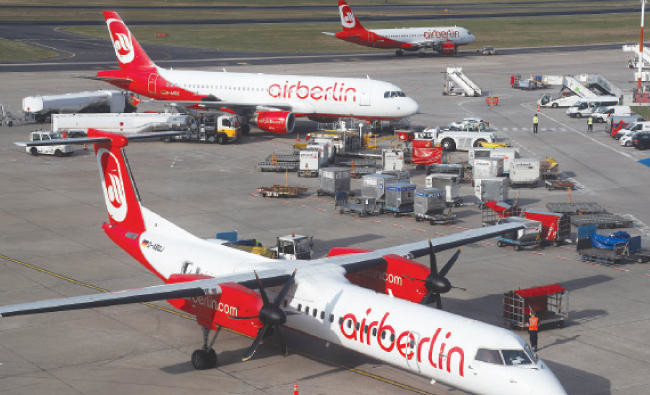
BERLIN: German investor Hans Rudolf Woehrl has unveiled a €500 million ($600 million) offer for bankrupt Air Berlin, hoping to buy the country’s second-largest airline whole rather than see it split up.
“We worked hard to be able to make this offer, with help not only from experts but also supportive comments and suggestions from employees, passengers and business partners of Air Berlin,” the Bavarian airline tycoon wrote in a Facebook post late on Sunday.
Nuremberg-based Woehrl first rose to prominence when he bought airline Deutsche BA from British Airways for a symbolic €1 in 2003, later selling it to Air Berlin.
On Sunday his company Intro offered €50 million immediately for the stricken airline, with up to €450 million of further payments “depending on performance,” he said.
Intro wants “Air Berlin as a whole” rather than buying up chunks, Woehrl emphasized, urging other potential buyers nosing around the airline such as Lufthansa, Condor, TUI, Germania and Austrian former Formula One driver Niki Lauda to join his offer.
But he added that the firm could if necessary buy up all of Air Berlin’s assets, including 140 leased aircraft and prized landing and takeoff slots at German airports.
The German government has argued that competition rules prevent any single airline taking over Air Berlin, the country’s second-largest carrier after Lufthansa.
After losing the lifeline of regular cash infusions from Gulf carrier Etihad in June, Air Berlin filed for insolvency on Aug. 15.
The firm has given potential buyers until Sept. 15 to make offers.
In the meantime, the airline has been kept aloft by a hastily agreed €150 million loan from the German government.
— AFP

German investor bids $600m for Air Berlin
Saudi POS stays above $4bn as Ramadan spending lifts outlays on home goods
RIYADH: Saudi point-of-sale transactions remained above $4 billion in the week ending Feb. 14, with spending on furniture and home supplies rising ahead of Ramadan, central bank data showed.
Overall POS activity totaled SR15.34 billion ($4.09 billion), representing a 4.8 percent week-on-week decrease, while the number of transactions dipped 1.6 percent to 252 million, according to the Saudi Central Bank.
Spending on furniture and home supplies rose 5.9 percent to SR697.35 million, marking the strongest weekly increase among major retail categories.
Expenditure on electronics increased 2.9 percent, while spending on construction and building materials rose 1.1 percent.

Sectors that saw declines includes freight transport and courier services, which posted a drop of 5 percent to SR64.86 million.
Pharmacy and medical supplies spending fell 8.2 percent to SR223.81 million, but outlays on medical services rose 5.7 percent to SR539.68 million.
Food and beverage expenditure decreased 4.3 percent, but the total spend of SR2.57 billion meant it retained the largest share of POS activity.
Restaurants and cafes followed with SR1.73 billion, despite a 4.7 percent decline. Apparel and clothing outlays represented the third-largest share of POS spending during the monitored week, up 0.5 percent to SR1.38 billion.

The Kingdom’s major urban centers mirrored the mixed national changes. Riyadh, which accounted for the largest share of total POS spending, saw a 3.4 percent drop to SR5.32 billion. The number of transactions in the capital reached 80.7 million, down 0.8 percent week on week.
In Jeddah, transaction values decreased 4.4 percent to SR2.12 billion, while Dammam reported a 3.3 percent decrease to SR746.29 million.
POS data, tracked weekly by SAMA, provides an indicator of consumer spending trends and the ongoing growth of digital payments in Saudi Arabia.
The data also highlights the expanding reach of POS infrastructure, extending beyond major retail hubs to smaller cities and service sectors, supporting broader digital inclusion initiatives.
The growth of digital payment technologies aligns with Saudi Arabia’s Vision 2030 objectives, promoting electronic transactions and contributing to the Kingdom’s broader digital economy.