KIEV: Ukrainian authorities on Monday vowed to punish those responsible after ex-Georgian leader Mikheil Saakashvili forced his way back into the country in the latest twist in a feud with President Petro Poroshenko.
Saakashvili, a one-time regional governor in Ukraine, and hundreds of his supporters on Sunday barged their way past border guards at a crossing with Poland to make a defiant return.
Saakashvili was stripped of Ukrainian citizenship in July by Poroshenko while he was out of the country after a major falling out with Kiev’s leadership over criticisms of their flagging fight against corruption.
That move left the charismatic pro-Western politician stateless as he was also stripped of his citizenship in his homeland Georgia.
Saakashvili has said he is determined to reclaim Ukrainian citizenship and get back into politics, but his re-entry drew a furious response from Kiev.
“A forceful breakthrough of the Ukranian border is a crime and those who were involved in the organization of this breakthrough should be held responsible,” Ukrainian Prime Minister Volodymyr Groysman wrote on Facebook on Monday.
The stand-off with Saakashvili is yet another headache for Poroshenko, who is battling a Russian-backed insurgency in the east and trying to revive a struggling economy.
Prime Minister Groysman urged against attempts to destabilize the country further.
“It’s time to fight for the state and not for power,” he said.
Interior Minister Arsen Avakov called the border breach “an attack on the state’s basic institutions,” saying all those responsible should turn themselves in.
Saakashvili’s whereabouts on Monday were not immediately clear but upon crossing the border Sunday he went to the Western city of Lviv.
He forced his way through the border even though Ukrainian authorities blocked a Kiev-bound train in Poland carrying Saakashvili, who eventually got off and took a bus to the Medyka crossing.
Saakashvili said that Kiev was “panicking,” claiming that he did “not want to overthrow President Poroshenko” but just defend his rights.
The interior ministry has said that 11 policemen and five border guards were injured in clashes with Saakashvili supporters.
Saakashvili, 49, is credited with pushing through pro-Western reforms in his native Georgia which he led from 2004 to 2013.
In the wake of the pro-Western revolution in Kiev he moved to Ukraine in 2015 to work for the country’s authorities as governor of the key Odessa region on the Black Sea.
But he had a major falling out with Poroshenko and accused Kiev of stalling in the fight against corruption.
Poroshenko stripped him of his Ukrainian citizenship at the end of July, when the charismatic reformer was out of the country.
Georgian authorities have asked Kiev to extradite the firebrand politician, saying he is defendant in four criminal cases.
Saakashvili denies the accusations, branding them a political witch hunt.


![]()
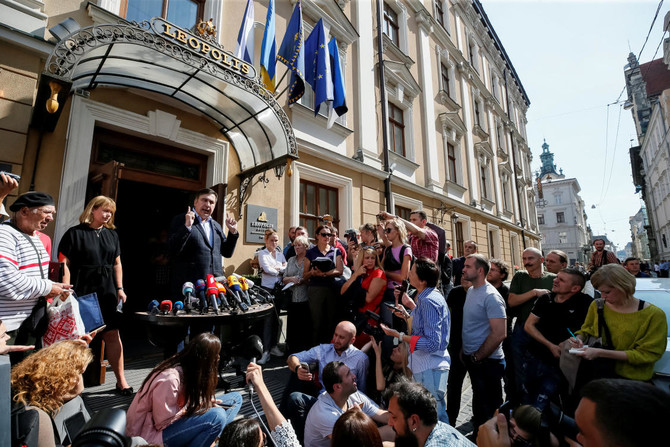
Ukraine vows punishments over Saakashvili border breach
Ukraine vows punishments over Saakashvili border breach
Latest updates


Recommended


© 2026 SAUDI RESEARCH & PUBLISHING COMPANY, All Rights Reserved And subject to Terms of Use Agreement.