ISTANBUL: The controversial trial of staff from Turkey’s main opposition newspaper resumed on Monday in a case seen as a test for press freedom under President Recep Tayyip Erdogan.
The case, which opened in Istanbul in July, involves 17 current and former writers, cartoonists and executives from Cumhuriyet (“Republic“) who are being tried on “terror” charges in a move denounced by supporters as absurd.
For government critics, the case is emblematic of the erosion of freedom following last year’s failed coup when Ankara launched a massive crackdown targeting those with alleged links to the putschists as well as opponents.
The secular daily is one of the few voices in the Turkish media to oppose Erdogan, with its embarrassing scoops causing anger in the halls of power.
On July 28, an Istanbul court freed seven of the newspaper’s staff after 271 days, including respected cartoonist Musa Kart and Turhan Gunay, editor of the books supplement.
But some of the paper’s most prominent staff remain in custody, among them commentator Kadri Gursel, investigative journalist Ahmet Sik, editor-in-chief Murat Sabuncu and chief executive Akin Atalay.
Eight other suspects have also been charged but are not being held in prison.
Sik has been held behind bars for 255 days while the other three have been jailed for 316 days. If convicted, they face varying terms of up to 43 years in jail.
Sik is the author of an explosive 2011 book called “The Imam’s Army” which exposed how followers of influential Muslim preacher Fethullah Gulen infiltrated the Turkish bureaucracy and built ties with the ruling party which have since collapsed.
Once a close ally of Erdogan who is now in self-imposed exile in the United States, Gulen is wanted on charges of ordering the failed coup, with Ankara arresting more than 50,000 people on suspicion of links to his movement. He denies the charges.
The second session of hearings is taking place adjacent to the high-security Silivri prison on the outskirts of Istanbul where the men are being held.
Those on trial are charged with using their position to support the Kurdistan Workers’ Party (PKK), the ultra-left Revolutionary People’s Liberation Party-Front (DHKP-C), and the Gulen movement.
Ankara has branded all three terror organizations.
Also on trial but in absentia is the paper’s former editor-in-chief Can Dundar, who was last year sentenced to five years and 10 months in jail over a front-page story accusing the government of sending weapons to Syria.
Dundar has now fled Turkey for Germany.
In the indictment, the newspaper was accused of an “intense perception operation” targeting both Turkey and Erdogan using the tactics of an “asymmetric war.”
The paper’s supporters claim the charges amount to “punishment,” insisting Cumhuriyet has always been strongly opposed to the three groups.
The daily’s front page on Monday was headlined “We want justice” with images of those still imprisoned.
Writing in Sunday’s edition of the paper, Asli Aydintasbas, Cumhuriyet columnist and a fellow at the European Council on Foreign Relations, said the case was the “symbolic trial” of this era.
“This case will go down in the history books as the most concrete and simultaneously the most absurd example of institutional failures and the problem of the judiciary in this period,” she added.
Cartoonist Kart on Saturday depicted a miserable Lady Justice dressed in white, waiting outside the Silivri complex holding pictures of those inside with a speech bubble saying: “I am waiting for my sons.”
According to the P24 press freedom group, there are 170 journalists behind bars in Turkey, most of whom were arrested after the coup in a move which has alarmed Turkey’s Western allies.
Turkey ranks 155 out of 180 on the latest RSF (Reporters Without Borders) world press freedom index.


![]()
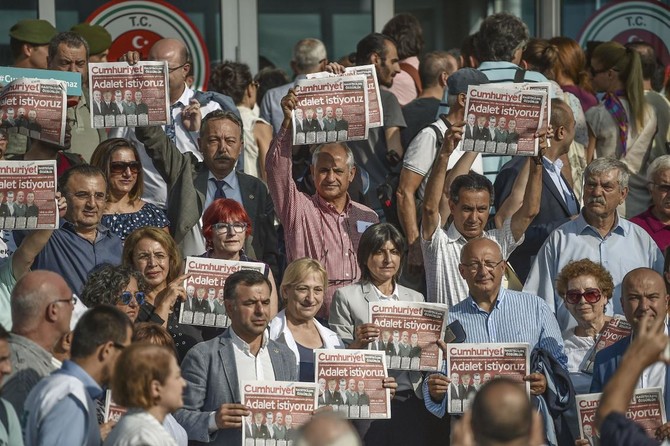
Trial of Turkey opposition newspaper staff resumes
Trial of Turkey opposition newspaper staff resumes
Latest updates


© 2026 SAUDI RESEARCH & PUBLISHING COMPANY, All Rights Reserved And subject to Terms of Use Agreement.