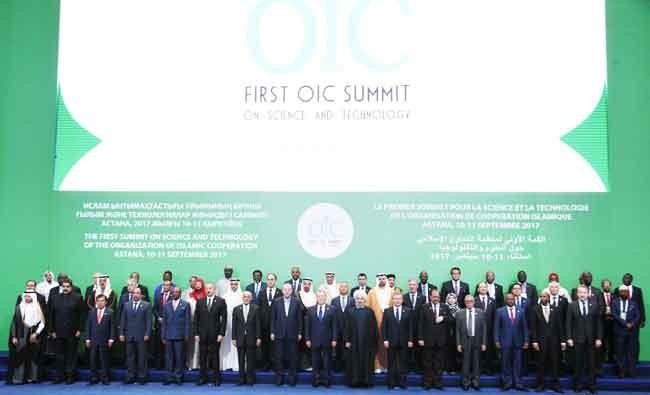
ASTANA: King Salman said that the first Islamic Summit of Science, Technology, Innovation and Modernization in the Islamic World, being held in Astana, Kazakhstan, emanates from the noble values of Islam and the principles of the Charter of the Organization of Islamic Cooperation (OIC) which focuses on the importance of science and knowledge.
Speaking on behalf of King Salman at the opening session of the summit on Sunday, Minister of Energy, Industry and Natural Resources Khalid Al-Falih said that the Islamic countries need today, more than ever, a knowledge revival in light of mega challenges they are facing in a world where competition for knowledge is raging and becoming the cornerstone of economic success.
Al-Falih said the achievement of the revival is based on four pillars, the first of which is development of education, which has to be based on encouragement of innovation and free thinking in a manner that will be a platform for the discovery of the talented and their promotion.
The second pillar, he said, is based on the encouragement of scientific and technical research and ensuring provision of finance, whether from the public or private sector.
The third pillar rests on building an integrated system where creators and their ideas are being cared for to ensure that their scientific research is transferred into practical applications with economic value, he said.
The fourth pillar rests on the establishment of cooperation and integration within one country, and between countries and global organizations such as the OIC, he said.
He said while the state organs represent the key to running the engine of the revival, efforts must expand to include public and private institutions as well as community members.
Meanwhile, the secretary-general of the Organization of Islamic Cooperation, Dr. Yousef bin Ahmed Al-Othaimeen, said that this summit comes at a crucial time for OIC countries. “It comes in the midst of unprecedented political, economic and security variables, which put the OIC in one trench to meet the challenges of the age.”
Al-Othaimeen said: “Political and security solutions to contemporary problems should be accompanied by effective social, cultural and economic plans based on science and knowledge.”


![]()
King Salman: Islamic countries need knowledge revival
King Salman: Islamic countries need knowledge revival
Latest updates


© 2026 SAUDI RESEARCH & PUBLISHING COMPANY, All Rights Reserved And subject to Terms of Use Agreement.