Egypt may reject French wheat as tough inspections rattle trade

1 / 2
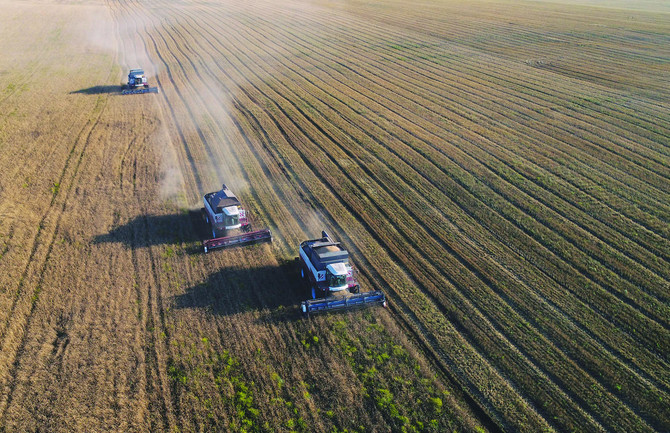
Egypt’s agricultural ministry said on Sunday its quarantine authority was examining seedsin a French wheat cargo. (Reuters)
2 / 2
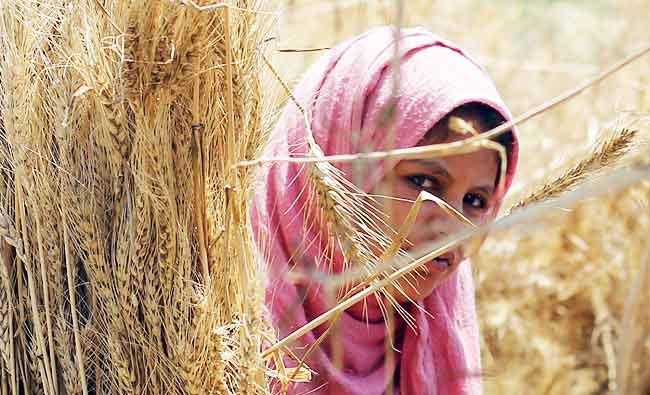
An Egyptian girl works in her grandfather's wheat field in Qaha, El-Kalubia governorate, northeast of Cairo, in this May 5, 2015 file photo. (Reuters)
Updated 11 September 2017
Follow

Egypt may reject French wheat as tough inspections rattle trade

DUBAI/CAIRO: Egypt is considering rejecting 59,000 tons of French wheat purchased by state grain buyer GASC due to the presence of poppy seeds, the second cargo to come under such scrutiny and raising fresh uncertainty over the country’s import policy.
The world’s biggest wheat importer threw the international grains market into confusion in 2015 by rejecting a cargo that contained the common wheat fungus ergot, triggering a row over policy in Cairo that is still simmering and worrying traders.
Egypt’s agricultural ministry said on Sunday its quarantine authority was examining seeds in the French cargo.
“If they prove to be poppy seeds a decision will be taken to reject the shipment and transfer the case to the general prosecutor,” spokesman Hamid Abdel Dayim told Reuters.
That would be the second case transferred to the general prosecutor in less than a month after a 63,000 ton Romanian wheat cargo was rejected by quarantine and is now under review by the prosecutor’s office for re-export.
The back-to-back cases have raised red flags among traders, who called poppy seeds “the new ergot” and an attempt by Egypt’s agriculture quarantine service to tighten import rules after losing its fight to ban the fungus last year.
Transgrain France, a supply company responsible for the French cargo, said it seemed strange for “quarantine to suddenly discover this type of seed for the first time in decades” and said quarantine may have confused the seeds with another type of poppy found in France but which is not toxic.
In December 2015, the rejection of a French wheat shipment purchased by GASC for containing ergot set off a nearly year-long row over import requirements as Egypt’s quarantine authority imposed a ban on any trace level of the fungus.
Trading companies said the requirement was impossible to guarantee and boycotted state tenders, effectively cutting Egypt off from global grains markets.
Egypt spends billions of pounds each year on wheat and bread subsidies to secure food for tens of millions of its poorest.
— Reuters


Arab food and beverage sector draws $22bn in foreign investment over 2 decades: Dhaman 

Updated 28 December 2025
Follow

Arab food and beverage sector draws $22bn in foreign investment over 2 decades: Dhaman 

JEDDAH: Foreign investors committed about $22 billion to the Arab region’s food and beverage sector over the past two decades, backing 516 projects that generated roughly 93,000 jobs, according to a new sectoral report. 

In its third food and beverage industry study for 2025, the Arab Investment and Export Credit Guarantee Corp., known as Dhaman, said the bulk of investment flowed to a handful of markets. Egypt, Saudi Arabia, the UAE, Morocco and Qatar attracted 421 projects — about 82 percent of the total — with capital expenditure exceeding $17 billion, or nearly four-fifths of overall investment. 

Projects in those five countries accounted for around 71,000 jobs, representing 76 percent of total employment created by foreign direct investment in the sector over the 2003–2024 period, the report said, according to figures carried by the Kuwait News Agency. 

“The US has been the region's top food and beverage investor over the past 22 years with 74 projects or 14 projects of the total, and Capex of approximately $4 billion or 18 percent of the total, creating more than 14,000 jobs,” KUNA reported. 

Investment was also concentrated among a small group of multinational players. The sector’s top 10 foreign investors accounted for roughly 15 percent of projects, 32 percent of capital expenditure and 29 percent of newly created jobs.  

Swiss food group Nestlé led in project count with 14 initiatives, while Ukrainian agribusiness firm NIBULON topped capital spending and job creation, investing $2 billion and generating around 6,000 jobs. 

At the inter-Arab investment level, the report noted that 12 Arab countries invested in 108 projects, accounting for about 21 percent of total FDI projects in the sector over the past 22 years. These initiatives, carried out by 65 companies, involved $6.5 billion in capital expenditure, representing 30 percent of total FDI, and generated nearly 28,000 jobs. 

The UAE led inter-Arab investments, accounting for 45 percent of total projects and 58 percent of total capital expenditure, the report added, according to KUNA. 

The report also noted that the UAE, Saudi Arabia, Egypt, and Qatar topped the Arab ranking as the most attractive countries for investment in the sector in 2024, followed by Oman, Bahrain, Algeria, Morocco, and Kuwait. 

Looking ahead, Dhaman expects consumer demand to continue rising. Food and non-alcoholic beverage sales across 16 Arab countries are projected to increase 8.6 percent to more than $430 billion by the end of 2025, equivalent to 4.2 percent of global sales, before exceeding $560 billion by 2029. 

Sales are expected to remain highly concentrated geographically, with Egypt, Saudi Arabia, Algeria, the UAE and Iraq accounting for about 77 percent of the regional total. By product category, meat and poultry are forecast to lead with sales of about $106 billion, followed by cereals, pasta and baked goods at roughly $63 billion. 

Average annual per capita spending on food and non-alcoholic beverages in the region is projected to rise 7.2 percent to more than $1,845 by the end of 2025, approaching the global average, and to reach about $2,255 by 2029. Household spending on these products is expected to represent 25.8 percent of total expenditure in 13 Arab countries, above the global average of 24.2 percent. 

Arab external trade in food and beverages grew more than 15 percent in 2024 to $195 billion, with exports rising 18 percent to $56 billion and imports increasing 14 percent to $139 billion. Brazil was the largest foreign supplier to the region, exporting $16.5 billion worth of products, while Saudi Arabia ranked as the top Arab exporter at $6.6 billion.