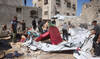
WASHINGTON/GAZA CITY: “At bedtime, I am afraid to turn the lights off. I am not a coward, it is just that I worry that this bulb hanging from the ceiling is the last light that remains (shining) in my life.”
Soon after he penned these words, Moath Al-Hajj, a young artist from a Gaza refugee camp, passed away in his sleep.
After not hearing from him for two days, his friends broke down the door of his house, and found him huddled with his blanket in a place in which he lived alone for 11 years.
Al-Hajj lived in Nuseirat, one of Gaza’s most crowded refugee camps.
Raised in the UAE, he returned to Gaza to join the Islamic University, but remained there, experiencing three wars and a decade-long blockade.
Somehow, the young man maintained a semblance of hope, as expressed in his many drawings and emotive commentary.
Al-Hajj learned to live in his own world ever since he was young. The outside world to him seemed unpredictable and at times cruel.
When his mother passed away, he was only 1 year old. His father died of cancer in the UAE, so due to circumstances beyond his control, Al-Hajj lived alone.
Keeping him company were his friends in the neighborhood, but mostly his self-effacing yet profound artistic expressions.
“Smile, may the war feel shame,” was one of his cartoons. In it, a little girl with a flowery dress turns her back to the reader.
Al-Hajj’s art characters always had their eyes closed, as if they refuse to see the world around them and insist on imagining a better world inside their own thoughts.
After his body was thoroughly examined, doctors concluded that he died from a stroke.
His heart, heavy with untold personal and collective miseries, had just given in. And just like that, one of Gaza’s finest young men was buried in an ever-crowded graveyard.
Social media buzzed with statements of condolence, mostly by young Palestinians from Gaza devastated to hear that Al-Hajj’s last light had been extinguished, and that the young man’s life had ended while the siege and state of war remain.
In that same week, Palestinians commemorated the three-year anniversary of the end of Israel’s devastating war against Gaza.
The war had killed more than 2,200 Palestinians, the vast majority of them civilians, and 71 Israelis, most of them soldiers.
The war left Gaza in ruins, as more than 17,000 homes were completely destroyed and thousands of other structures — including hospitals, schools and factories — were destroyed or severely damaged.
The war shattered whatever semblance of economy Gaza had had. Today, 80 percent of Palestinians there live below the poverty line, most of whom depend on humanitarian aid.
A whole generation of Palestinians in Gaza have grown up knowing nothing but war and siege, and have never seen the world beyond its deadly borders.
Following are the voices of some of these young Gazans, who kindly shared their tragic personal stories, hoping that the world will heed their calls for freedom and justice.
Isra Migdad, an Islamic finance student
“After our house had been partially damaged during the 2014 Israeli war, it took my family about a year and a half to rebuild it, due to the delay in construction material being allowed into Gaza and because of the prohibitive prices of such material, when it’s available.
“I lost my master’s degree scholarship in 2014 due to the closure and my family’s difficult financial situation after the war.
“I’ve spent the last three years applying for scholarships, only to learn that many universities in Europe know nothing, or very little, about the Israeli siege on Gaza and the continued closure of the borders.
“I attained another scholarship, only to lose it again since I didn’t have enough time to complete my travel procedures and negotiate an exit from Gaza.
“I want a better life, but I also love Gaza. Yet the situation is becoming more difficult with each passing day.
“It’s hard to find a stable job, and even if one gets an opportunity elsewhere, it’s nearly impossible to get out.”
Ghada, 23, studied English literature, works as a translator
“Day by day, the situation in Gaza becomes more complicated and even worse than before. Since the last war to this day, nothing seems to get better. Nothing at all.
“During my work at the Palestinian Trade Center (Pal-Trade), which focuses on the Palestinian economy, every day I see people struggling in all economic sectors.
“The electricity crisis is destroying businesses everywhere. The agriculture sector is in ruins as farmers can’t export their products, and can’t even access the Palestinian market in the West Bank.
“Despite substantial donor pledges to support reconstruction following the 2014 conflict, the situation for Palestinians living in Gaza has never been worse.
“Moreover, people in Gaza are facing a dire shortage of drinkable water and an adequate and equitable sanitation system.
“Even the sea has become polluted because of the sewage that’s dumped daily. There’s little hope on the horizon for better conditions.”
Banias Harb, a teacher
“The unprecedented closure and blockade imposed on Gaza have created a feeling of helplessness.
“The most frustrating problem that youths have been suffering from is the closure of the Rafah border crossing.
“Gaza’s youths constitute about a third of the Palestinian population, yet less than 10 percent of all youths have been able to see what’s beyond Gaza. We feel abandoned, alone.”
Kholod Zughbor, has a degree in English literature from Al-Azhar University, Gaza
“The siege on Gaza has been in place since 2006. The situation has been terrible here, even before the wars started. Unemployment among Gaza’s youth is estimated at 60 percent.
“I’ve witnessed three wars. I saw life gradually worsen, especially after the last one. Three years after the 2014 war, the situation is getting harder and more miserable.
“Gaza is still far from full recovery, and what has been built is only a drop in the ocean of destruction.”
Sondos, a social worker, has a degree in English literature
“As a social worker, I’ve visited more than 350 families impacted by the war and its aftermath.
“They’re burdened by deep psychological scars, and are constantly overshadowed by the feeling of impending catastrophe.
“In every house I’ve visited there’s a heartbreaking story of poverty, unemployment, fear of the future, fear of another Israeli war.
“Without outside pressure on Israel, Gazans will continue to relive this nightmare in their open-air prison.
“They can’t reconstruct their demolished homes, import their basic needs, or have access to electricity and clean water on a regular basis.
“But Gaza will continue to hang on to life and won’t fall into despair. Our youths will continue to pursue higher education and will labor to achieve their goals, no matter the odds.
“They’ll continue to use their imagination to overcome all hurdles, as we’ve done for many years. Courage and determination are our most prized qualities.”
— Yousef Aljamal, a writer and Ph.D. student from Gaza, contributed to this feature.