ASEAN to sign Hong Kong free-trade deal in November

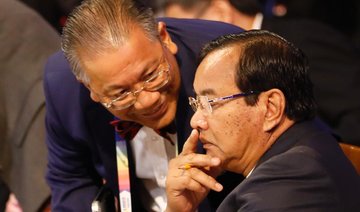
The Chinese special administrative region began free-trade negotiations with ASEAN in 2014. (AFP)
Updated 10 September 2017
Follow

ASEAN to sign Hong Kong free-trade deal in November

MANILA: The Association of Southeast Asian Nations (ASEAN) is to sign a free-trade agreement with Hong Kong in November, a Philippine government official said Saturday, following three years of talks.
The Chinese special administrative region began free-trade negotiations with ASEAN in 2014, four years after the 10-nation economic bloc signed a similar trade deal with China in 2010.
Hong Kong also completed negotiations on an investment pact with ASEAN, said Philippine Trade Undersecretary Ceferino Rodolfo.
“This would... send a positive signal for the international community of ASEAN’s resolute commitment to free trade and open markets,” Rodolfo told reporters.
He gave no details of the two agreements, which dealt with lowering import duties and cutting barriers to investment.
The agreement was reached as ASEAN economic ministers held a dialogue in Manila Saturday with Hong Kong government officials.
ASEAN, an economic bloc with a combined population of more than 600 million, is Hong Kong’s second-largest trading partner after mainland China, according to the territory’s Trade and Industry Department website.
Hong Kong also acts as an important entrepot for trade between mainland China and ASEAN, an economic grouping made up of Brunei, Cambodia, Indonesia, Laos, Malaysia, Myanmar, the Philippines, Singapore, Thailand and Vietnam.
It has remained a separate customs entity from mainland China since the city’s 1997 handover by Britain.
ASEAN members have established a free-trade area among themselves aiming to slash tariffs on most goods to zero and minimize non-tariff barriers. They have also signed free-trade deals with key trading partners such as Japan and China.
Rodolfo said the Hong Kong deals are to be signed in November, when the Philippines hosts an ASEAN summit.
ASEAN also has free-trade deals with India, Australia and New Zealand, and South Korea.


Saudi Aramco, ExxonMobil, Samref ink deal to study Yanbu refinery upgrade

Updated 08 December 2025
Follow

Saudi Aramco, ExxonMobil, Samref ink deal to study Yanbu refinery upgrade

RIYADH: Energy giants Saudi Aramco, ExxonMobil, and Samref have signed a venture framework agreement to upgrade the Yanbu refinery and expand it into an integrated petrochemical complex.

As a part of the deal, the companies will explore capital investments to upgrade and diversify production, including high-quality distillates that result in lower emissions and high-performance chemicals, according to a joint press statement.

The agreement will also see the parties explore opportunities to improve the refinery’s energy efficiency and reduce environmental impacts from operations through an integrated emissions-reduction strategy.

Samref is an equally owned joint venture between Aramco and Mobil Yanbu Refining Co. Inc., a wholly owned subsidiary of Exxon Mobil Corp.

The refinery currently has the capacity to process more than 400,000 barrels of crude oil per day, producing a diverse range of energy products, including propane, automotive diesel oil, marine heavy fuel oil, and sulfur.

“This next phase of Samref marks a step in our long-term strategic collaboration with ExxonMobil. Designed to increase the conversion of crude oil and petroleum liquids into high-value chemicals, this project reinforces our commitment to advancing Downstream value creation and our liquids-to-chemicals strategy,” said Aramco Downstream President, Mohammed Y. Al Qahtani.

He added that the deal will help position Samref as a key driver of the Kingdom’s petrochemical sector’s growth.

The press statement further said that companies will commence a preliminary front-end engineering and design phase for the proposed project, which would aim to maximize operational advantages, enhance Samref’s competitiveness, and help to meet growing demand for high-quality petrochemical products in Saudi Arabia.

The firms added that these plans are subject to market conditions, regulatory approvals, and final investment decisions by Aramco and ExxonMobil.

“We value our partnership with Aramco and our long history in Saudi Arabia. We look forward to evaluating this project, which aligns with our strategy to focus on investments that allow us to grow high-value products that meet society’s evolving energy needs and contribute to a lower-emission future,” said Jack Williams, senior vice president of Exxon Mobil Corp.