MEXICO CITY: A powerful 8.2-magnitude earthquake rocked Mexico late on Thursday, killing at least 32 people in what the president called the quake-prone country’s biggest one in a century.
The quake hit offshore in the Pacific at 11:49 p.m. (04:49 GMT), about 100 km from the coastal town of Tonala, in far southern Chiapas state, Mexico’s seismologic service said.
“It was a major earthquake in scale and magnitude, the strongest in the past 100 years,” said President Enrique Pena Nieto in an address from the National Disaster Prevention Center’s headquarters, where he was supervising the emergency response.
The quake was apparently stronger than a devastating 1985 temblor that flattened swathes of Mexico City and killed thousands, but this time, damage to the city was limited.
A number of buildings suffered severe damage in parts of southern Mexico. Some of the worst initial reports came from the town of Juchitan in Oaxaca state, where sections of the town hall, a hotel and other buildings were reduced to rubble.
Alejandro Murat, the state governor, said 23 deaths were registered in Oaxaca, 17 of them in Juchitan.
A spokesman for emergency services said seven people were also confirmed dead in the neighboring state of Chiapas. Earlier, Arturo Nunez, governor of Tabasco, said two children had died in his state.
Rescue workers labored through the night in badly affected areas to check for people trapped in collapsed buildings.
Windows were shattered at Mexico City airport and power went out in several neighborhoods of the capital, affecting more than 1 million people. The cornice of a hotel came down in the southern tourist city of Oaxaca, a witness said.
The tremor was felt as far away as neighboring Guatemala. The quake triggered waves as high as 0.7 meters in Mexico, the Pacific Tsunami Warning Center said. Mexican television showed images of the sea retreating about 50 meters, and authorities evacuated some coastal areas.
The president said the tsunami risk on the Chiapas coast was not major. “We are alert,” he told local television.
More aftershocks were likely, the president said, advising people to check their homes and offices for structural damage and for gas leaks.
The US Geological Survey (USGS) reported multiple aftershocks, ranging in magnitude from 4.3 to 5.7.
Classes were suspended in most of central and southern Mexico on Friday to allow authorities to review damage.
There was no tsunami threat for American Samoa and Hawaii, according to the US Tsunami Warning System. The national disaster agency of the Philippines put the country’s eastern seaboard on alert, but no evacuation was ordered.
“The house moved like chewing gum and the light and Internet went out momentarily,” said Rodrigo Soberanes, who lives near the Chiapas state city of San Cristobal de las Casas.
People in Mexico City, one of the world’s largest cities, ran out into the streets in pajamas and alarms sounded after the quake struck just before midnight, a Reuters witness said.
“I had never been anywhere where the earth moved so much. At first I laughed, but when the lights went out, I didn’t know what to do,” said Luis Carlos Briceno, an architect, 31, who was visiting Mexico City. “I nearly fell over.”
State oil company Pemex said it was still checking for damage at its installations.
President Pena Nieto said operations at the Salina Cruz refinery in the same region as the epicenter were temporarily suspended as a precautionary measure.


![]()
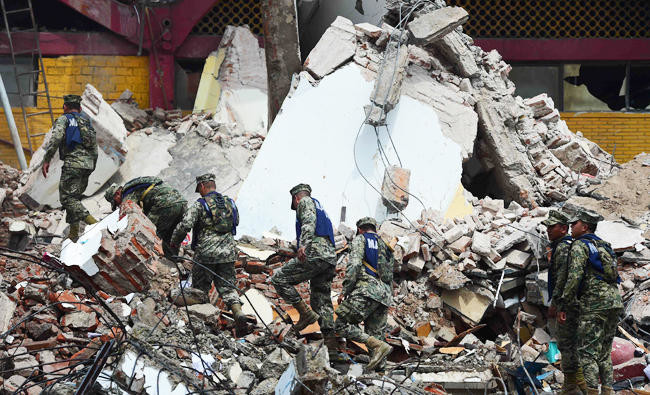
32 dead in Mexico’s biggest earthquake in a century
32 dead in Mexico’s biggest earthquake in a century

Latest updates



© 2026 SAUDI RESEARCH & PUBLISHING COMPANY, All Rights Reserved And subject to Terms of Use Agreement.