WASHINGTON: US President Donald Trump stressed to the emir of Qatar the importance of unity in fighting terrorism, the White House said on Friday, a day after Trump offered to mediate the Gulf country’s dispute with its Arab neighbors.
In a telephone call Thursday with Qatari Emir Sheikh Tamim bin Hamad Al-Thani, “the president underscored the importance of all countries following through on commitments from the Riyadh Summit to maintain unity while defeating terrorism, cutting off funding for terrorist groups, and combating extremist ideology,” the White House said.
They also discussed the continued threat Iran poses to regional stability, it said.
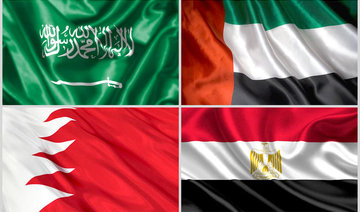
Meanwhile, the Anti-Terror Quartet (ATQ), comprising Saudi Arabia, Bahrain, Egypt and the UAE, maintained a tough line.
The ATQ cut ties with Qatar in June, accusing it of bankrolling extremist groups and of being too close to Iran.
The four countries also shut down air, maritime and land links and imposed economic sanctions on Qatar.
In a statement early Friday, the Saudi-led bloc questioned the Kuwaiti emir’s statement that Qatar would be willing to accept their 13 demands.
“Dialogue on the implementation of the demands should not be preceded by any conditions,” they said in the joint statement carried by the Saudi Press Agency (SPA).
The bloc also voiced “regret” about the Kuwaiti ruler’s statement “on the success of mediation in stopping military intervention.”
Instead, the ATQ stressed that “the military option has not been and will not be considered” under any circumstances.
“Setting preconditions for dialogue confirms Qatar’s lack of seriousness in dialogue, combating and financing terrorism and interfering in the internal affairs of countries,” it said.

Trump speaks to Qatar emir on Gulf unity, terrorism fight
Deadly militant offensive sweeps northern and eastern Burkina Faso
- Burkina Faso, ruled by a military junta since September 2022, has faced more than 10 years of raids by groups linked to Al-Qaeda and the Daesh
ABIDJAN: Al-Qaeda-affiliated JNIM has in recent days claimed to have inflicted heavy losses in Burkina Faso as a surge in deadly militant attacks sweeps across the Sahelian state.
Burkina Faso, ruled by a military junta since September 2022, has faced more than 10 years of raids by groups linked to Al-Qaeda and the Daesh, including the Group for the Support of Islam and Muslims (JNIM).
A February UN Security Council report noted that the “pace of JNIM attacks” had slowed in September as fighters were diverted to Mali to back an attempted fuel blockade.
“The group’s efforts in Mali have been the primary focus since early September last year,” said Heni Nsaibia, analyst at conflict monitor ACLED.
But attacks never fully stopped, and JNIM has launched a string of large-scale assaults in northern and eastern Burkina Faso since mid-February, killing dozens, including civilians.
“Since February 14, JNIM has claimed responsibility for 10 attacks across different regions of Burkina Faso,” said Hasret Kargin, an Africa studies researcher at intelligence firm Mintel World.
Deadly assaults
The deadliest incidents targeted Titao’s military base on February 15 in the northwest, where the group says it killed dozens of soldiers.
A separate ambush on the same day left around 50 forestry officers dead in Tandjari in the east.
Around 10 civilians were also killed in Titao, including seven Ghanaian traders.
“This latest round demonstrated a high degree of coordination, given the number of large-scale attacks that occurred between 12 and 22 February,” Nsaibia said.
“Over 130 people” — Burkinabe soldiers, civilian auxiliaries and JNIM fighters — “were killed in this series of battles.”
Kargin noted that JNIM has issued no formal statement explaining the recent uptick after several months of reduced activity.
But militant groups often strike “right before and during” the Muslim holy month of Ramadan, he said, adding current dry-season conditions had helped them on the ground.
‘Smuggling zones’
Recent attacks have gripped the country’s north and east, areas seen as financial hubs for Al-Qaeda’s Sahel branch.
“These are zones with numerous gold sites and key routes that fuel the group’s smuggling activities,” a Burkinabe security analyst said, requesting anonymity.
The north “acts as a bridge” to JNIM’s “main central command” in Mali, Kargin said, while he east — home to a vast nature reserve straddling Niger, Benin and Burkina Faso — allows the group to push into neighboring countries.
The forests, he added, both shield fighters from airstrikes and generate income through illegal timber sales and control of artisanal gold mining.
The Tandjari attack near regional capital Fada N’Gourma highlights JNIM’s growing freedom of movement after having “gained a lot of ground in recent years,” Nsaibia said.
“The question is not the frequency of attacks — they never stopped — but how these groups are able to inflict such heavy losses” when the army claims to be better equipped and better organized, said a Burkinabe political scientist.
The army, which rarely comments on attacks, said in mid-February it now controls 74 percent of national territory, with some “600 villages retaken.”
According to the UN report, JNIM recently appointed a senior leader in eastern Burkina Faso tasked with expanding into Benin, Ivory Coast, Ghana, Niger and Togo.