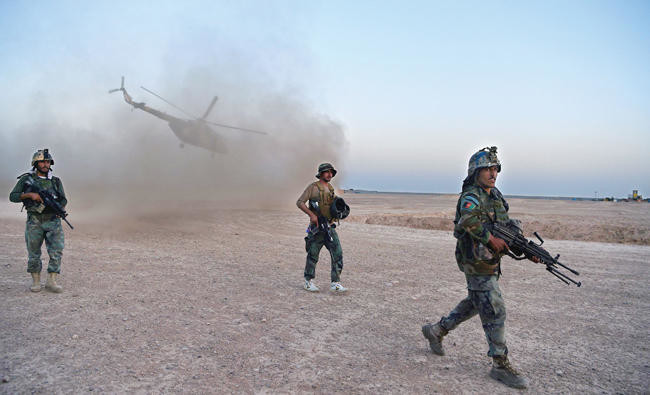
KABUL: Iran provides arms and military equipment to Taliban guerrillas in Afghanistan, an army chief has claimed, marking the first confirmation from a high-ranking official of the war-torn country.
President Ashraf Ghani raised the matter with his Iranian counterpart during his recent visit to Tehran, Lt. Gen. Mohammed Sharif Yaftali, chief of general staff for the Afghan National Army, told the BBC Persian Service.
Yaftali said Kabul had documents showing “Iran was providing arms and military equipment to the Taliban in western Afghanistan.” He gave no further details.
Some local officials in western Afghanistan in the past had spoken about Iran’s role in the Afghan war and its backing of the insurgents.
Yaftali’s comments are however the first from a high-ranking Afghan official pointing to Iran’s alleged support for the Taliban.
Taliban spokesmen were unavailable for comment, and the Iranian embassy in Kabul could not immediately be reached. Tehran, which opposes the presence of US troops in Afghanistan, has in the past rejected claims that it backs the Taliban.
Dawlat Waziri, the chief spokesman for the Afghan Ministry of Defense on Thursday said Yaftali’s comments were “misquoted” and that he expects a correction. He told Arab News that Afghanistan had “reports, not evidence about Iran’s involvement” and that it was verifying the reports.
Others say however that there is firm evidence that Iran is supporting the fundamentalist political group.
“Iranian land mines and weapons are used by the Taliban and it is directly engaged in supporting the Taliban militarily and financially,” analyst Bashir Bezhen told Arab News.
“It has its reservations over water distribution with Afghanistan and secondly is locked in a deep rivalry with the US in Afghanistan. It wants to see the US defeat and ignominious withdrawal from Afghanistan.”
Iran has long been at loggerheads with Kabul, often over water disputes.
Much to Kabul’s anguish, Iran has in recent years officially hosted mid-ranking Taliban commanders at gatherings of Islamic scholars. Reports of its military and financial backing of the Taliban have increased ever since Ghani’s government signed a strategic security pact with Washington in 2014.
Former Taliban leader Akhtar Mansour, who was killed in a US drone strike in Pakistan last year, was reportedly en-route there from Iran where, according to media reports, many mid-ranking Taliban commanders have transferred their families to live.
Some Afghan observers say Iran is part of a regional block pushing the withdrawal of US troops that overthrew the Taliban regime 16 years ago in Afghanistan.

Iran arming Taliban, says top Afghan general
‘Peace and stability are ultimate prerequisites for growth and prosperity,’ Indonesia’s president tells WEF
- While world faces tightening financial conditions, trade tensions, political uncertainty, ‘Indonesia continues to grow,’ says Prabowo Subianto
- He says country does not fear economic integration
BEIRUT: History teaches us that “peace and stability are our most valuable assets” and the “ultimate prerequisites for growth and prosperity” as there will be no prosperity without peace, Indonesia’s president said on Thursday.
Prabowo Subianto, in his special address before the World Economic Forum, said: “We gather here in Davos at a time of great uncertainty; a time when wars continue to break out … a time when trust between nations, between institutions, between peoples is fragile.”
According to Subianto, the International Monetary Fund recently described Indonesia as “a global bright spot with strong economic growth amid a challenging external environment.”
While the world faced tightening financial conditions, trade tensions and political uncertainty, “Indonesia continues to grow,” Subianto said, adding that his country’s economy had grown by more than 5 percent every year over the last decade.
“I am confident that this year our growth will be higher,” he said, noting that inflation remained at about 2 percent, while the government deficit had been kept below 3 percent of gross domestic product.
He said that international institutions did not praise Indonesia because of unfounded optimism, but because of evidence. “They recognized that Indonesia’s economy is resilient,” he said, emphasizing that “peace and stability in Indonesia over the years” did not happen by chance.
He added that his country had always chosen unity over fragmentation, and friendship and collaboration over confrontation. He stressed “friendship over enmity.”
Subianto explained that his country had never defaulted on paying its debts and “succeeding regimes always pay the debts of the preceding regime.”
Regarding the economy, the Indonesian president said his country did not fear economic integration, adding: “We have been a trading nation for hundreds of years, and we now conclude trade agreements, not because it is fashionable but we consider it necessary.
“We believe in the concept of win-win. Last year we signed free trade agreements and comprehensive economic partnership agreements with Europe, the EU, Canada (and) Peru, and I have just visited the UK to sign our new strategic partnership and also an economic growth agreement.” He hopes that by 2027 Indonesia has in place a comprehensive economic partnership agreement with the UK.
Its policy is part of the country’s strategy to deepen productivity, reduce barriers and unlock private sector growth for Indonesia, ASEAN (the Association of Southeast Asian Nations) and the Global South, he said.
Subianto added in a session chaired by Borge Brende, WEF’s president and CEO: “We believe that trade integration, when done fairly, is not a threat to sovereignty. We believe trade is a tool for prosperity.
“Indonesia has a clear vision, as we are determined to become a modern country integrated with the global economy (while) providing (a) good quality of life for its citizens, living free of poverty and hunger.”
He further highlighted the importance of political and economic stability as a prerequisite for investments.
Toward the end of his address, the Indonesian president reiterated that “peace and stability is a long and arduous program.”
He added: “Indonesia chooses peace versus chaos. We want to be a friend to all, and an enemy to none. We want to be a good neighbor and a good, responsible citizen of the world, protecting the environment and protecting nature. We must not destroy nature, and live with it.
“Let us build the world we want to live in together. Let us continue the journey to improve the quality of life for all to live in peace, freedom, friendship, tolerance, coexistence, and (with) cooperation for all races, ethnicities, and religions.
“Let us continue our pursuit of justice for all, and security and freedom for all.”