Fake Brazilian warzone ‘photographer’ duped BBC and others

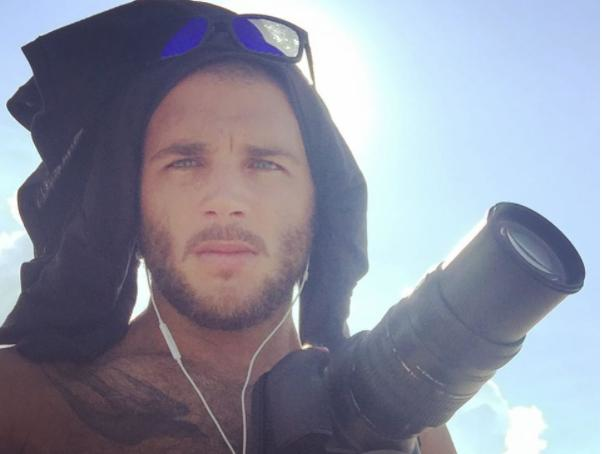
Eduardo Martins who portrayed himself as a Brazilian war photographer committed to helping people who worked for the UN. (Photo courtesy: social media)
Updated 07 September 2017
Follow

Fake Brazilian warzone ‘photographer’ duped BBC and others

BRASÍLIA: He went by the name Eduardo Martins and portrayed himself as a Brazilian war photographer committed to helping people who worked for the UN — who had a fondness for surfing.
Along the way he developed quite a following on Instagram, with 120,000 or so fans subscribed to his updates ostensibly posted from the Middle East, Africa and elsewhere.
But Martins the war photographer never existed — the photos and videos he posted were doctored ones stolen from real photographers who risked their lives in places like Iraq.
Now the Instagram account has vanished, leaving in its place myriad question marks over who was behind the scam, which lasted several years and saw photos attributed to Martins published by prestigious news outlets including the BBC and Getty Images.
The bogus images escaped detection because they were edited and inverted to fool software designed to detect plagiarism.
Doubts over the photographer’s true identity emerged after he or she contacted a journalist named Natasha Ribeiro, a BBC Brazil contributor who lives in the Middle East, the British broadcaster said this week.
Ribeiro said alarm bells rang when it emerged that none of the Brazilian journalists working in Iraq had ever heard of Eduardo Martins — and nor had the UN or any of the organizations he claimed to have worked with, according to the BBC.
Fernando Costa Netto, a journalist who interviewed Martins for a surfing magazine, said the con artist described himself as a Sao Paulo native aged 32 with blond hair and blue eyes.
Martins sold pictures from war zones but also found time to teach children in Gaza to surf, said Costa Netto, who said he has received many messages from people who had also fallen for the fake photographer’s schtick.
He claimed to have survived leukaemia at 18, but avoided personal contact and always seemed to be somewhere with bad communications.
The last time Costa Netto contacted Martins was the day after another reporter told him it might all be a scam.
“Hey bro. I’m in Australia. I made the decision of spending a year traveling around the world in a van. I will cut off everything, including the Internet... I want to be in peace. We’ll speak again when I’m back,” the person wrote, according to Costa Netto.


Western media refute Trump’s claims Iran possesses Tomahawk missiles

Updated 10 March 2026
Follow

Western media refute Trump’s claims Iran possesses Tomahawk missiles

  • Speaking to journalists, Trump suggested Tehran used US-made cruise missile in school attack that killed over 170, calling the weapon ‘very generic’
  • CNN, Sky News and analysts said that ‘neither Israel nor Iran use Tomahawk missiles,’ urged accurate identification to ensure credibility in public discourse

LONDON: Western media outlets and defense analysts have pushed back against claims by US President Donald Trump that Iran possesses Tomahawk cruise missiles, after he raised the possibility while discussing a recent strike on an Iranian school that has drawn international scrutiny.

Speaking to reporters on Monday, Trump suggested Iran may have used Tomahawks in the attack, calling the weapon “very generic” and implying that multiple countries, including Iran, could have access to the system.

However, journalists and weapons experts swiftly disputed that assertion. They noted that Tomahawk missiles are US-manufactured cruise missile systems that Washington supplies only to a small number of close allies, primarily the UK and Australia. There is no credible evidence that Iran has ever obtained the weapon.

CNN anchor Erin Burnett referenced an investigation by correspondent Isobel Yeong that concluded “neither Israel nor Iran use Tomahawk missiles, according to experts.” Sky News and other Western outlets also challenged Trump’s remarks.

Analysts pointed out that Iran has developed its own domestic cruise missile systems, such as the Soumar and Hoveyzeh, which are believed to be based partly on older Soviet-era designs.

While these systems resemble cruise missiles in concept, experts say they differ significantly from the Tomahawk in design, propulsion configuration and operational characteristics.

While Iran has made substantial advances in ballistic and domestically produced cruise missiles over the past two decades, defense analysts said there is no verified evidence that Tehran holds the American-made system.

The episode reflects a broader pattern in which statements about military technology are rapidly scrutinized by open-source investigators and defense experts.

Experts say the distinction is important: accurately identifying the type of missile used in a strike can provide clues about the likely actor responsible, the launch platform involved and the broader geopolitical consequences of a strike.

Analysts also say that accurate identification of military systems remains essential for avoiding misinformation and for maintaining credibility in public discourse surrounding regional security.

Despite the growing body of evidence, the precise circumstances of the school attack nonetheless remain unclear, with investigators hampered by a lack of weapons fragments and limited access to the site.

Norway-based rights group Hengaw said the school was holding its morning session at the time of the reported attack and had at least 168 children and 14 teachers.

Trump said the US was continuing to investigate the incident. “Whatever the report shows, I’m willing to live with that report,” he said.