With no government help, Mumbai flood victims are on their own

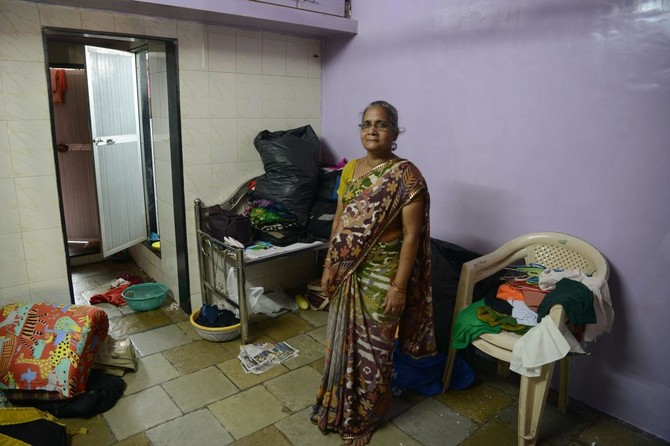
Surekha Chiplunkar, 60, standing in her house that had recently flooded, during an interview with AFP in Mumbai. (AFP)
Updated 07 September 2017
Follow

With no government help, Mumbai flood victims are on their own

MUMBAI: When Surekha Chiplunkar’s home started to flood during recent heavy rains in Mumbai she knew exactly what to do — she had to; catastrophe comes every year and no one else was going to help.
Her family’s tiny ground floor apartment in central Mumbai is one of hundreds of thousands of homes in India’s financial capital that regularly flood during the monsoon months of June to September.
“We grab all of our possessions and move to one of our neighbors on a higher floor until the water subsides,” explains the 60-year-old.
Last week, as floods wreaked unaccustomed havoc across parts of Texas, global news coverage was dominated by scenes of Americans being winched to safety.
People in Houston, America’s fourth biggest city, told reporters of their anguish at being forced from their homes by the unusually fierce Hurricane Harvey, as a sophisticated rescue and recovery operation revved into high gear.
President Donald Trump visited the affected area twice, while his vice president, Mike Pence, also went to assure Texans that the might of the US government was behind them, and would help them pick up the pieces in the wake of a storm that caused tens of billions of dollars’ damage and killed around 60 people.
At the same time, half a world away, monsoon rains were dumping millions of gallons of water on India.
Mumbai, a city of around 20 million inhabitants where at least ten people died, was brought to a virtual standstill for two days.
But there were no prime ministerial visits; no pledges of national unity; no promises to help the slum dwellers rebuild their washed-away homes.
India largely shrugged and carried on, almost inured to a near-annual tragedy.
“No one from the government comes to check to see if we have managed to survive the floods or not,” said Chiplunker.
“People from top floors provide us with food during flooding as we cannot cook for ourselves.”
The help provided by members of the community during a disaster is often referred to, usually by local newspapers and leaders, as the “spirit of Mumbai.”
Many of the homes that flood in Mumbai are shanties packed tightly into narrow dark alleyways lining the city’s sprawling slums.
The slums, where over 50 percent of Mumbai’s population live, become covered in a sea of blue tarpaulin every monsoon as residents try to keep out whatever rain they can.
But sturdily-built houses flood as well. Chiplunkar, her three sons, one daughter-in-law and two grandchildren, live in a basic flat built in an old chawl, or tenement, which used to house Mumbai’s mill workers.
“We prepare for every monsoon by packing our belongings in plastic covers and keeping buckets ready,” Aditya Jadhav, who lives in the one-room apartment opposite, tells AFP.
The speed with which the rain fell — more than 315 millimeters (12 inches) in just a few hours — caught both families by surprise this year though.
“We were shocked. A lot of our valuables were damaged this time including a refrigerator and washing machine, causing us a lot of financial loss,” says Chiplunkar.
Activists claim Mumbai’s susceptibility to floods has worsened in recent years due to a rapid construction boom that is trying to keep up with the city’s swelling population.
They blame many in power as well as property developers for an insatiable desire to make money from luxury residential tower developments built on reclaimed land.
An estimated 40 percent of Mumbai’s mangrove cover, which is extremely effective in helping to drain water, has been destroyed over the past decade to make way for glitzy high-rises.
“Mumbai’s estuaries have been tampered with and there is no space for water to flow out,” Stalin D, a director of the environmental non-profit organization Vanashakti, told AFP.
Mumbai’s drainage system was built by the British in the 1860s when the population was a tenth of what it is now. Many drains are full of rubbish and desilting operations are often inadequate, activists say.
While Chiplunkar and her neighbors are used to fleeing the floods at short notice, there’s one aspect they can never get used to — cleaning up on their return.
“All of us fall sick as the water is very dirty and sometimes we find dead rats in it. The children are particularly prone to getting diseases,” she says.


After accepting US deportees, South Sudan wanted sanctions relief for top official, documents show

Updated 1 sec ago
Follow

After accepting US deportees, South Sudan wanted sanctions relief for top official, documents show

JUBA: After agreeing to accept deportees from the United States last year, South Sudan sent a list of requests to Washington that included American support for the prosecution of an opposition leader and sanctions relief for a senior official accused of diverting over a billion dollars in public funds.
The requests, contained in a pair of diplomatic communications made public by the State Department this month, offer a glimpse into the kind of benefits that some governments may have sought as they negotiated with the US over the matter of receiving deportees.
In the documents, the US expresses “appreciation” to South Sudan for accepting the deportees and details the names, nationalities and crimes for which each individual was convicted.
In July, South Sudan became the first African country to receive third-country deportees from the US Rwanda, Eswatini, Ghana and Equatorial Guinea have since received deportees.
The eight deportees to South Sudan included nationals of Mexico, Cuba, Vietnam, Laos, Myanmar and South Sudan itself.
Contentious deportations
They arrived in the South Sudanese capital of Juba after spending weeks on a US military base in Djibouti, where they were held after a US court temporarily blocked their deportation. Six of the eight men remain at a residential facility in Juba under the supervision of security personnel.
South Sudanese national Dian Peter Domach was later freed, according to the Ministry of Foreign Affairs, while Jesus Munoz-Gutierrez, a Mexican, was repatriated in September.
South Sudanese officials have not publicly said what long-term plan is in place for those still in custody. The third-country deportations were highly contentious, criticized by rights groups and others who expressed concern South Sudan would become a dumping ground.
Details of the deal between the US and South Sudan remain murky. It is still unclear what, if anything, South Sudan may have actually received or been promised. The documents only offer a glimpse into what the South Sudanese government hoped to get in return.
In other cases, Human Rights Watch said it saw documents showing the US agreed to pay Rwanda’s government around $7.5 million to take up to 250 deportees. The US will give Eswatini $5.1 million to take up to 160 deportees, according to the group.
For South Sudan, in one communication dated May 12 and marked confidential, South Sudan’s Ministry of Foreign Affairs raised eight “matters of concern which the Government of South Sudan believes merit consideration.” These ranged from the easing of visa restrictions for South Sudanese nationals to the construction of a rehabilitation center and “support in addressing the problem of armed civilians.”
Request to lift sanctions
But an eye-catching ask was for the lifting of US sanctions against former Vice President Benjamin Bol Mel as well as Washington’s support for the prosecution of opposition leader Riek Machar, the now-suspended first vice president of South Sudan who faces treason, murder and other criminal charges in a controversial case.
The allegations against Machar stem from a violent incident in March, when an armed militia with historical ties to him attacked a garrison of government troops. Machar’s supporters and some activists describe the charges as politically motivated.
Bol Mel is accused of diverting more than a billion dollars earmarked for infrastructure projects into companies he owns or controls, according to a UN report. He wielded vast influence in the government and was touted by some as Kiir’s likely successor in the presidency until he was dismissed and placed under house arrest in November.
Bol Mel was also viewed as a key figure behind the prosecution of Machar, one of the historical leaders of South Sudan’s ultimately successful quest for independence from Sudan in 2011.
Machar was Kiir’s deputy when they fell out in 2013, provoking the start of civil war as government troops loyal to Kiir fought forces loyal to Machar.
A 2018 peace agreement brought Machar back into government as the most senior of five vice presidents. His prosecution has been widely criticized as a violation of that agreement, and has coincided with a spike in violence that the UN says killed more than 1,800 people between January and September 2025.
The UN has also warned that a resurgence of fighting has brought the country “back to the edge of a relapse into civil war.” Machar is under house arrest in Juba while his criminal trial proceeds slowly.
In its communications with the US, South Sudan also asked for sanctions to be lifted over South Sudanese oil companies “to encourage direct foreign investments,” and for the US to consider investing in other sectors including fossil fuels, minerals and agriculture.
When asked if the US government had provided or promised South Sudan anything in return for accepting the deportees, a State Department official said, “In keeping with standard diplomatic practice, we do not disclose the details of private discussions.”
A spokesman for South Sudan’s Ministry of Foreign Affairs, Thomas Kenneth Elisapana, declined to comment.
US aid cuts
Despite accepting the US request to admit deportees, relations between the two governments have been strained in recent months.
In December, the US threatened to reduce aid contributions to the country, accusing the government of imposing fees on aid groups and obstructing their operations.
The US has historically been one of the largest donors to South Sudan, providing roughly $9.5 billion in aid since 2011. Over the years, South Sudan’s government has struggled to deliver many of the basic services of a state, and years of conflict have left the country heavily reliant on foreign aid.