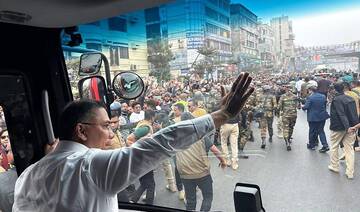
PYONGYANG: North Korea held a mass celebration for the scientists involved in carrying out its largest nuclear blast to date, with fireworks and a mass rally in Pyongyang.
Citizens of the capital lined the streets Wednesday to cheer buses carrying the specialists into the city, and tens of thousands of people gathered in Kim Il-Sung Square to praise their efforts.
The blast triggered global condemnation and calls by the US, South Korea, Japan and others for stronger United Nations Security Council sanctions against the North.
The official Korean Central News Agency described it as a “successful ICBM-ready H-bomb test.”
Speakers at the rally said the North’s military “will put an end to the destiny of the gangster-like US imperialists through the most merciless and strongest preemptive strikes if they and the hordes of traitors finally ignite a war,” KCNA reported.
Sunday’s blast was the North’s sixth nuclear detonation and by far its biggest to date.
Hydrogen bombs, or H-bombs, are thermonuclear weapons far more powerful than ordinary fission-based atomic bombs, and use a nuclear blast to generate the intense temperatures required for fusion to take place.
Foreign governments have yet to confirm whether Sunday’s blast was a full two-stage thermonuclear weapon, or an enhanced fission device.
Working out its size depends on factors including the magnitude of the earthquake generated, the depth at which it was buried, and the type of rock surrounding it.
Estimates vary from South Korea’s 50 kilotons to Japan’s 160. But all of them are far larger than the 15-kiloton US bomb that destroyed Hiroshima in 1945.
North Korea in July carried out its first two successful tests of an intercontinental ballistic missile (ICBM), apparently bringing much of the US mainland into range.
Seoul and Washington early Thursday deployed four more launchers in the South for the THAAD missile defense system, whose presence has infuriated Beijing.
The move was part of measures to defend the South from the North, Seoul’s defense ministry said.


North Korea celebrates success of largest nuclear test

North Korea celebrates success of largest nuclear test


Bangladesh’s religio-political party open to unity govt
- Opinion polls suggest that Jamaat-e-Islami will finish a close second to the Bangladesh Nationalist Party in the first election it has contested in nearly 17 years
DHAKA: A once-banned Bangladeshi religio-political party, poised for its strongest electoral showing in February’s parliamentary vote, is open to joining a unity government and has held talks with several parties, its chief said.
Opinion polls suggest that Jamaat-e-Islami will finish a close second to the Bangladesh Nationalist Party in the first election it has contested in nearly 17 years as it marks a return to mainstream politics in the predominantly Muslim nation of 175 million.
Jamaat last held power between 2001 and 2006 as a junior coalition partner with the BNP and is open to working with it again.
“We want to see a stable nation for at least five years. If the parties come together, we’ll run the government together,” Jamaat chief Shafiqur Rahman said in an interview at his office in a residential area in Dhaka, days after the party created a buzz by securing a tie-up with a Gen-Z party.
Rahman said anti-corruption must be a shared agenda for any unity government.
The prime minister will come from the party winning the most seats in the Feb. 12 election, he added. If Jamaat wins the most seats, the party will decide whether he himself would be a candidate, Rahman said.
The party’s resurgence follows the ousting of long-time Prime Minister Sheikh Hasina in a youth-led uprising in August 2024.
Rahman said Hasina’s continued stay in India after fleeing Dhaka was a concern, as ties between the two countries have hit their lowest point in decades since her downfall.
Asked about Jamaat’s historical closeness to Pakistan, Rahman said: “We maintain relations in a balanced way with all.”
He said any government that includes Jamaat would “not feel comfortable” with President Mohammed Shahabuddin, who was elected unopposed with the Awami League’s backing in 2023.