MAKKAH: A number of muftis of Arab and Islamic countries and key Islamic figures in the world, and guests of the Muslim World League (MWL) for the current Hajj season have lauded King Salman’s efforts in serving and defending Islamic causes.
They also appreciated his generous stances in re-opening Al-Aqsa Mosque and highlighting the moderate approach and cultural dimension of Islam through the establishment of the King Salman Center for Global Peace, the Global Center for Combating Extremist Ideology (GCCEI) and the Saudi Ideological War Center (IWC).
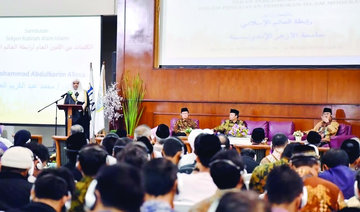
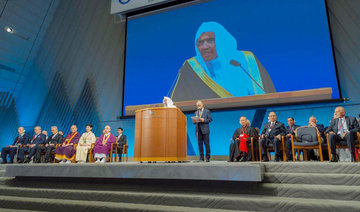
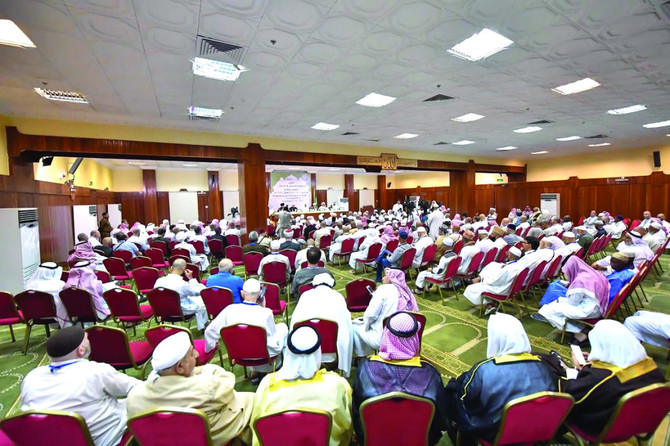
This came in a final statement following their participation in the Hajj forum which was organized by the MWL in Mina titled “Moderation and tolerance in Islam … texts and facts.”
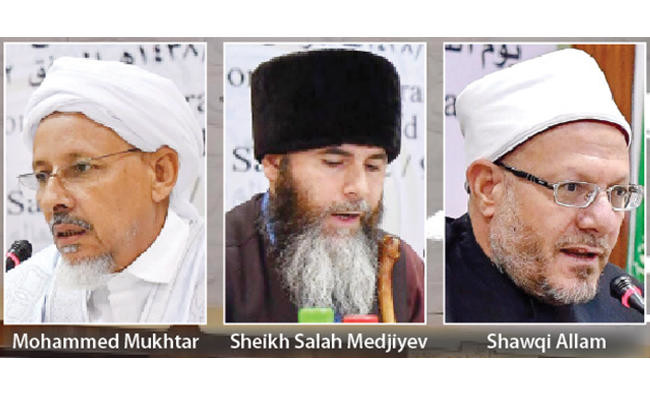
Among the participants of the forum were Grand Mufti of Saudi Arabia, head of the Higher Council of Scholars and Chairman of the Founding Council of the WML Sheikh Abdul Aziz bin Abdullah Al-Asheikh ; Secretary-General of WML, board chairman of the International Organization of Muslim Scholars and member of the Saudi Higher Council of Scholars Sheikh Mohammed bin Abdul Karim Al-Issa; Grand Mufti of Egypt Shawqi Allam; General Mufti of Al-Quds and Palestine Sheikh Mohammed Ahmed Husain; Grand Mufti of the Chechen Republic Sheikh Salah Medjiyev; head of the Mauritanian Higher Council of Fatwa and Grievances Sheikh Mohammed Mukhtar bin Imbala; and a number of scholars from 72 Arab and Islamic countries, in addition to Saudi scholars.
In an opening address at the forum, Al-Asheikh stressed that moderation, justice and tolerance are key features reflected by Islam and Prophet Muhammad (peace be upon him).
Al-Asheikh said one of the manifestations of moderation in Islam is what is described as qualities of goodness, nobility, tenderness, justice, fairness, mercy, brotherhood, love, renunciation of unjustified violence and aggression, advocacy of forgiveness of wrong doers, patience, and charity and mercy to others.
He said all Muslims have to show the bright side of Islam by behaving with virtuous Islamic ethics, showing good treatment, demonstrating tenderness, speaking good words, correlating words with deeds, observing honesty in financial and commercial transactions, honoring contracts and promises, keeping away from injustice, treachery, lying and harming others, and respecting people in their blood, money and dignity.
Al-Asheikh called on scholars, preachers, intellectuals and writers to show the side of moderation and tolerance in Islam through their deeds and words, in writing and contributing to mass media, and through the Internet and social media and other available means to remove that which has hidden the reality of Islam to allow everyone see the virtues of this religion.
He said every one of us should try in his field and within his capabilities to reflect the bright aspects of Islam, its virtuous ethics, good conduct, and lofty teachings, so that each of us can be an honest messenger and true example of the teachings of this great religion.
Al-Issa also addressed the event and welcomed the attendees. He explained the noble values in Islam including moderation and tolerance, adding that everyone should practically translate these values away from abstract theory. Practical application will reflect correctness of the idea with its effective impact and, above all, honor one’s self by observing the true path of Islam and avoid non-compliant words with deeds that may offend the image of the religion.
He stressed the need to address the behavior of the terrorists based on the approach of knowledge of others and to deal with them with a message of wisdom, flexibility and containment without limiting to falsify, ignore or abuse them. All should know how to agree and disagree, and that logic necessitates that any verbal or practical offense committed in the name of religion is actually a crime against the religion itself, he said. He affirmed the importance of scholars, preachers and thinkers in clarifying the truth of Islam and to address the suspicions, illusions and allegations of which extremists have intentionally passed.
For his part, Grand Mufti of Al-Quds Sheikh Mohammed Ahmed Husain expressed thanks to the Kingdom for its care for pilgrims in the holy sites to perform their rituals peacefully. He also thanks the MWL for its invitation to this forum adding that the theme of the forum, on moderation, is the core of Islam and that such forums will enrich the Islamic path.
He said Al-Aqsa Mosque suffers from Israeli aggression. Muslims experienced an ordeal in occupied Palestine last July, and in this context, he lauded King Salman’s efforts in ending the crisis with the support of brothers in a number of Islamic countries.
Grand Mufti of Egypt Shawqi Allam expressed thanks to the MWL secretary-general and other scholars for convening this forum and, at same time, congratulated the Kingdom for the success of the Hajj season and the good arrangements in this regard.
“Islam is a civilization that enters hearts before bodies, and we have seen in our history how scholars of the companions and followers when they went out of the Arabian Peninsula did not use sermons or just talk but translated the meanings of Islam in the form of behavior that captured hearts before bodies,” he said.
In his address, Grand Mufti of the Chechen Sheikh Salah Medjiyev said Allah described the Islamic nation as a moderate nation and, therefore, the Islamic nation obtained the highest honor from the God.
He said Shariah texts that promote tolerance and coexistence are many, but tolerance is conditional on non-takfir and disrespect to the basics of Islam because takfiri ideas and terror lead to bloodshed and destruction.
For his part, the head of the Mauritanian Higher Council of Fatwa and Grievances, Sheikh Mohammed Mukhtar bin Imbala, said the responsibility to achieve tolerance and moderation rests on scholars because wars normally originate in ideas which have to be met with other ideas and logic. He said examples are so many in the religious texts, and scholars have always warned against extravagance in religion because extravagance is a great fatality.
He said our Shariah is between those who have over-excessed and shown laxity, and the Sunnis, who have kept their faith moderate between extravagance and laxity. On the political side, Islam was a moderate divine system that came between democracy and dictatorship, he said.
The participants affirmed that moderation and tolerance in Islam are key pillars of the religion, adding that any deviation comes from ignorance, error or deviant ideas. Moderation and tolerance were clear features of the Islamic nation throughout its long history in line with the Holy Qur’an and Sunnah, and in the footsteps of good men of the nation in the face of anomaly of ideas and visions on Islam.
They said Islam with its balanced moderation, good values, fair provisions, comprehensive systems, and unique cultural experiences is capable of providing solutions to chronic problems of human communities and saving them from their moral and social degradation.
The participants also stressed the need to modernize the religious message that takes into account the differences of time, place and developments, but runs consistent with the basics and identity of Islam that could address problems of contemporary societies away from immediate emotions and reactions by presenting the true Islamic vision that will bring about the interests of the Islamic nation.
They also called for the encouragement of conducting research and studies that originate the principles of moderation and tolerance in Islam, and their spread among civilizations, and refute suspicious ideas of extremists who carry deviant ideas that run counter to Islamic jurisprudence and objectives of the Islamic Shariah.
The participants further noted that scientific intellectual gatherings act as a venue for unifying the Muslim ranks, while consolidating the belief in global diversity and pluralism while explaining the right things with wisdom and good preaching.
The participants stressed the need to support the scientific and research institutions in the world to detect media campaigns against Islam and draw up suitable strategies to deter such campaigns, and correct the erroneous image on Islam and Muslims, whereby the world will know the great Islamic principles and face “Islamophobia” campaigns.
They also called for a clarification on the position of Islam on issues of the current era, its sciences, developments, and study of its social, political and economic systems and to be assessed from the Islamic moderate approach in order to work out a clear-cut, accurate and applicable Islamic vision to overpass the current problems.
Earlier, participants of the forum presented detailed work papers on themes that included moderation and tolerance, the realty of moderation and tolerance, challenges and responsibilities. They called for dealing with all issues in Islamic countries and the formulation of collective solutions that will represent the voice of one united (Islamic) nation.