Indonesia to bar Myanmar protest at world’s biggest Buddhist temple

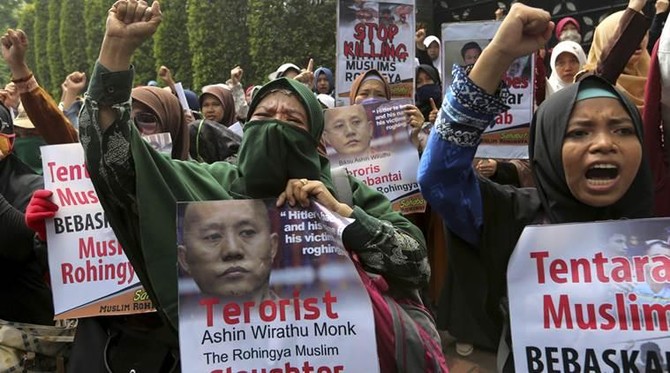
Muslim women raise their fists as they shout slogans during a rally against persecution of Rohingya Muslim minority, outside Myanmar Embassy in Jakarta, Indonesia. (AP)
Updated 05 September 2017
Follow

Indonesia to bar Myanmar protest at world’s biggest Buddhist temple

JAKARTA: Indonesian police have pledged to bar Islamist groups from staging a rally on Friday at the Borobudur Buddhist temple in central Java to protest against the persecution of Myanmar’s Rohingya Muslims.
Islamist groups say they plan the demonstration close to the stupa-topped Borobudur temple, which dates from the 9th century and is a popular tourist site, to call for an end to violence against the religious and ethnic minority in Myanmar.
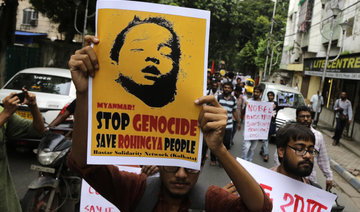
Indonesia has the world’s largest population of Muslims and there have been a number of anti-Myanmar protests in Jakarta and the Malaysian capital Kuala Lumpur over the treatment of Buddhist-majority Myanmar’s roughly 1.1 million Rohingyas.
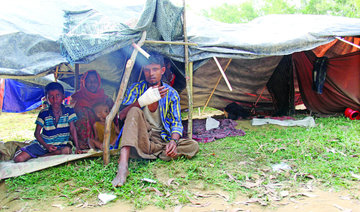
Almost 125,000 Rohingyas have been forced to flee clashes between Rohingya insurgents and the army in the northwest Rakhine state. Tens of thousands have crossed the border into neighboring Bangladesh.
“The action at Borobudur temple will be prohibited,” National Police Chief Tito Karnavian told reporters, according to media.
“This is not just part of the heritage of Indonesia, but that of the world. There is no need for protests in response to the Rohingya conflict because the Indonesian government is taking action on it already.”
Indonesian Foreign Minister Retno Marsudi on Monday met Myanmar leader Aung San Suu Kyi and top security officials to call for a halt to the bloodshed. Marsudi was due in Dhaka, the Bangladeshi capital, on Tuesday.
Pakistani Foreign Minister Khawaja Muhammad Asif expressed “deep anguish at the ongoing violence against the Rohingya Muslims” and urged the Organization of Islamic Cooperation to take “immediate and effective action to bring an end to all human-rights violations against innocent and unarmed Rohingya Muslim population.”
An organizer of Friday’s planned protest said the groups wanted to protest peacefully near the Borobodur temple to show Indonesia’s tolerance.
“The Borobudur is an extraordinary symbol of tolerance,” said Anang Imamuddin. “We want the world to know that it is in a majority Muslim country but it is safe. Buddhist monks are safe here too.”


UNICEF warns of rise in sexual deepfakes of children

Updated 12 sec ago
Follow

UNICEF warns of rise in sexual deepfakes of children

  • The findings underscored the use of “nudification” tools, which digitally alter or remove clothing to create sexualized images

UNITED NATIONS, United States: The UN children’s agency on Wednesday highlighted a rapid rise in the use of artificial intelligence to create sexually explicit images of children, warning of real harm to young victims caused by the deepfakes.
According to a UNICEF-led investigation in 11 countries, at least 1.2 million children said their images were manipulated into sexually explicit deepfakes — in some countries at a rate equivalent to “one child in a typical classroom” of 25 students.
The findings underscored the use of “nudification” tools, which digitally alter or remove clothing to create sexualized images.
“We must be clear. Sexualized images of children generated or manipulated using AI tools are child sexual abuse material,” UNICEF said in a statement.
“Deepfake abuse is abuse, and there is nothing fake about the harm it causes.”
The agency criticized AI developers for creating tools without proper safeguards.
“The risks can be compounded when generative AI tools are embedded directly into social media platforms where manipulated images spread rapidly,” UNICEF said.
Elon Musk’s AI chatbot Grok has been hit with bans and investigations in several countries for allowing users to create and share sexualized pictures of women and children using simple text prompts.
UNICEF’s study found that children are increasingly aware of deepfakes.
“In some of the study countries, up to two-thirds of children said they worry that AI could be used to create fake sexual images or videos. Levels of concern vary widely between countries, underscoring the urgent need for stronger awareness, prevention, and protection measures,” the agency said.
UNICEF urged “robust guardrails” for AI chatbots, as well as moves by digital companies to prevent the circulation of deepfakes, not just the removal of offending images after they have already been shared.
Legislation is also needed across all countries to expand definitions of child sexual abuse material to include AI-generated imagery, it said.
The countries included in the study were Armenia, Brazil, Colombia, Dominican Republic, Mexico, Montenegro, Morocco, North Macedonia, Pakistan, Serbia, and Tunisia.