Malaysian police arrest suspected Abu Sayyaf leader, seven others

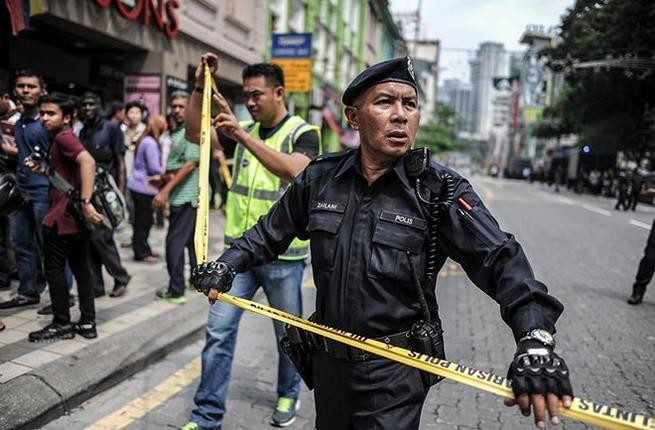
Malaysian police. (File photo by AFP)
Updated 03 September 2017
Follow

Malaysian police arrest suspected Abu Sayyaf leader, seven others

KUALA LUMPUR: Malaysian police arrested a suspected leader and seven members of the Daesh-linked Abu Sayyaf Islamist group in the capital, Kuala Lumpur, a police source said on Sunday.
Police detained Hajjar Abdul Mubin — otherwise known as Abu Asrie — in the Wednesday raid, according to the source, who was not authorized to speak to the media on the case.
Hajjar, a Filipino, was arrested along with one other Filipino and six Malaysians from the Borneo state of Sabah, which shares a porous maritime border with the Philippines.
The arrests were first reported by the English daily, The Star.
The Abu Sayyaf is notorious for bombings, beheadings, extortion and kidnap-for-ransom in the south of the mainly Roman Catholic Philippines.
The arrests were the latest in an ongoing crackdown on militancy by Muslim-majority Malaysia. More than 250 people have been arrested between 2013 and 2016 for suspected militancy linked to Daesh.
Governments in Southeast Asia have been worried over the possible expansion of Daesh in the region as battle-hardened militants return home after the collapse of their self-styled caliphate in the Middle East.
Militants loyal to Daesh seized large parts of Marawi city in the southern Philippines in May. Some 620 militants, 136 soldiers and police and 45 civilians were killed in more than 100 days of fighting.


Indonesia’s first woman president awarded honorary doctorate by Princess Nourah University

Updated 10 February 2026
Follow

Indonesia’s first woman president awarded honorary doctorate by Princess Nourah University

  • Megawati was recognized for her leadership and contributions to social, legal affairs
  • She has received 10 other honorary degrees from Indonesian and foreign institutions

JAKARTA: Megawati Sukarnoputri, who served as Indonesia’s fifth president and was the country’s only female head of state to date, has been awarded an honorary doctorate by Princess Nourah bint Abdulrahman University in Riyadh, becoming the first foreign national to receive the title.

Megawati, the eldest daughter of Indonesia’s first President Sukarno and chairwoman of the country’s largest political party, the PDIP, served as president from 2001 to 2004.

The 79-year-old was awarded an honorary doctorate in organizational and legal affairs in Riyadh on Monday during a ceremony overseen by Princess Nourah University’s acting president, Dr. Fawzia bint Sulaiman Al-Amro.

“This recognition was given in appreciation of her efforts during her presidency, her significant contributions to social, organizational, and legal fields, and her role in strengthening institutional leadership in Indonesia,” the university said in a statement.

This is Megawati’s 11th honorary doctorate. She has received similar degrees from Indonesian and foreign universities, including the Moscow State Institute of International Relations in 2003 and the Soka University of Japan in 2020.

She has also been awarded the title of honorary professor by several institutions, including by the Seoul Institute of the Arts in 2022.

“We gather at the Princess Nourah bint Abdulrahman University, a university that stands as a symbol of women’s progress in education, knowledge and public service … To see so many intelligent women, I feel very proud,” Megawati said in her acceptance speech.

“Women’s empowerment is not a threat to any values, culture or tradition. It is actually a condition for nations that believe in their future … A great nation is one that is able to harness all of its human potential. A strong nation is one that does not allow half of its social power to be left on the sidelines of history.”

Megawati is the longest-serving political leader in Indonesia. Indonesia’s first direct presidential elections took place during her presidency, consolidating the country’s transition to democracy after the downfall of its longtime dictator Suharto in 1998.