Palestinian pilgrims: King Salman’s generosity eased our sufferings

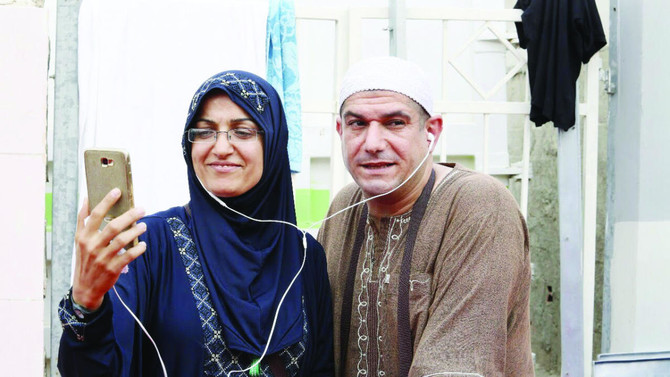
Mohammed and his wife Khalidiyah. (AN photo)
Updated 03 September 2017
Follow

Palestinian pilgrims: King Salman’s generosity eased our sufferings

MINA: Mohammed and his wife, Palestinian pilgrims, said the generosity of King Salman has eased many of their sufferings. “We know the generous deeds of the king, not only with the Palestinians, but with all Arab and Islamic peoples,” they said.
“I have been patient for so long, and at last, I found myself among the pilgrims and, even, I could not believe it when I heard that I was selected in the king’s Hajj and Umrah program,” he said.
He said he wished his whole family could have come with him but the Zionist aggression killed his three sons.
His wife Khalidiyah recalled the painful memories of losing her sons as a result of Israel bombing her city. She said she still felt the wounds of losing them, but her sole relief was that they were martyred on the path of Allah in defense of the rights of the usurped Palestine.
They said they have felt blessed since their reception at the Hajj Terminal Complex at King Abdul Aziz International Airport in Jeddah and when they arrived in Makkah, which reflects the generosity offered by the Saudis in how they deal with pilgrims.


Leading AI company to partner with Saudi Arabia, CEO tells Arab News

Updated 06 February 2026
Follow

Leading AI company to partner with Saudi Arabia, CEO tells Arab News

  • Argentum’s Andrew Sobko: ‘Very easy’ to build new infrastructure, data centers in Kingdom
  • In 2024, Saudi Arabia announced $100bn plan to establish AI hub

CHICAGO: The founder and CEO of Argentum AI, one of the world’s leading artificial intelligence companies, has told Arab News that he is looking forward to partnering with Saudi Arabia.

Ukrainian-born Andrew Sobko, based in Chicago, said Crown Prince Mohammed bin Salman has made a significant commitment to AI use.

In 2024, Saudi Arabia announced a $100 billion plan under Vision 2030 to build a hub to develop technology and data centers to handle a significant portion of the world’s AI workload.

The Kingdom reportedly expects AI to contribute more than $135.2 billion to its gross domestic product by 2030, representing roughly 12.4 percent of its economy.

“The US still is the kind of core leader of this AI innovation, development and infrastructure, but we quickly realized that Saudi Arabia sees this as an important asset class, not just as an innovation,” Sobko said.

“They’re deploying tons of capital. If you try to build some new infrastructure or data center, it’s very easy to do it in Saudi Arabia,” he added. “Saudi Arabia realizes and sees this compute as almost like a second asset class after oil.”

The term “compute” refers to the process of calculations that fuels AI development and applications in everyday use.

“The Middle East wants to be one of the largest exporters of compute. They realized that a couple of years ago and they’re aggressively expanding,” Sobko said, adding that AI is being used more and more in industries such as sports, in which Saudi Arabia has invested heavily.

Argentum AI recently added Majed Al-Sorour, CEO of the Saudi Golf Federation, to its board.

“Majed is also a huge believer in AI and AI infrastructure,” said Sobko. “With the help of Majed, we’re focusing on global expansion. He’s leading charge on that.”

Sobko said the challenge is not simply recognizing the importance of AI, but the ability to power data centers that it requires, and Saudi Arabia recognizes that need.

“If you secure a significant amount of power and you have data center capacity, you can actually control this kind of compute and AI,” he added.

“And the biggest bottleneck to continue expanding as we enter into this new age of robotics industry, it needs a lot more compute.”

Following meetings with US leadership, including President Donald Trump last November, Saudi Arabia secured agreements on AI technology transfers, aiming to avoid reliance on other nations’ systems.