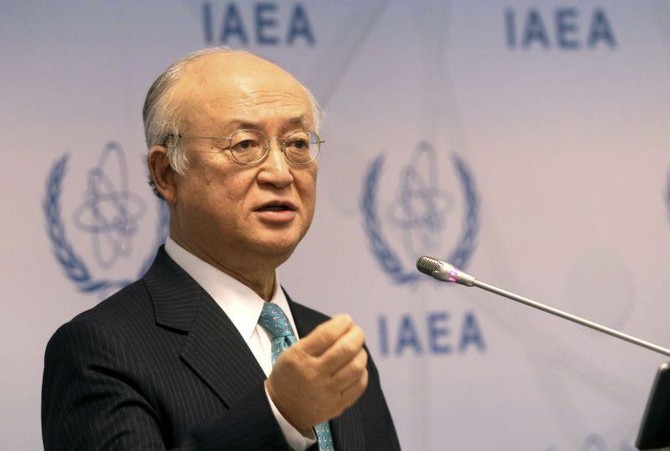
VIENNA: The top UN official monitoring Iran’s nuclear program on Thursday rejected Tehran’s claim that its military sites were off-limits to inspection, saying his agency needs access to all “relevant locations” if suspicions arise of possible hidden atomic activities.
The comments by International Atomic Energy Agency chief Yukiya Amano are significant — his agency is policing the deal capping atomic activities that Iran says are peaceful but the US suspects are a covert pursuit of nuclear arms.
Adding to their weight is their timing. President Donald Trump has repeatedly criticized the deal as too soft on Tehran and has left open the option of pulling out of the treaty that Washington and five other world powers agreed to with Iran just over two years ago.
Although Russia, China, Britain, France and Germany also signed on to the pact, Iran and the US were the key players. A US pullout could effectively kill the agreement, and lead Iran to quickly ramp up programs that could be used to make weapons.
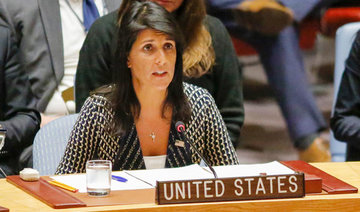
In added US pressure on Iran, Nikki Haley, Washington’s UN ambassador, met with Amano last week to underline the American view that military sites are part of any IAEA monitoring. Iranian officials from President Hassan Rouhani down have rejected that option, with government spokesman Mohammad Bagher Nobakht this week dismissing any push for military inspections as a “dream.”
Amano didn’t directly contradict the Iranian officials, saying his agency doesn’t react to “news reports.”
But he told The Associated Press that under monitoring conditions accepted by Iran, his agency “has access to (all) locations without making distinctions between military and civilian locations” as it works to ensure that Iran doesn’t have hidden nuclear activities.
Haley, in a statement Thursday, said that if “inspections of Iranian military sites are ‘merely a dream,’ then Iranian compliance .... is also a dream.”
Even if Iran accepts such inspections, it is bound to demand stringent concessions.
IAEA experts normally do the work of swiping equipment and sampling the soil and air at sites they suspect was used for hidden nuclear activities. But in the last known inspection of a military site, the agency allowed Iranian personnel to do that work under limited conditions two years ago at Parchin, a facility where the agency suspects Iranian scientists worked in the past on atomic arms.
But while the previous US administration showed flexibility in its pursuit of a nuclear understanding with Iran, the Trump presidency is unlikely to follow suit as it looks for possible reasons to abrogate the pact.
The deal outlines what Tehran has to do to pull back its nuclear program from the brink of weapons-making capacity in return for economic and other sanctions relief for Iran.
Amano’s agency on Thursday noted no violations by Tehran in its latest quarterly Iran monitoring report. At the same time, the report said that the agency continues to hunt for “undeclared nuclear material and activities.”


![]()
UN nuclear agency rejects Iran’s stance on military sites
UN nuclear agency rejects Iran’s stance on military sites

Latest updates




© 2026 SAUDI RESEARCH & PUBLISHING COMPANY, All Rights Reserved And subject to Terms of Use Agreement.