Brotherhood figures among 296 names added to Egypt terror list

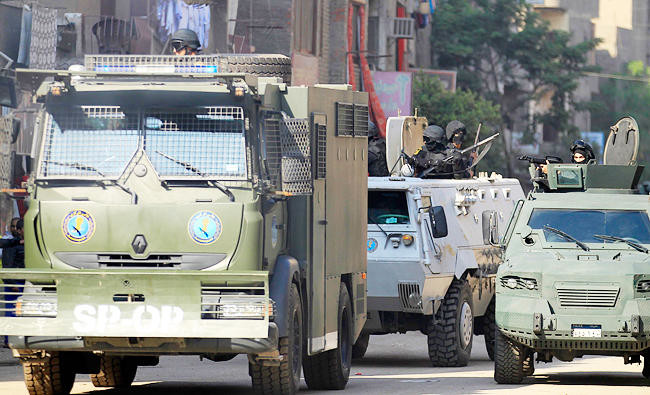
Riot police take their positions with their armoured personnel vehicles during clashes with supporters of Muslim Brotherhood and ousted Egyptian President Mohamed Mursi in the Cairo suburb of Matariya, in this November 28, 2014 file photo. (Reuters)
Updated 01 September 2017
Follow

Brotherhood figures among 296 names added to Egypt terror list

CAIRO: An Egyptian court on Wednesday published the names of 296 people who have been added to the country’s terror list, including some with links to the outlawed Muslim Brotherhood.
The verdict, issued by Cairo’s criminal court on July 24, ruled that the 296 people be added to the national terrorist list for three years.
It said some of the defendants were found guilty of leading the Brotherhood, being members, funding the group, or harming the national economy and public security.
As per Egyptian law, those on the list are barred from leaving the country, their assets have been frozen and their passports canceled.
The list of names includes several Brotherhood leaders living outside the country. Among them are Mahmoud Ezzat, the group’s deputy supreme guide who fled Egypt in 2013, and Secretary-General Ibrahim Mounir, who lives in in London.
Both were found guilty of planning terror attacks in Egypt while abroad. Figures designated on the list and living abroad could be arrested upon their return.
In December 2013, the government listed the Brotherhood as a terrorist group, accusing it of involvement in a series of deadly attacks against the state.
“Every country that wages a war on terrorism has to undergo three main steps to paralyze a group: Leadership decapitation, cutting sources of financing, and hampering recruitment by labeling it a terrorist organization,” said Said Sadek, a Cairo-based political sociology professor.
Paul J. Sulliven, adjunct professor of security studies at Georgetown University, said: “Terrorists need to be contained by squeezing terror groups of their financing and other means of recruiting and retaining people.
“But containment isn’t enough. With the right education, economic and religious programs and efforts, Egypt could help rid itself of violent extremism and groups that may want to harm it.”


UN humanitarian chief’s fresh funding call as Sudan crisis passes 1,000 days amid famine, mass displacement

Updated 6 sec ago
Follow

UN humanitarian chief’s fresh funding call as Sudan crisis passes 1,000 days amid famine, mass displacement

  • ‘Today we are signaling that the international community will work together to bring this suffering to an end,’ Tom Fletcher tells fundraising event in Washington
  • Sudan is a central pillar of the UN’s global humanitarian plan for 2026, which aims to save 87m lives worldwide, he adds

NEW YORK CITY: The UN on Tuesday launched a renewed appeal for funding and the political backing to address what it described as the catastrophic humanitarian crisis in Sudan, which has now been locked in civil war for more than 1,000 days.

Speaking at a fundraising event for Sudan in Washington, organized by the US Institute for Peace, the UN under-secretary-general for humanitarian affairs, Tom Fletcher, said the scale of the suffering in Sudan had reached intolerable levels marked by famine, mass displacement and widespread sexual violence against women and girls.

“The horrific humanitarian crisis in Sudan has endured more than 1,000 days — too long,” he said. “Too many days of famine, of brutal atrocities, of lives uprooted and destroyed.”

The global community was now united in its desire to halt the suffering and ensure life-saving aid reaches those most in need, Fletcher said.

“Today we are signaling that the international community will work together to bring this suffering to an end,” he added.

Sudan is a central pillar of the UN’s global humanitarian plan for 2026, which aims to save 87 million lives worldwide, Fletcher explained as he thanked donors, including the US, the EU and the UAE, for stepping forward.

“Sudan is the most important component of that plan,” he said, noting that humanitarian operations there have been chronically underfunded and plagued by danger. “We have lost hundreds of colleagues in Sudan, colleagues of incredible courage.”

The UN plans to provide food, medicine, water and sanitation services to more than 14 million people across Sudan this year, as well as protection for vulnerable groups, Fletcher said.

He stressed that funding alone would not be sufficient, however, and called for stronger measures to protect civilians and aid workers, secure humanitarian access and support a temporary truce between the warring factions.

“The money is not enough,” he said. “We need the air assets, the security, the medical support for our teams, and the mediation work that has to underpin the access.”

The UN will work, through the Sudan Humanitarian Initiative, with the so-called “Quad” group of international partners (the US, Egypt, Saudi Arabia and the UAE) and others to identify priority areas for urgent action and remove obstacles to the delivery of aid, Fletcher said.

He added that the UN seeks visible progress toward a humanitarian truce in Sudan within the next few weeks, and called for those guilty of any violations in the country to be held accountable.

“We have set a target date of the beginning of Ramadan to make visible progress on this work,” Fletcher said. Ramadan is expected to begin on or around Feb. 17 this year.

Quoting UN Secretary-General Antonio Guterres, he added that the urgency of ending the conflict was growing as the third anniversary of its outbreak on April 15, 2023, approaches.

“The guns must fall silent and a path to peace must be charted,” Fletcher said, adding that the UN fully supports efforts to secure a humanitarian truce and rapidly scale up aid across Sudan.

“Today, we’re saying, ‘Enough.’ Let today be the signal that the world is uniting in solidarity for practical impact.”