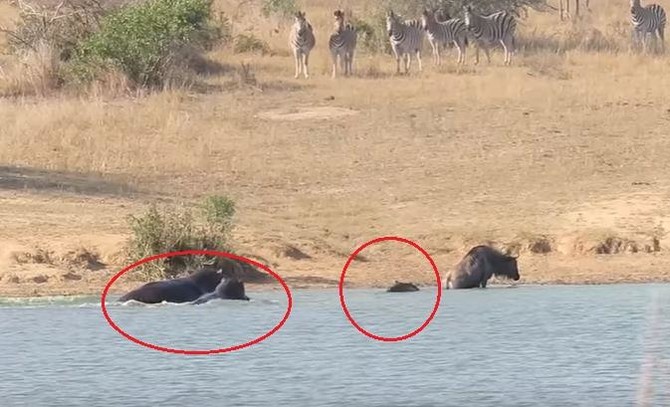
DUBAI: This is the dramatic moment a crocodile tries to drag a wildebeest into the water, but is stopped in its tracks by two hippos.
At first it looks like the large water loving creatures are trying to save the crocodile’s victim, but it is possible the hippos were being territorial.
The footage, that has already been watched thousands of times in the first 24 hours since it was posted, is the work of Mervyn Van Wyk, 72, who was visiting the South Africa’s Kruger Park with his wife Tokkie.
The couple was watching the wildebeest grazing by the river, along with other animals when it was grabbed by a large crocodile.
The crocodiles prey put up a fight for about eight minutes, before it eventually looked like it was finally succumbing to the water and its inevitable demise, when two hippos suddenly appeared in shot and moved quickly in, giving the wildebeest a moment to escape.
But while it looks like the wildebeest lived to see another day, it has obviously suffered a serious injury to the leg the crocodile had caught it by.
Commentators on YouTube all seem agreed that while it got free of the crocodile, the likelihood is it will not live much longer with its injury as it will not be able to outrun land-based predators.

VIDEO: Wildebeest apparently rescued from crocodile by hippos, but is that really what happened?
St. Francis relics go on public show for first time in Italy
Assisi, Italy: Saint Francis of Assisi’s skeleton is going on public display from Sunday for the first time for the 800th anniversary of his death, drawing hundreds of thousands of visitors.
Inside a nitrogen-filled plexiglass case with the Latin inscription “Corpus Sancti Francisci” (The Body of St. Francis), the remains are being shown in the Italian hill town’s Basilica of St. Francis of Assisi.
St. Francis, who died on October 3, 1226, founded the Franciscan order after renouncing his wealth and devoting his life to the poor.
Giulio Cesareo, director of communications for the Franciscan convent in Assisi said he hoped the display could be “a meaningful experience” for believers and non-believers alike.
Cesareo, a Franciscan friar, said the “damaged” and “consumed” state of the bones showed that St. Francis “gave himself completely” to his life’s work.
His remains, which will be on display until March 22, were transferred to the basilica built in the saint’s honor in 1230.
But it was only in 1818, after excavations carried out in utmost secrecy, that his tomb was rediscovered.
Apart from previous exhumations for inspection and scientific examination, the bones of Saint Francis have only been displayed once, in 1978, to a very limited public and for just one day.
Usually hidden from view, the transparent case containing the relics since 1978 was brought out on Saturday from the metal coffer in which it is kept, inside his stone tomb in the crypt of the basilica.
The case is itself inside another bullet-proof and anti-burglary glass case.
Surveillance cameras will operate 24 hours a day for added protection of the remains.
St. Francis is Italy’s patron saint and the 800th anniversary commemorations of his death will also see the restoration of an October 4 public holiday in his honor.
The holiday had been scrapped nearly 50 years ago for budget reasons.
Its revival is also a tribute to late pope Francis who took on the saint’s name.
Pope Francis died last year at the age of 88.
‘Not a movie set’
Reservations to see the saint’s remains already amount to “almost 400,000 (people) coming from all parts of the world, with of course a clear predominance from Italy,” said Marco Moroni, guardian of the Franciscan convent.
“But we also have Brazilians, North Americans, Africans,” he added.
During this rather quiet time of year, the basilica usually sees 1,000 visitors per day on weekdays, rising to 4,000 on weekends.
The Franciscans said they were expecting 15,000 visitors per day on weekdays and up to 19,000 on Saturdays and Sundays for the month-long display of the remains.
“From the very beginning, since the time of the catacombs, Christians have venerated the bones of martyrs, the relics of martyrs, and they have never really experienced it as something macabre,” Cesareo said.
What “Christians still venerate today, in 2026, in the relics of a saint is the presence of the Holy Spirit,” he said.
Another church in Assisi holds the remains of Carlo Acutis, an Italian teenager who died in 2006 and who was canonized in September by Pope Leo XIV.
Experts said the extended display of St. Francis’s remains should not affect their state of preservation.
“The display case is sealed, so there is no contact with the outside air. In reality, it remains in the same conditions as when it was in the tomb,” Cesareo said.
The light, which will remain subdued in the church, should also not have an effect.
“The basilica will not be lit up like a stadium,” Cesareo said. “This is not a movie set.”