

North Korea says more missiles to come as UN condemns launch

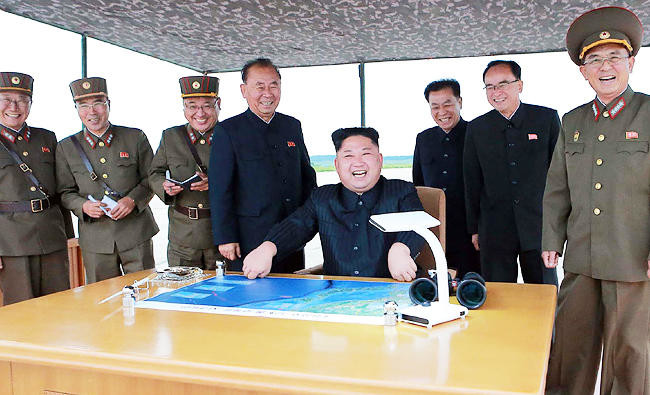
This photo from North Korea's official Korean Central News Agency (KCNA) taken on Tuesday and released on Wednesday shows North Korean leader Kim Jong-Un (C) watching the launch of an intermediate-range strategic ballistic rocket Hwasong-12 in Pyongyang. (AFP)
Updated 30 August 2017
Follow

North Korea says more missiles to come as UN condemns launch

SEOUL: North Korea leader Kim Jong-Un has promised more missile flights over Japan, insisting his nuclear-armed nation’s provocative launch was a mere “curtain-raiser,” in the face of UN condemnation and US warnings of severe repercussions.
The Hwasong-12 intermediate-range missile that Pyongyang unleashed on Tuesday represented a major escalation in the face of tensions over its weapons programs.
In recent weeks it has threatened to send a salvo of missiles toward the US territory of Guam, while President Donald Trump has warned of raining “fire and fury” on the North.
After the latest launch Trump said that “all options” were on the table, reviving his implied threat of pre-emptive US military action just days after congratulating himself that Kim appeared to be “starting to respect us.”
The UN Security Council — which has already imposed seven sets of sanctions on Pyongyang — said in a unanimous statement the North’s actions “are not just a threat to the region, but to all UN member states.”
Both the North’s key ally China and Russia, which also has ties to it, backed the US-drafted declaration, but it will not immediately lead to new or tightened measures against Pyongyang.
The Rodong Sinmun newspaper, the mouthpiece of the North’s ruling party, on Wednesday carried more than 20 pictures of the launch near Pyongyang, one showing Kim smiling broadly at a desk with a map of the Northwest Pacific, surrounded by aides.
Another showed him gazing upwards as the missile rose into the air.
South Korea’s military said Tuesday that it had traveled around 2,700 kilometers (1,700 miles) and reached a maximum altitude of 550 kilometers.
The official Korean Central News Agency cited Kim as saying that “more ballistic rocket launching drills with the Pacific as a target in the future” were necessary.
Tuesday’s launch was a “meaningful prelude to containing Guam, advanced base of invasion,” he said, and a “curtain-raiser” for the North’s “resolute countermeasures” against ongoing US-South Korean military exercises which the North regards as a rehearsal for invasion.
Wednesday’s statement was the first time the North has acknowledged sending a missile over Japan’s main islands. Two of its rockets previously did so, in 1998 and 2009, but on both occasions it claimed they were space launch vehicles.

Tuesday’s missile overflight triggered consternation in world capitals and on the ground, with sirens blaring out and text message alerts being sent in Japan warning people to take cover.
“Threatening and destabilising actions only increase the North Korean regime’s isolation in the region and among all nations of the world,” Trump said in a White House statement. “All options are on the table.”
At the UN Security Council emergency meeting Washington’s Ambassador Nikki Haley warned that “enough is enough” and that tough action had to be taken.
“It’s unacceptable,” Haley said. “They have violated every single UN Security Council resolution that we’ve had, and so I think something serious has to happen.”
The North last month carried out its first two successful tests of an intercontinental ballistic missile, apparently bringing much of the US mainland into range, but the Pentagon said Tuesday’s launch was judged not to have represented a threat.
Any missile fired by the North at Guam would have to pass over Japan, and analysts told AFP that Pyongyang appeared to have chosen the trajectory as a “half-way house” option to send a message without crossing a red line.
Japan’s Prime Minister Shinzo Abe was nevertheless visibly unsettled, dubbing the launch an “unprecedented, serious and grave threat.”
Despite Trump’s rhetoric, officials in Washington privately echo the warning by Trump’s now former chief strategist Steve Bannon that it is too late for a pre-emptive strike against the North.
“There’s no military solution, forget it,” Bannon told the American Prospect in an August 16 interview, his last before losing his job.
“Until somebody solves the part of the equation that shows me 10 million people in Seoul don’t die in the first 30 minutes from conventional weapons, I don’t know what you’re talking about, there’s no military solution here, they got us.”


Top UN court to hear Rohingya genocide case against Myanmar

Updated 6 sec ago
Follow

Top UN court to hear Rohingya genocide case against Myanmar

THE HAGUE: Did Myanmar commit genocide against its Rohingya Muslim minority? That’s what judges at the International Court of Justice will weigh during three weeks of hearings starting Monday.
The Gambia brought the case accusing Myanmar of breaching the 1948 Genocide Convention during a crackdown in 2017.
Legal experts are watching closely as it could give clues for how the court will handle similar accusations against Israel over its military campaign in Gaza, a case brought to the ICJ by South Africa.
Hundreds of thousands of Rohingya Muslims fled violence by the Myanmar army and Buddhist militias, escaping to neighboring Bangladesh and bringing harrowing accounts of mass rape, arson and murder.
Today, 1.17 million Rohingya live crammed into dilapidated camps spread over 8,000 acres in Cox’s Bazar in Bangladesh.
From there, mother-of-two Janifa Begum told AFP: “I want to see whether the suffering we endured is reflected during the hearing.”
“We want justice and peace,” said the 37-year-old.

’Senseless killings’

The Gambia, a Muslim-majority country in West Africa, brought the case in 2019 to the ICJ, which rules in disputes between states.
Under the Genocide Convention, any country can file a case at the ICJ against any other it believes is in breach of the treaty.
In December 2019, lawyers for the African nation presented evidence of what they said were “senseless killings... acts of barbarity that continue to shock our collective conscience.”
In a landmark moment at the Peace Palace courthouse in The Hague, Nobel Peace laureate Aung San Suu Kyi appeared herself to defend her country.
She dismissed Banjul’s argument as a “misleading and incomplete factual picture” of what she said was an “internal armed conflict.”
The former democracy icon warned that the genocide case at the ICJ risked reigniting the crisis, which she said was a response to attacks by Rohingya militants.
Myanmar has always maintained the crackdown by its armed forces, known as the Tatmadaw, was justified to root out Rohingya insurgents after a series of attacks left a dozen security personnel dead.

‘Physical destruction’

The ICJ initially sided with The Gambia, which had asked judges for “provisional measures” to halt the violence while the case was being considered.
The court in 2020 said Myanmar must take “all measures within its power” to halt any acts prohibited in the 1948 UN Genocide Convention.
These acts included “killing members of the group” and “deliberately inflicting on the group conditions of life calculated to bring about its physical destruction in whole or in part.”
The United States officially declared that the violence amounted to genocide in 2022, three years after a UN team said Myanmar harbored “genocidal intent” toward the Rohingya.
The hearings, which wrap up on January 30, represent the heart of the case.
The court had already thrown out a 2022 Myanmar challenge to its jurisdiction, so judges believe they have the power to rule on the genocide issue.
A final decision could take months or even years and while the ICJ has no means of enforcing its decisions, a ruling in favor of The Gambia would heap more political pressure on Myanmar.
Suu Kyi will not be revisiting the Peace Palace. She has been detained since a 2021 coup, on charges rights groups say were politically motivated.
The ICJ is not the only court looking into possible genocide against the Rohingya.
The International Criminal Court, also based in The Hague, is investigating military chief Min Aung Hlaing for suspected crimes against humanity.
Another case is being heard in Argentina under the principle of universal jurisdiction, the idea that some crimes are so heinous they can be heard in any court.