

Private Hajj operators respond to rising demand

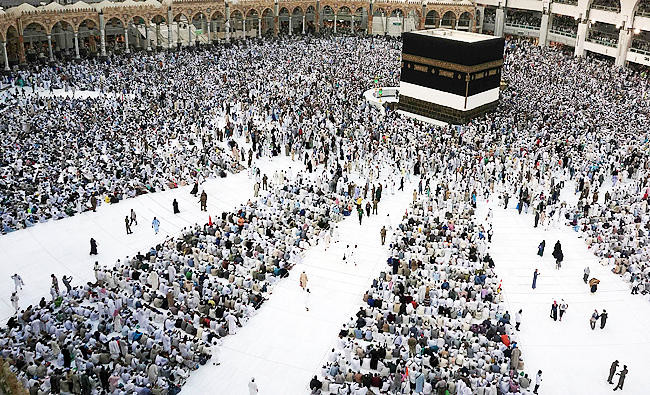
Muslim pilgrims sit and circumambulate around the Kaaba, the cubic building at the Grand Mosque, ahead of the annual Hajj pilgrimage in the Muslim holy city of Makkah, Saudi Arabia on Monday. (AFP)
Updated 30 August 2017
Follow

Private Hajj operators respond to rising demand

Robert Bianchi, adviser and visiting professor, Middle East Studies Institute, Shanghai International Studies University and author of “Guests of God: Pilgrimage and Politics in the Islamic World.”

Q: What kind of Hajj packages are popular in 2017?
A: There is more variety and choice every year. State Hajj agencies are shifting larger shares of the market to private firms that target different income groups with high-end packages. There is a great deal of controversy over inflated prices and substandard accommodations.

Q: Is the demand for Hajj visits rising or falling?
A: Demand far exceeds the number of visas available. In many countries, prospective pilgrims must register for waiting lists that extend for 10 to 20 years. Governments and travel agencies are trying to relieve the pressure by encouraging people to make the Umrah instead of the Hajj because an Umrah can be performed in any season. However, the Umrah cannot substitute for the Hajj as a religious duty so the problem of excess demand continues to worsen.

Q: What types of packages are pilgrims requesting?
A: There are many touristic routes that include side trips to places outside of Saudi Arabia such as Turkey, Palestine and Iraq. Family packages are increasingly popular as are special arrangements for elderly people who can not wait for years to reach the head of the waiting lists. High prices are creating many opportunities for corruption and favoritism. Nearly every country is plagued with Hajj-related scandals that reverberate in the mass media and in political campaigns.

Q: Do many customers now take out Hajj loans to fund their trips? Is this act deemed Shariah-compliant?
A: Loans are rare, but special long-term savings accounts for prospective pilgrims are very widespread. The early programs arose in Malaysia, Indonesia and Pakistan. They have spread to nearly all of the larger Muslim countries in Asia and Africa as well as the growing Muslim communities in Europe and North America. The management and investment of these funds can be Shariah-compliant, but there is still no global consensus about standards for making that determination.



Rare sighting of critically endangered leatherback turtle in Red Sea

Updated 05 February 2026
Follow

Rare sighting of critically endangered leatherback turtle in Red Sea

  • Turtles travel thousands of kilometers to Red Sea
  • Nesting 6,500km away in India’s Andaman Islands

RIYADH: Saudi Arabia’s National Center for Wildlife has documented a rare sighting of a leatherback sea turtle in the Red Sea, marking a significant biological record for one of the planet’s most critically endangered marine species.

The sighting occurred approximately 30 km off the coast of Al-Qunfudhah within the Blue Holes Protected Area, a newly established marine reserve, according to a recent report from the Saudi Press Agency.

The NCW said the presence of a leatherback in these waters was an exceptional event.

Recognized as the largest turtle species on Earth, the leatherback can weigh up to 900 kilograms. It has a unique leathery, black carapace — distinguished by five longitudinal ridges rather than a hard bony shell — and able to dive to depths exceeding 1,000 meters.

Shutterstock image

Noting the species’ migratory nature, the center explained that leatherbacks travel thousands of kilometers foraging for jellyfish. The specimen likely navigated through the Bab Al-Mandeb Strait in search of food.

This is considered a remarkable journey, the NCW said, noting that the nearest known populations reside in the Indian Ocean, spanning waters from South Africa to Sri Lanka (roughly 7,000 to 8,000 km away).

The closest known nesting grounds are located in India’s Andaman Islands, approximately 6,500 kilometers away. No nesting activity has been recorded in the Red Sea.

According to the Red List of the International Union for Conservation of Nature, the leatherback is Critically Endangered in the Indian Ocean.

While data for the Red Sea and Arabian Gulf is scarce, recent isolated sightings include a juvenile recorded in Jordan in December 2025 and another off Djibouti in 2019.

The NCW emphasized that these rare appearances highlight the ecological importance of the Kingdom's marine conservation efforts in the Red Sea.

The center pointed to the Farasan Islands Marine Protected Area, along with the new Blue Holes and Ras Hatiba reserves, as critical sanctuaries that could support the expansion in range of such endangered species.