Egyptian scholars value Saudi Arabia's efforts to provide services to Hajj pilgrims

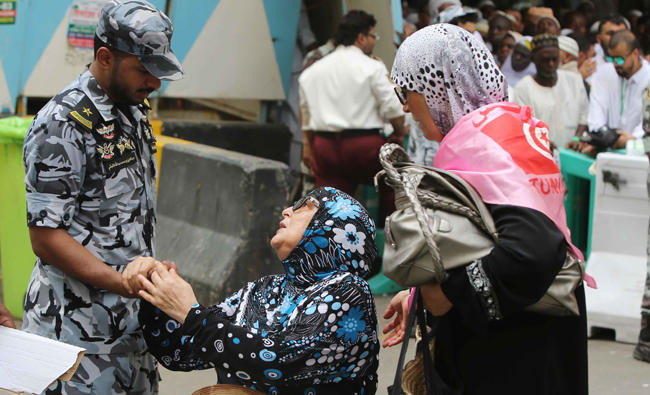
A pilgrim talks with a security official at the Grand Mosque in Makkah. (AN Photo by Ahmad Hashad)
Updated 28 August 2017
Follow

Egyptian scholars value Saudi Arabia's efforts to provide services to Hajj pilgrims

CAIRO: Egyptian scholars and men of religion have valued the efforts and services provided by Saudi Arabia to pilgrims coming from different countries, so they can peacefully and securely perform their Hajj rituals.
As they expressed their appreciation of the king for inviting 1,000 pilgrims from families of Egyptian army and police martyrs to the Kingdom, and ordered that private jets belonging to Saudia be sent to Doha airport to bring Qatari pilgrims at his expenses, they underscored that Saudi Arabia has put its human and financial resources at the service this season’s Hajj.
They rejected the false allegations politicizing Hajj directed toward the Kingdom, asserting that pilgrims from all nationalities are welcome.
In a statement to the Saudi Press Agency (SPA), Magdy Ashour, scientific adviser to the Egyptian grand mufti, lauded the efforts of the Kingdom, which always strives for the convenience of every pilgrim.
He thanked the Kingdom for hosting 1,000 Egyptian martyrs’ family members, for it truly values the sacrifices made by the Egyptian army and police in combatting terrorist groups’ extremist ideologies.
He said that Hajj, being one of Islam’s pillars, aims to bring Muslims together around religious rituals, rather than generating political tensions. Therefore, Muslims should focus on performing their rituals, instead of listening to calls for division.
Ibrahim Najm, adviser to the mufti of Egypt, affirmed that such allegations promote extremism and terrorism, and contradict the principle of unity, which is the pilgrimage’s main goal.
He commended King Salman, the Saudi people, and all the organizers for the efforts exerted in facilitating this season’s Hajj, and for creating an environment of love, fraternity, peace, security and piety.
Abdul Hamid El-Atrach said that Hajj can only have a religious dimension, never a political one. That is why attempting to bring political disputes into the religious sphere aim to create strife, which is utterly unacceptable.
He then noted that the Kingdom will take any decision deemed necessary to protect the pilgrims, noting that no other country in the world is able to host millions of people in a small area, during such a short period of time.


Experimental farm in Al-Lith looks into future of Saudi Arabian agriculture

Updated 01 February 2026
Follow

Experimental farm in Al-Lith looks into future of Saudi Arabian agriculture

  • Research initiative reflects strategic transformation

JEDDAH: An experimental farm in Saudi Arabia’s Al-Lith Governorate is one of the research initiatives reflecting the strategic transformation taking place in the Kingdom’s agricultural sector.

The farm uses highly efficient, sustainable production models that combine scientific research with commercial application, contributing to strengthening the country’s food security system and the sustainability of water resources.

Located in the Ghumaiqa Center on an area of about 10 hectares, the cutting-edge farm is a testing platform for modern agricultural technologies that tackle the challenge of water scarcity.

The farm includes developed open fields and modern greenhouses, supported by smart irrigation encompassing drip and sprinkler irrigation alongside surface and subsurface technologies.

All the systems operate via smart controls that enable the monitoring of water consumption and ensure improved efficiency, thereby achieving a balance between agricultural production and water conservation.

The farm also uses treated and diluted low-salinity seawater.

It aims to diversify agricultural water sources, reduce reliance on freshwater, and open new horizons for agriculture in coastal and semi-arid environments.

The project represents a promising investment opportunity in the field of smart agriculture, enabling the development of commercially scalable production models, particularly for high-value vegetables and fruits, while reducing operational costs associated with water and energy, enhancing the economic feasibility of future agricultural projects.

In addition, the project contributes to transferring and localizing agricultural expertise, supporting local food supply chains, and creating an attractive environment for agricultural investment.

This aligns with Sustainable Development Goals and enhances the efficiency of the private sector in adopting innovative agricultural solutions.

Yahya bin Abdulrahman Al-Mahabi, the director of the Ministry of Environment, Water and Agriculture office in Al-Lith Governorate, told the Saudi Press Agency that the project represented the future of agriculture in the Kingdom.

He explained that the vision was based on investing in technology, enhancing the return on water per unit, and integrating scientific research with investment opportunities.

Al-Mahabi spoke of the experimental farm as a modern, scalable and replicable model applicable in several regions of the Kingdom, particularly in coastal environments.

Al-Mahabi highlighted the Ministry of Environment, Water and Agriculture’s commitment to supporting distinctive projects that contributed to achieving food security while developing rural areas and enhancing agricultural production efficiency, in line with the objectives of the Kingdom’s Vision 2030.