Loveless monkey adopts chicken at Israeli zoo

1 / 2
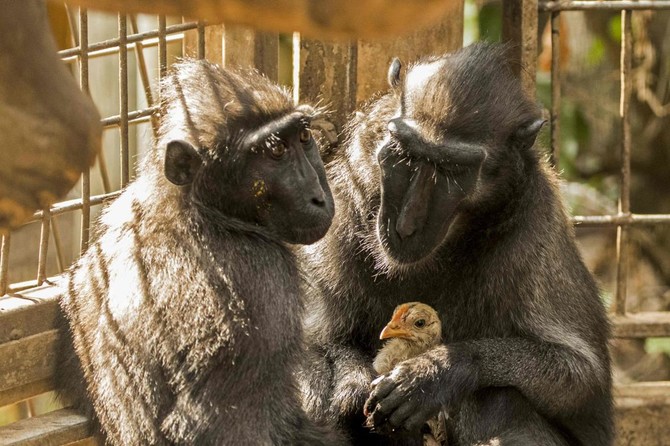
A four-year-old Indonesian black macaque named Niv (R) holds a young chicken at the Ramat Gan Safari Park near Tel Aviv on August 25, 2017 after she adopted the chicken when it wondered into their enclosure. Niv, has spent the past week caressing, cleaning and playing with the bird at the Ramat Gan and zoo officials say the unlikely pair have become inseparable. (AFP)
2 / 2
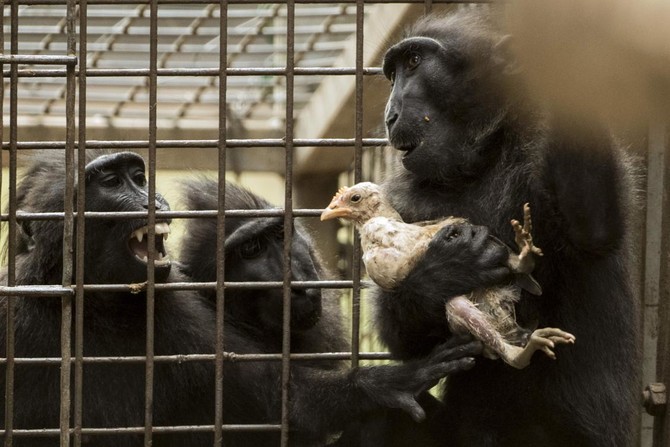
A four-year-old Indonesian black macaque named Niv (R) holds a young chicken at the Ramat Gan Safari Park near Tel Aviv on August 25, 2017 after she adopted the chicken when it wondered into their enclosure. Niv, has spent the past week caressing, cleaning and playing with the bird at the Ramat Gan and zoo officials say the unlikely pair have become inseparable. (AFP)
Updated 27 August 2017
Follow

Loveless monkey adopts chicken at Israeli zoo

RAMAT GAN, Israel: A lonely monkey at an Israeli zoo has found a way to soothe her maternal urges: by adopting a chicken.
Niv, an Indonesian black macaque, has spent the past week caressing, cleaning and playing with the bird at the Ramat Gan Safari Park near Tel Aviv.
“It seems that Niv, who is four years old and has reached the age of sexual maturity, has difficulty finding a partner,” the zoo’s spokeswoman Mor Porat said.
“This probably explains the maternal instinct she expresses to this chicken.”
The bird, which doesn’t have a name, could easily escape through the bars but chooses to stay near Niv.
“These kinds of relationships are rare,” Porat told AFP. “Sometimes macaques kill and eat chickens that enter their pens or play with them until they die.”
To avoid such a tragic end, officials separated Niv and her feathered companion from the other macaques — apart from her mother, who is often the target of hostilities from other females.
Porat said the chicken “seems very happy to have found a surrogate mother. At night they sleep together.”
A few months ago, Niv attempted to adopt a previous chicken, but it spurned her advances.
Seemingly unlikely animal friendships are often the result of different species being put together by humans.
A bear, lion and tiger discovered during a drug raid in the United States remained inseparable for life after they were moved to an animal sanctuary.
But Porat said it wasn’t clear where the chickens at the zoo had come from.
The black macaque is listed as critically endangered by the International Union for the Conservation of Nature.
The domesticated chicken is the most common bird in the world.


Viral phenomenon in Argentina has young people identifying themselves as animals

Updated 27 February 2026
Follow

Viral phenomenon in Argentina has young people identifying themselves as animals

  • As the movement gains traction, psychologists are stepping in to analyze the phenomenon and its place in public discourse

BUENOS AIRES: On a recent Sunday, a Buenos Aires plaza transformed into a makeshift wilderness for an unusual group of teenagers.
Sofía, wearing a lifelike beagle mask, ran across the grass on all fours. Nearby, 15-year-old Aguara leapt through the air, clearing an obstacle course while imitating the precise movements of a Belgian breed dog. Others dressed as cats and foxes perched in the branches of trees, keeping their distance from curious onlookers.
It was the latest gathering of “therians,” individuals who say they identify mentally, spiritually or psychologically with non-human animals. The trend has taken over Argentine social media over the past few months, gaining traction on platforms like TikTok, where the hashtag #therian has surpassed 2 million posts, with Argentina leading all other Latin American countries in engagement. The surge has drawn the attention of influencers and media outlets alike, sparking reactions that range from laughter and bewilderment to outright anger.
And as the movement gains traction, psychologists are stepping in to analyze the phenomenon and its place in public discourse.
Aguara, who claims to identify as a Belgian Malinois and counts her age as the equivalent of two years and two months in dog years, says she’s a lot like any other teenager.
“I wake up like a normal person and live my life like a normal person,” she said. “I simply have moments when I like being a dog.”
As the leader of what she calls her “pack,” Aguara — the name she identifies with — boasts more than 125,000 followers on TikTok and coordinates regular meetups around the Argentine capital.
Aru, a 16-year-old who wore a seal mask to the park meetup, said she considers herself part of the “otherpaw” branch of therians: individuals who wear masks and tails or move on all fours just for fun. “It’s not necessarily about identifying as an animal,” she said.
She reckons the therian trend took off in Argentina because of the country’s “fairly free” environment. For other young Argentines, the movement has provided a vital community where they can feel truly accepted.
Should parents be worried?
Débora Pedace, a psychologist and director of the Integral Therapeutic Center in Buenos Aires, acknowledged that the phenomenon generates a complex mix of confusion, laughter and even anger.
“From a psychological standpoint, this is a symbolic identification with an animal,” Pedace said. “It becomes pathological or alarming only when it turns into a deeply rooted belief and the person fully assumes the role of an animal, potentially leading to self-harm or hurting others.”