Saudi factory stitches gold-laced cover for Islam’s holiest site

1 / 4
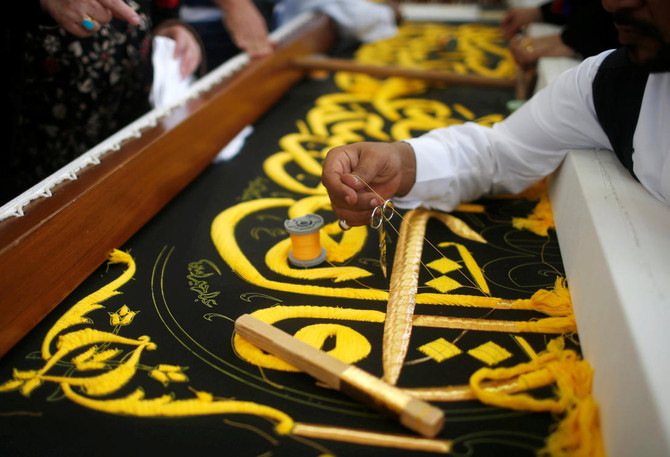
A man embroiders the Kiswa, a silk cloth covering the Holy Kaaba, ahead of the annual haj pilgrimage, at a factory in the holy city of Mecca, Saudi Arabia August 26, 2017. Picture taken August 26, 2017. REUTERS/Suhaib Salem
2 / 4
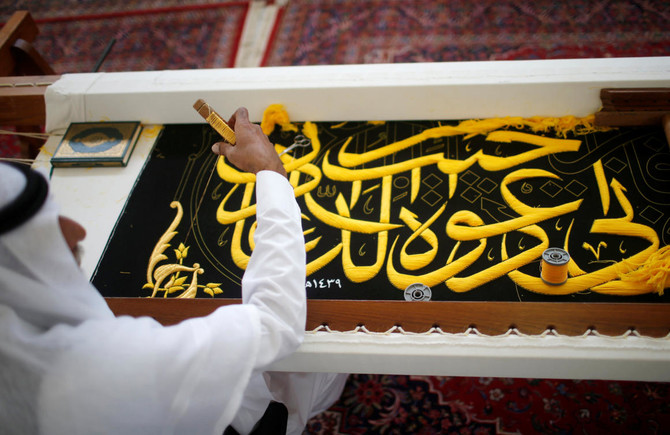
A man embroiders the Kiswa, a silk cloth covering the Holy Kaaba, ahead of the annual haj pilgrimage, at a factory in the holy city of Mecca, Saudi Arabia August 26, 2017. Picture taken August 26, 2017. REUTERS/Suhaib Salem
3 / 4
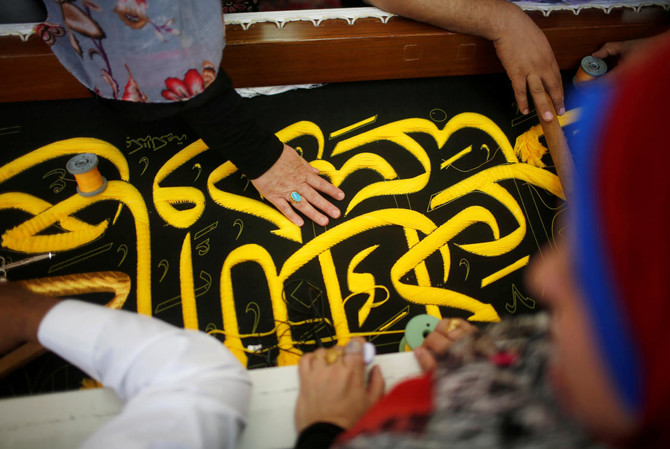
A man embroiders the Kiswa, a silk cloth covering the Holy Kaaba, ahead of the annual haj pilgrimage, at a factory in the holy city of Mecca, Saudi Arabia August 26, 2017. Picture taken August 26, 2017. REUTERS/Suhaib Salem
4 / 4
A man embroiders the Kiswa, a silk cloth covering the Holy Kaaba, ahead of the annual haj pilgrimage, at a factory in the holy city of Mecca, Saudi Arabia August 26, 2017. Picture taken August 26, 2017. REUTERS/Suhaib Salem
Updated 27 August 2017
Follow

Saudi factory stitches gold-laced cover for Islam’s holiest site

MAKKAH: Dozens of Saudi craftsmen, mostly in their 40s and 50s, are hard at work in a factory in Makkah preparing an embroidered black and gold cloth to cover the Kaaba, the holiest site in Islam.
Known as the kiswa, the cloth is woven from silk and cotton and adorned with verses from the Qur'an. A new one is made each year to be placed on the Kaaba in Makkah’s Grand Mosque during the annual Muslim Hajj pilgrimage, which begins on Wednesday.
Many of the craftsmen have worked in the factory in the Oum Al-Jood district of Makkah all their lives but they will retire soon, so a new generation is being trained to carry on the trade.
General manager Mohammed bin Abdullah Bajuda said King Salman had ordered all the machines, which were introduced some 30 years ago to help automate the process, to be replaced with newer ones by next year.
“He also called for a new cadre of manufacturers to take the place of the current one,” Bajuda said during a visit to the factory on Saturday.
A cube-shaped stone structure, the Kaaba is a focal point of the Hajj, during which some two million pilgrims walk around it in a mass ritual.
When Muslims anywhere in the world say their prayers five times a day, it is toward Makkah and the Kaaba that they face.
The Kaaba’s black stone was revered even before the birth of Islam. Muslims believe it was originally built by the prophet Ibrahim, the Biblical Abraham, on the site of the first house of worship built by Adam. It has since been rebuilt more than once.
’THE BEST FEELING’
The kiswa was manufactured in Egypt until 1962. There have been red, green or white coverings in centuries past, but now it is always black with embroidered gold calligraphy.
Nearly 670 kg (1,477 pounds) of silk, enough to cover a structure estimated to measure about 50 feet (15 meters) high and 35 to 40 feet long, is imported from Italy. Silver and gold-plated thread comes from Germany.
But the kiswa is embroidered and stitched together in Saudi Arabia and paid for by the kingdom each year at a cost of $6 million.
Asked about that expenditure at a time of austerity in the kingdom, Bajuda said: “This glorifies the house of God. The Kaaba more than deserves this honor.”
Waleed Al-Juhani has worked at the factory, which opened in 1977, for 17 years.
“Thanks to God we are working to serve the holy Kaaba. This is a great blessing,” he said, while embroidering a Qur'anic verse that takes 60 days to complete.
“When we succeed in our work, we are glad that Muslims will celebrate a new cover for the Kaaba. This is the best feeling.”
At the end of Hajj, the used cloth will be cut into pieces to be distributed to dignitaries and religious organizations. Recipients regard the fragments as heirlooms.
This year’s kiswa is complete, but the workers have already started on the next one.


Motherhood during Ramadan 

Updated 6 sec ago
Follow

Motherhood during Ramadan 

  • Planning ahead, flexibility, and family support helps mothers make it through the holy month 

JEDDAH: For mothers — new, working or stay-at-home, Ramadan comes with its own set of demands as they strive to balance work, house, and children of different age groups, all while fasting. 

As routines shift and energy levels fluctuate, Arab News spoke to mothers on how they manage to keep their world together. 

Elaf Trabulsi, founder and creative at Ctrl C Agency and a full-time employee, is a mother to an 18-month-old daughter. For Trabulsi, Ramadan is “controlled chaos, honestly. It’s my favorite month but it’s also the one that tests every system I’ve built — work, home, health, sleep. There’s something about fasting while managing a full schedule that forces you to be very deliberate about where your energy goes. I’ve come to appreciate that pressure.” 

Planning is a vital strategy during Ramadan, mothers said, because without a clear structure in place, the household ends up in a state of disarray. A lot of decisions have to be made professionally and domestically to hold the house together. 

“I juggle a full-time job alongside the agency, so Ramadan is really about protecting the hours that matter most and being honest about what can wait,” Trabulsi said. 

Baraa Hifni, a physical education teacher at Jeddah Campus International School, echoed similar sentiments. “I rely on planning ahead, distributing household responsibilities, and organizing my children’s time. I also make sure to take some time for myself so that I can stay in a good mood throughout the day. Balance requires calmness and clear priorities,” the mother of two young daughters said. 

Even with a schedule planned, juggling motherhood and work can often be challenging because newborns and toddlers function on their own timeline, and it is the sleep schedule that takes a hit. 

“Ramadan flips your schedule naturally — late gatherings, suhoor, staying up — and then you have a toddler operating on her own timeline regardless. That gap between when you slept and when she’s ready to start her day is where it gets hard. You learn to function on less and find energy where you can,” Trabulsi told Arab News. 

Finding pockets of peace or solitude during Ramadan for worship is also quite difficult for mothers because they cannot set or follow a rigid schedule.

For Hifni, it is usually after the chaos around iftar settles after maghrib prayer “even if it’s just a few minutes to regain my calmness and draw closer to God.”  

For Trabulsi it is “whenever and wherever I can find it … sometimes it’s the quiet after she sleeps, sometimes it’s during the drive home from a gathering.” 

Hana Barakat, an occupational therapist and mompreneur productivity coach, shares similar thoughts. 

“Allow worship to be brief and spread throughout the day. Measure productivity by consistency, not quantity. Accept fluctuating energy from day to day. Recognize that a quieter Ramadan can still be deeply spiritual,” she said.

“Achieving balance — or harmony, as I prefer — does not mean pushing the body to match spiritual intentions but adjusting expectations and practices so that the body supports the experience rather than resists it,” she said. “Realism supports well-being and allows space to experience the month with calm.”

She advises new mothers to reset their expectations by prioritizing recovery and infant care over productivity. For a new mother, this shift can feel especially intense because she is already adapting to life after childbirth — “caring for an infant whose needs are unpredictable.”

Fasting can also influence emotional regulation, particularly when combined with sleep deprivation.

“When hunger combines with lack of sleep and fatigue, the nervous system becomes more sensitive; the crying baby may make mothers feel more overwhelmed than usual,” Barakat said.

“Emotional reactions may occur more quickly, and the mother needs extra effort to calm herself. These are normal physiological responses, not a sign of being an impatient or inadequate mother.”

Barakat outlined several strategies to help new mothers navigate the month with greater ease. Reducing nonessential tasks is not neglect, it preserves the strength needed to move steadily through the month, she said. 

Choosing one meaningful task per day prevents energy from being drained by trying to accomplish everything. Waiting for an uninterrupted stretch may lead to frustration. Brief quiet moments can become restorative spiritual pauses, she added. 

Even a few minutes of true rest can help regulate the nervous system, improving patience and emotional balance. Less complexity in meals, social obligations, and routines leaves more room for spiritual presence.

Meaningful support, Barakat said, must be practical rather than merely verbal, for all mothers. 

Spouses and family members should help by taking responsibility for specific daily tasks, giving mothers uninterrupted time to rest, reducing social expectations placed upon her, and understanding fluctuations in her energy and mood.

“When responsibility is shared, the mother can experience Ramadan with greater calm, ease, and presence,” she said.