Second storm hits Hong Kong and Macau amid typhoon recovery

People use umbrellas during heavy rain as severe tropical storm Pakhar passes over Macau on Sunday. (AFP)
Updated 27 August 2017
Follow

Second storm hits Hong Kong and Macau amid typhoon recovery

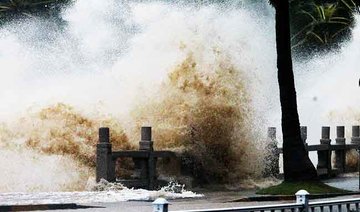
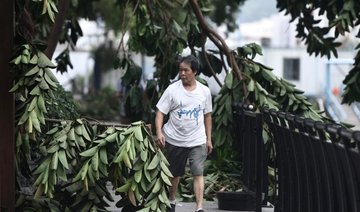
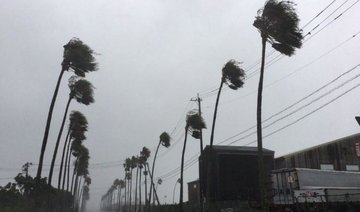
HONG KONG: A powerful storm lashed Hong Kong and Macau on Sunday, just days after a punishing typhoon swept through southern China and claimed at least 18 lives.
Both cities raised a Typhoon 8 signal, the third-highest warning level, early Sunday morning as severe tropical storm “Pakhar” made landfall in the region, where emergency workers are still battling to repair Wednesday’s damage.
Hong Kong’s flagship carrier Cathay Pacific and Cathay Dragon canceled 50 flights on Sunday morning and are expecting more delays and cancelations.
All ferry services in Hong Kong were suspended.
The Typhoon 8 storm warning level would typically shut down Hong Kong’s stock market, schools and businesses.
Packing winds of up to 130 kilometers (80 miles) per hour, Pakhar — named after a freshwater fish in the lower Mekong river — smashed into southern China as worst-hit Macau was still picking up the pieces after Typhoon Hato.
Hato ripped through the gambling hub Wednesday, plunging casinos into darkness and causing destructive floods.
The official death toll in Macau reached 10, as the enclave’s government faces recriminations over its lack of preparation.
A further eight people are known to have died from Typhoon Hato in the neighboring Chinese mainland province of Guangdong.
Hong Kong and Macau both raised the most severe Typhoon 10 warning last week, only the third time a storm of this power had pounded Hong Kong in the past 20 years.
In Macau, it was the strongest typhoon in 53 years, according to the city government.
Pakhar, which also brought occasional heavy rain, is expected to persist for most of Sunday morning, moving toward the Pearl River Estuary, the Hong Kong Observatory said.
Summer is typhoon season for Hong Kong, which can experience storms of such severity that the entire city shuts down.


How decades of deforestation led to catastrophic Sumatra floods

Updated 9 sec ago
Follow

How decades of deforestation led to catastrophic Sumatra floods

  • At least 1.4m hectares of forest in flood-affected provinces were lost to deforestation since 2016
  • Indonesian officials vow to review permits, investigate companies suspected of worsening the disasters

JAKARTA: About a week after floods and landslides devastated three provinces in Indonesia’s Sumatra island, Rubama witnessed firsthand how the deluge left not only debris and rubble but also log after log of timber.

They were the first thing that she saw when she arrived in the Beutong Ateuh Banggalang district of Aceh, where at least two villages were wiped out by floodwaters.

“We saw these neatly cut logs moving down the river. Some were uprooted from the ground, but there are logs cut into specific sizes. This shows that the disaster in Aceh, in Sumatra, it’s all linked to illegal forestry practices,” Rubama, empowerment manager at Aceh-based environmental organization HAKA, told Arab News.

Monsoon rains exacerbated by a rare tropical storm caused flash floods and triggered landslides across Aceh, North Sumatra, and West Sumatra in late November, killing 969 people and injuring more than 5,000 as of Wednesday, as search efforts continue for 252 others who remain missing.

In the worst-hit areas, residents were cut off from power and communication for days, as floodwater destroyed bridges and torrents of mud from landslides blocked roads, hampering rescue efforts and aid delivery to isolated villages.

When access to the affected regions gradually improved and the scale of the disaster became clearer, clips of washed-up trunks and piles of timber crashing into residential areas circulated widely online, showing how the catastrophic nature of the storm was compounded by deforestation.

“This is real, we’re seeing the evidence today of what happens when a disaster strikes, how deforestation plays a major role in the aftermath,” Rubama said.

For decades, vast sections of Sumatra’s natural forest have been razed and converted for mining, palm oil plantations and pulpwood farms.

Around 1.4 million hectares of forest in Aceh, North Sumatra and West Sumatra were lost to deforestation between 2016 and 2025 alone, according to Indonesian environmental group WALHI, citing operations by 631 permit-holding companies.

Deforestation in Sumatra stripped away natural defenses that once absorbed rainfall and stabilized soil, making the island more vulnerable to extreme weather, said Riandra Purba, executive director of WALHI’s chapter in North Sumatra.

Purba said the Sumatra floods should serve as a “serious warning” for the government to issue permits more carefully.

“Balancing natural resource management requires a sustainable approach. We must not sacrifice natural benefits for the financial benefit of a select few,” he told Arab News.

“(The government) must evaluate all the environmental policies in the region … (and) implement strict monitoring, including law enforcement that will create a deterrent effect to those who violate existing laws.”

In Batang Toru, one of the worst-hit areas in North Sumatra where seven companies operate, hundreds of hectares had been cleared for gold mining and energy projects, leaving slopes exposed and riverbeds choked with sediment.

When torrential rains hit last month, rivers in the area were swollen with runoff and timber, while villages were buried or swept away.

As public outrage grew in the wake of the Sumatra floods, Indonesian officials, including Environment Minister Hanif Faisol Nurofiq, have moved to review existing permits and investigate companies suspected of worsening the disaster. 

“Our focus is to ensure whether company activities are influencing land stability and (increasing) risks of landslides or floods,” Nurofiq told Indonesian magazine Tempo on Saturday.

Sumatra’s natural forest cover stood at about 11.6 million hectares as of 2023, or about 24 percent of the island’s total area, falling short of the 30 to 33 percent forest coverage needed to maintain ecological balance.

The deadly floods and landslides in Sumatra also highlighted the urgency of disaster mitigation in Indonesia, especially amid the global climate crisis, said Kiki Taufik, forest campaigner at Greenpeace Indonesia. 

Over two weeks since floods and landslides inundated communities in Sumatra, a few villages remain isolated and over 800,000 people are still displaced. 

“This tropical cyclone, Senyar, in theory, experts said that it has a very low probability of forming near the equator, but what we have seen is that it happened, and this is caused by rapid global warming … which is triggering hydrometeorological disasters,” Taufik told Arab News.

“The government needs to give more attention, and even more budget allocation, to mitigate disaster risks … Prevention is much more important than (disaster) management, so this must be a priority for the government.”