PHOENIX, USA: President Donald Trump spared former Arizona Sheriff Joe Arpaio the prospect of serving jail time in granting the first pardon of his turbulent tenure, wiping away the lawman’s recent federal conviction stemming from his immigration patrols that focused on Latinos.
The White House said 85-year-old Arpaio was a “worthy candidate” for the pardon, citing his “life’s work of protecting the public from the scourges of crime and illegal immigration.” Trump granted the pardon less than a month after a judge found Arpaio guilty of a misdemeanor contempt-of-court charge in a trial that was prosecuted by the president’s own Justice Department.
“I appreciate what the president did,” Arpaio told The Associated Press as he celebrated the news over an Italian restaurant meal and someone in his party ordered champagne. “I have to put it out there: Pardon, no pardon — I’ll be with him as long as he’s president.”
The pardon drew a swift and harsh denunciation from an array of Latinos and political leaders, who said it amounted to presidential approval of racism by eliminating the conviction of a law officer who the courts said had used immigration patrols to racially profile Latinos. And it overturned what critics saw as a long-awaited comeuppance for a lawman who long escaped accountability for his use of headline-grabbing tactics as sheriff in Phoenix.
“Pardoning Joe Arpaio is a slap in the face to the people of Maricopa County, especially the Latino community and those he victimized as he systematically and illegally violated their civil rights,” Phoenix Mayor Greg Stanton said.
The White House announced the pardon late Friday as a powerful Category 4 hurricane threatened Texas with severe flooding and on the same day Trump fleshed out the details of his ban on transgender individuals serving in the military, another move that will cheer his conservative base. The decision followed the uproar that ensued after Trump assigned blame to “both sides” participating in race-fueled clashes in Charlottesville, Virginia, this month.
Trump has been plagued by poor job approval ratings, currently at 34 percent, the lowest mark ever for a president in his first year.
His decision on the former sheriff may also serve to energize supporters dispirited by the president’s dismissal a week ago of chief strategist Steve Bannon, a favorite on the far right wing of the Republican Party.
GOP leaders were mixed in reacting to the pardon. Sen. John McCain criticized the move and said it undermines Trump’s “claim for the respect of rule of law as Mr. Arpaio has shown no remorse for his actions.” Republican Gov. Doug Ducey said Arpaio should be given credit for his crime-fighting efforts and allowed to “move on” and enjoy his retirement.
Arpaio earned a national reputation by taking aggressive action to arrest immigrants in the country illegally. But years of legal issues and related costs took a toll on his political power at home, and he was handily defeated by a Democrat in the 2016 election.
The loss coincided with Trump’s election, based in large part on his anti-immigrant rhetoric. Arpaio campaigned for him around the country and spoke at the Republican National Convention.
Arpaio defied court orders that he stop the patrols and has been pardoned by a president who has shown lack of respect for judges with whom he disagrees. Trump has had harsh words about judges overseeing the case against his now-defunct Trump University and his travel ban.
“So Sheriff Joe was convicted for doing his job?” Trump asked supporters at Tuesday’s rally. “I’ll make a prediction. I think he’s going to be just fine, OK.”
Trump issued the pardon seven months after taking office, though it is not unprecedented for a president to issue a pardon in their first year in office.
George H. W. Bush granted clemency after seven months in office, said Jeffrey Crouch, a professor of politics at American University who wrote a book on presidential pardons.
Asked whether Trump sought a recommendation from the Justice Department’s pardon attorney or the deputy attorney general, White House press secretary Sarah Huckabee Sanders said Thursday: “I would imagine they go through the thorough and standard process.”
It is not unheard of for a president to exercise his broad power to grant pardons without formal input from the Justice Department, particularly when it involves an associate or a friend. President Bill Clinton ignited a major controversy on his final day in office with a last-minute pardon for fugitive financier Marc Rich, the ex-husband of a major Democratic fundraiser.
Former President George W. Bush set off a political backlash over his decision to commute the prison sentence of I. Lewis “Scooter” Libby on a perjury and obstruction of justice case that stemmed from a CIA leak. And Gerald Ford pardoned Richard Nixon for his involvement in the Watergate scandal just days after taking over for his predecessor.
Critics say the Arpaio pardon removed the last opportunity to hold the lawman accountable for what they say is a long history of misconduct, including a 2013 civil verdict in which the sheriff’s officers were found to have racially profiled Latinos in his immigration patrols.
Arpaio was accused of prolonging the patrols for 17 months after a judge had ordered them stopped so that he could promote his immigration enforcement efforts in a bid to boost his successful 2012 re-election campaign.
Arpaio acknowledged extending the patrols, but insisted it wasn’t intentional. He blamed a former attorney for not properly explaining the importance of the court order and brushing off the conviction as a “petty crime.”
He accused then-President Barack Obama of trying to influence the 2016 sheriff’s race by announcing in court weeks before Election Day that it was willing to prosecute Arpaio. Prosecutors never filed criminal charges. They were instead recommended by the judge who presided over the profiling case, which began in the Bush administration. The judge in the profiling case was a Bush appointee as well.
Lawyers in Trump’s Justice Department prosecuted the case during a five-day trial this summer, and the judge handed down the conviction last month. Arpaio said he’ll discuss the case in more detail next week. He said he’ll remain involved in the political scene now that he’s no longer facing jail time.
“I don’t fish,” Arpaio said. “I’ll be very active.”


![]()
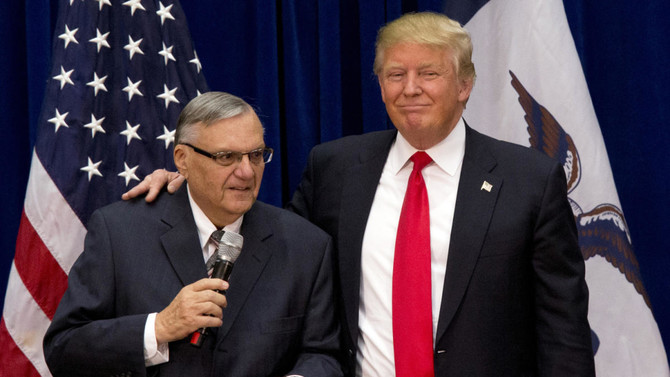

Trump’s first pardon spares political ally Arpaio
Trump’s first pardon spares political ally Arpaio
Malawi suffers as US aid cuts cripple health care
LILONGWE: A catastrophic collapse of health care services in Malawi a year after US funding cuts is undoing a decade of progress against HIV/AIDS, providers warn, leaving some of the most vulnerable feeling like “living dead.”
In the impoverished southern Africa country, the US government’s decision to slash foreign aid in January 2025 has led to significant cuts in HIV treatments, a spike in pregnancies and a return to discrimination.
Chisomo Nkwanga, an HIV-positive man who lives in the northern town of Mzuzu, told AFP that the end of US-funded specialized care was like a death sentence.
After his normal provider of life-saving antiretroviral therapy (ART) vanished due to budget cuts, he turned to a public hospital.
“The health care worker shouted at me in front of others,” Nkwanga recalled. “They said, ‘You gay, you are now starting to patronize our hospitals because the whites who supported your evil behavior have stopped?’“
“I gave up,” he said, trembling. “I am a living dead.”
More than one million of aid-dependent Malawi’s roughly 22 million people live with HIV and the United States previously provided 60 percent of its HIV treatment budget.
Globally, researchers estimate that hundreds of thousands of preventable deaths have been caused by the Trump administration’s dismantling of US foreign aid, which has upended humanitarian efforts to fight HIV, malaria and tuberculosis in some of the world’s poorest regions.
- Lay offs, panic -
In Malawi, the drying up of support from USAID and the flagship US anti-HIV program, PEPFAR, has left a “system in panic,” said Gift Trapence, executive director of the Center for the Development of People (CEDEP).
“The funding cut came on such short notice that we couldn’t prepare or engage existing service providers,” Trapence told AFP.
“We had to lay off staff... we closed two drop-in centers and maintained two on skeleton staff,” he said.
“We did this because we knew that if we closed completely, we would be closing everything for the LGBTI community.”
The Family Planning Association of Malawi (FPAM) non-government organization, a cornerstone of rural health care, has been forced to ground the mobile clinics that served as the only medical link for remote villages.
“We had two big grants that were supporting our work, particularly in areas where there were no other service providers,” said executive director Donald Makwakwa.
“We are likely to lose out on all the successes that we have registered over the years,” he said.
A resident of a village once served by FPAM told AFP there had been an explosion in unplanned pregnancies when the family planning provider stopped work.
“I know of nearly 25 girls in my village who got pregnant when FPAM suspended its services here last year,” said Maureen Maseko at a clinic on the brink of collapse.
- Progress undone -
For over a decade, Malawi’s fight against AIDS relied on “peer navigators” and drop-in centers that supported people with HIV and ensured they followed treatment.
With the funding for these services gone, the default rate for people taking the HIV preventative drug PrEP hit 80 percent in districts like Blantyre, according to a report by the CEDEP.
“This is a crisis waiting to happen,” the report quoted former district health care coordinator Fyness Jere as saying.
“When people stop taking PrEP, we increase the chances of new HIV infections... we are undoing a decade of progress in months,” she said.
Trapence noted that without specialized support, thousands of patients had simply disappeared from the medical grid.
“We lost everything, including the structures that were supporting access... treatment and care,” he said.
In the impoverished southern Africa country, the US government’s decision to slash foreign aid in January 2025 has led to significant cuts in HIV treatments, a spike in pregnancies and a return to discrimination.
Chisomo Nkwanga, an HIV-positive man who lives in the northern town of Mzuzu, told AFP that the end of US-funded specialized care was like a death sentence.
After his normal provider of life-saving antiretroviral therapy (ART) vanished due to budget cuts, he turned to a public hospital.
“The health care worker shouted at me in front of others,” Nkwanga recalled. “They said, ‘You gay, you are now starting to patronize our hospitals because the whites who supported your evil behavior have stopped?’“
“I gave up,” he said, trembling. “I am a living dead.”
More than one million of aid-dependent Malawi’s roughly 22 million people live with HIV and the United States previously provided 60 percent of its HIV treatment budget.
Globally, researchers estimate that hundreds of thousands of preventable deaths have been caused by the Trump administration’s dismantling of US foreign aid, which has upended humanitarian efforts to fight HIV, malaria and tuberculosis in some of the world’s poorest regions.
- Lay offs, panic -
In Malawi, the drying up of support from USAID and the flagship US anti-HIV program, PEPFAR, has left a “system in panic,” said Gift Trapence, executive director of the Center for the Development of People (CEDEP).
“The funding cut came on such short notice that we couldn’t prepare or engage existing service providers,” Trapence told AFP.
“We had to lay off staff... we closed two drop-in centers and maintained two on skeleton staff,” he said.
“We did this because we knew that if we closed completely, we would be closing everything for the LGBTI community.”
The Family Planning Association of Malawi (FPAM) non-government organization, a cornerstone of rural health care, has been forced to ground the mobile clinics that served as the only medical link for remote villages.
“We had two big grants that were supporting our work, particularly in areas where there were no other service providers,” said executive director Donald Makwakwa.
“We are likely to lose out on all the successes that we have registered over the years,” he said.
A resident of a village once served by FPAM told AFP there had been an explosion in unplanned pregnancies when the family planning provider stopped work.
“I know of nearly 25 girls in my village who got pregnant when FPAM suspended its services here last year,” said Maureen Maseko at a clinic on the brink of collapse.
- Progress undone -
For over a decade, Malawi’s fight against AIDS relied on “peer navigators” and drop-in centers that supported people with HIV and ensured they followed treatment.
With the funding for these services gone, the default rate for people taking the HIV preventative drug PrEP hit 80 percent in districts like Blantyre, according to a report by the CEDEP.
“This is a crisis waiting to happen,” the report quoted former district health care coordinator Fyness Jere as saying.
“When people stop taking PrEP, we increase the chances of new HIV infections... we are undoing a decade of progress in months,” she said.
Trapence noted that without specialized support, thousands of patients had simply disappeared from the medical grid.
“We lost everything, including the structures that were supporting access... treatment and care,” he said.
Latest updates


© 2026 SAUDI RESEARCH & PUBLISHING COMPANY, All Rights Reserved And subject to Terms of Use Agreement.