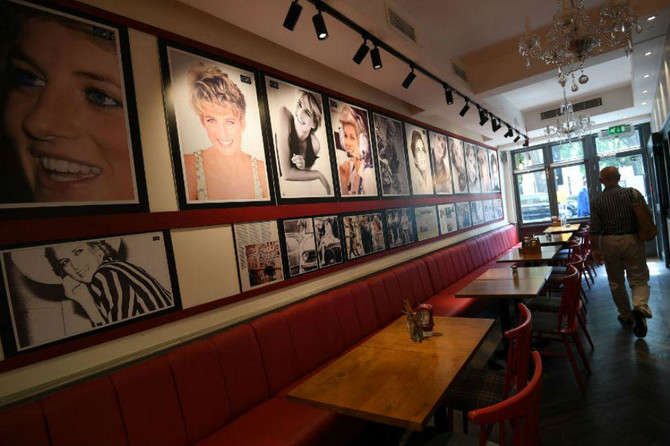
PARIS: The 20th anniversary of Princess Diana’s death has filled magazines, newspapers and television screens in Britain for weeks, but not only there: across Europe, media groups are marking the occasion, underlining her international appeal.
Britain’s celebrity press have offered special editions, supplements and reams of news articles picking over the impact of her tragic life and death as well as her relationships with her sons and Prince Charles.
The popularity of Charles, the heir to the British throne, has plunged as a result of the renewed attention on his former wife and their apparently loveless marriage.
In Europe, many media groups have commissioned documentaries, special reports or their own investigations two decades after her death in a Paris car crash on August 31, 1997.
In Austria, public broadcaster ORF will screen several documentaries about the princess this week, including one entitled “Diana — Forever and Ever,” a retrospective of her life inside Buckingham Palace.
“It shows a life inside a golden cage, imprisoned by traditions, and Diana’s repeated attempts to break out of this golden cage,” ORF’s royal expert Lisbeth Bischoff said in a statement to AFP.
On August 31, the anniversary of her death, Radio Vienna will dedicate its entire programming to the princess, led by Austrian journalist and Diana fan Ewald Wurzinger who raised a monument to her in a Vienna park in 2013.
In France, the public channel France 2 will offer a day of programming about her on Sunday which is to include several documentaries and an investigation.
“Twenty years after, it’s time to look again at what she brought to the monarchy in spirit and who she was really,” said one of the channel’s royal experts, Stephane Bern.
He said her enduring appeal was her “tragic destiny” which put her among stars whose early deaths have immortalized them, such as American actresses Grace Kelly or Marilyn Monroe.
Matthias Gurtler, director of the celebrity weekly Gala, said the magazine had published a special edition on Diana in response to French interest in the British princess.
The attraction for her was linked to her image as a rebel and someone who “broke the rules in a stiff and uptight world,” he said.
In Poland, women’s magazine Wysokie Obcasy put Diana on its front page this month.
“We’re taking the anniversary very seriously. Poles are still captivated by her,” said editor-in-chief Ewa Wieczorek. “Diana’s story is a modern-day fairy tale turned legend.”
One of Bulgaria’s most popular newspapers, 24 Chasa, recently published five pages of stories and a large photo spread about the BBC’s new documentary on Lady Diana and her sons.
“Princess Diana’s life and the circumstances of her death still interest the public, that’s why we wanted to be the first to run a large story,” 24 Chasa editor-in-chief Borislav Zumbulev told AFP.
Public broadcaster BNT will also screen the BBC documentary “Diana, 7 days” in which the princes talk about their mother’s death.
They have given a series of interviews in the run-up to the death anniversary, including for a separate documentary on Britain’s ITV channel, in which they open up about the last time they spoke to their mother and their relationship with her.


![]()
‘Diana-mania’ spreads from Britain as death anniversary looms
‘Diana-mania’ spreads from Britain as death anniversary looms

Latest updates





Recommended


© 2026 SAUDI RESEARCH & PUBLISHING COMPANY, All Rights Reserved And subject to Terms of Use Agreement.