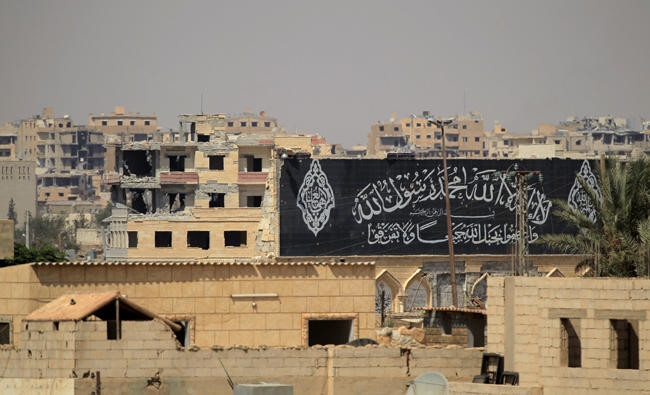
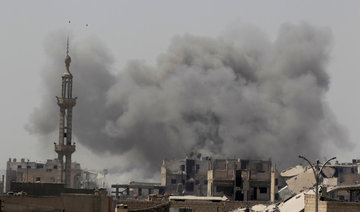
BEIRUT: At least 34 Syrian soldiers and allied fighters have been killed in a Daesh (Islamic State) counterattack in eastern Raqqa province, rolling back regime gains, a monitor said Friday.
The Syrian Observatory for Human Rights, a Britain-based monitor, said the jihadist group had recaptured large swathes of territory from government forces in the fighting on Thursday.
Syria’s army is seeking to advance through Raqqa province to reach neighboring Deir Ezzor, where jihadists have besieged government forces and civilians in the provincial capital since 2015.
Earlier this month, government troops and allied fighters arrived at the outskirts of Madan, the last Daesh-held town in the eastern Raqqa province countryside before Deir Ezzor.
But in Thursday’s counterattack, Daesh “made major progress and... expanded the area under its control along the southern bank of the Euphrates,” the Observatory said.
“Daesg has managed to push regime forces back 30 kilometers (18 miles) from the western outskirts of Madan,” Observatory director Rami Abdel Rahman said.
The Syria army operation in the area, backed by air support from ally Russia, is separate from the battle for provincial capital Raqqa city.
The effort to oust Daesh from the city, once the jihadist group’s Syrian stronghold, is being led by the Syrian Democratic Forces (SDF), a US-backed alliance of Kurdish and Arab fighters.
The SDF has captured just under 60 percent of Raqqa city since it entered in June after months of fighting to encircle it.
More than 330,000 people have been killed in Syria since the conflict began in March 2011 with anti-government protests.

Daesh counterattack kills 34 Syria regime forces in Raqqa province: monitor
UNESCO fears for fate of historical sites during Iran war
- “UNESCO is deeply concerned by the first impact that the hostilities are already having on many world heritage sites,” Assomo said
- Tehran’s Golestan palace, damaged in US–Israeli strikes, is testimony to the grandeur of Iran’s civilization in the 19th century
PARIS: UNESCO said it is deeply concerned about the fate of world heritage sites in Iran and across the region, after Tehran’s Golestan palace, often compared to Versailles, and a historic mosque and palace in Isfahan were damaged in the war.
The United Nations’ cultural agency on Wednesday urged all parties to protect the region’s outstanding cultural sites, saying four of Iran’s 29 world heritage sites had been damaged since the start of the US and Israeli war with Iran.
“UNESCO is deeply concerned by the first impact that the hostilities are already having on many world heritage sites,” Lazare Eloundou Assomo, director of the World Heritage Center, told Reuters, adding he was also concerned for sites in Israel, Lebanon and across the Middle East.
Tehran’s Golestan palace, damaged in US–Israeli strikes, is testimony to the grandeur of Iran’s civilization in the 19th century, he said.
The palace was chosen as the Persian royal residence and seat of power by the Qajar family and shows the introduction of European styles in Persian arts, according to the UNESCO website. The last Shah of Iran, Mohammad Reza Pahlavi, held a coronation ceremony there in 1969.
“We sometimes even compare it with the Versailles Palace in France, for instance, and it has suffered, unfortunately, some damage. We don’t know the extent for the moment. But clearly, with the images that we have been able to receive, we can confirm ... it has been affected,” Eloundou Assomo said.
Photos of the interior of the palace have shown piles of smashed glass and shards of wood on the floor, and shattered woodwork.
Isfahan was one of Central Asia’s most important cities and a key point on the Silk Road trading route. Its Masjed-e Jame (Jameh Mosque) is more than 1,000 years old and shows the development of Islamic art through 12 centuries.
Buildings close to the buffer zone of the prehistoric sites of the Khorramabad Valley have also been damaged, UNESCO said.
UNESCO has shared coordinates of key cultural sites to all parties, Eloundou Assomo said, and was monitoring damage.
“We are calling for the protection of all sites of cultural significance ... everything that tells the history of all the civilizations of the 18 countries in the region,” he said.