Typhoon Hato leaves 16 dead after lashing southern China

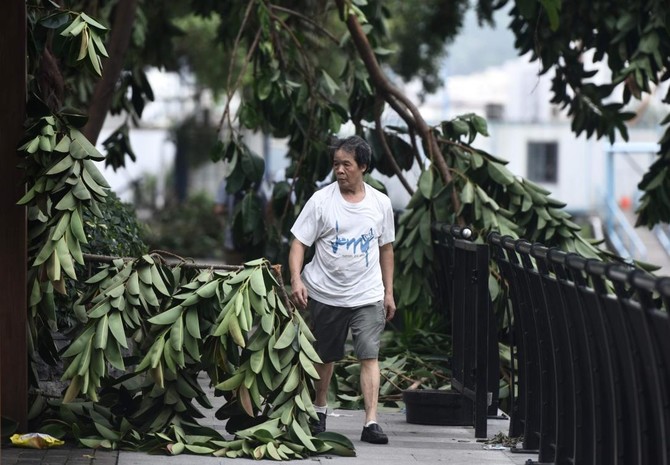
A man walks past a fallen tree in Macau on August 24, 2017. The death toll from Severe Typhoon Hato rose to at least 16 after the storm left a trail of destruction across southern China, blacking out Macau's mega-casinos and battering Hong Kong's skyscrapers. (AFP)
Updated 24 August 2017
Follow

Typhoon Hato leaves 16 dead after lashing southern China

MACAU: The death toll from Severe Typhoon Hato rose to at least 16 Thursday after the storm left a trail of destruction across southern China, blacking out Macau’s mega-casinos and battering Hong Kong’s skyscrapers.
Eight died in the gambling hub of Macau, where local media showed cars underwater and people swimming along what are normally streets. The enclave’s famed mega-casinos were running on backup generators.
A man was killed after being injured by a wall that blew down, another fell from a fourth floor terrace and one was hit by a truck.
The Macau government said two bodies were found in a flooded carpark early Thursday, but details on the remaining victims were not immediately available.
Footage published Thursday on the website of Apple Daily showed water gushing into an underground carpark, with people wading through neck-deep water littered with debris as one man shouted in panic. It was not clear if it was the same carpark where the bodies had been found.
“I have never seen Macau like this since I came here in the 70s,” a taxi driver aged in his 50s who gave his name as Lao told AFP.
He added he thought authorities had reacted too slowly and did not do enough to alert residents of the coming storm.
“It’s like they were trying to gamble with their luck... because Macau had been lucky before,” he added, saying there was not enough time for residents to prepare or buy groceries.
The enclave’s sprawling Venetian casino resort had been on back-up power Wednesday and without air conditioning or proper lighting, according to one source.
A member of staff at the Grand Lisboa Hotel in central Macau told AFP Thursday that it was still without electricity and water and that its casino and restaurants were closed following the typhoon.
The city’s gambling industry generated over 220 billion patacas ($27.29 billion) in revenue in 2016, over half of its annual GDP, as it hosted more than 30 million visitors.
AFP reporters saw debris scattered on roads, with a shipping container washed up on its side on one street in front of a temple.
Residents holding plastic buckets were also seen queueing for water from fire hydrants.
Ferry services between Macau and Hong Kong resumed Thursday morning but passengers said they experienced delays.
In Hong Kong, Hato — whose name is Japanese for “pigeon” — sparked the most severe Typhoon 10 warning, only the third time a storm of this power has pounded the financial hub in the past 20 years.
The city could have suffered losses of HK$8 billion ($1.02 billion), Chinese University of Hong Kong economics professor Terence Chong told AFP, referring to the value of its daily GDP.
More than 120 were injured as the city was lashed with hurricane winds and pounding rain. However, one 83-year-old man earlier thought to be a victim of the weather had committed suicide during the typhoon.
In the neighboring southern Chinese province of Guangdong, at least eight people have died, state broadcaster CCTV reported, while around 27,000 were evacuated to temporary shelters, the official Xinhua news agency said. Nearly two million households were briefly without power.
CCTV said four of the mainland deaths had occurred in Zhuhai, three in Zhongshan and one in Jiangmen.
In Zhuhai, which borders Macau, some 275 homes had collapsed, with the typhoon causing an estimated 5.5 billion yuan ($826 million) in damage, according to state-run Beijing News.
Hong Kong and the surrounding region is regularly battered by typhoons between July and October.
The city saw its strongest storm in 1962 when the eye of Typhoon Wanda passed over and gusts of 284 kilometers per hour were recorded.
It killed 130 and left 72,000 people homeless in Hong Kong alone.


Air India crash still shrouded in mystery six months on

Updated 4 sec ago
Follow

Air India crash still shrouded in mystery six months on

AHMEDABAD: What caused an Air India Boeing 787-8 Dreamliner to crash, killing 260 people? Six months on, investigators have yet to provide clear answers, fueling disputes between pilots, the airline and the manufacturer.
As required by international law, India’s Aircraft Accident Investigation Bureau (AAIB) published a preliminary report one month after the June 12 disaster, when the plane exploded into flames shortly after takeoff from Ahmedabad in western India.
That report provided some technical information, but the investigation is still ongoing.

- What happened? -

Air India flight 171 took off at 1:38 p.m. from Ahmedabad airport with 230 passengers and 12 crew members on board, bound for London Gatwick Airport.
Less than a minute later, it crashed into the buildings of a medical university campus, located a few hundred meters (yards) from the runway.
Video footage shows it taking off but failing to gain altitude, before crashing in a fireball.
The crash killed 241 of the 242 people on board and 19 on the ground.
Only one passenger survived but was seriously injured.
Among the dead were 200 Indians, 52 British nationals, seven Portuguese and one Canadian.

- Initial findings -

The AAIB report published on July 12 said that the fuel supply switches for both engines were almost simultaneously placed in the “off” position just after takeoff.
“In the cockpit voice recording, one of the pilots is heard asking the other why did he cut off (the fuel supply). The other pilot responded that he did not do so,” the report states.
The aircraft then began to lose altitude.
The report also notes that an auxiliary power unit, intended to provide power to the aircraft in the event of engine failure, deployed automatically.
Less than 10 seconds later, both switches were returned to the “on” position.
Immediately afterwards, “one of the two pilots” managed to transmit “Mayday, Mayday, Mayday,” before the plane crashed.
The 15-page document does not mention whether the turning off of the fuel switches could have been caused by pilot maneuver, or by any kind of malfunction.

- Controversy -

As soon as it was published, the report met strong criticism.
Pilot associations argue that the dialogue between the captain and his co-pilot, which the report merely paraphrases, suggests the possibility of human error without providing evidence.
They also pointed out that the AAIB did not recommend at that stage any control measures on the aircraft or its engines — effectively ruling out the possibility of a technical failure, or a maintenance or servicing defect.
A war of words erupted between the families of the victims, lawyers and pilots on one side, and the airline and the manufacturer on the other.
The father of one of the pilots took the case to the Supreme Court.
Pushkaraj Sabharwal, 91, father of pilot Sumeet Sabharwal, said the preliminary investigation was “profoundly flawed.”
In his petition, seen by AFP, he argued that it appeared to “predominantly focus on the deceased pilots, who are no longer able to defend themselves, while failing to examine or eliminate other more plausible technical and procedural causes of the crash.”

- Hypotheses -

British lawyer Sarah Stewart, who represents around 50 families of victims, also favors a scenario not involving the pilots.
“The factual information raises a troubling spectre that this accident may have been caused by uncommanded fuel cut off, suggesting a possible failure in the Boeing systems,” she said in a statement.
Air India CEO Campbell Wilson, in a speech on September 10, said that the “preliminary report indicates nothing wrong with the aircraft, nothing wrong with the engines, nothing wrong with the airline’s operation.”
Some experts, however, seem to doubt this.
“There were electrical faults reported before the crash on this plane,” former commercial pilot Amit Singh, founder of Safety Matters Foundation, told AFP.
“The narrative of the report is built in such a way that the reader tends to believe that the pilots are responsible” even though “a lot of the data presented are not sourced,” he said.
The final report “could be manipulated,” he warned.
Aviation expert Mark Martin goes even further, calling it a “cleverly designed cover-up.”
“Boeing did exactly the same after the 737 MAX crashes — they blamed the pilots,” he said of the accidents in 2018 and 2019, noting that an investigation later found a design flaw.
“Boeing cannot afford to take the blame for the crash,” said Martin.
Contacted by AFP, the US aircraft manufacturer declined to comment.