In violent Mexico, it is a deadly job to be a journalist

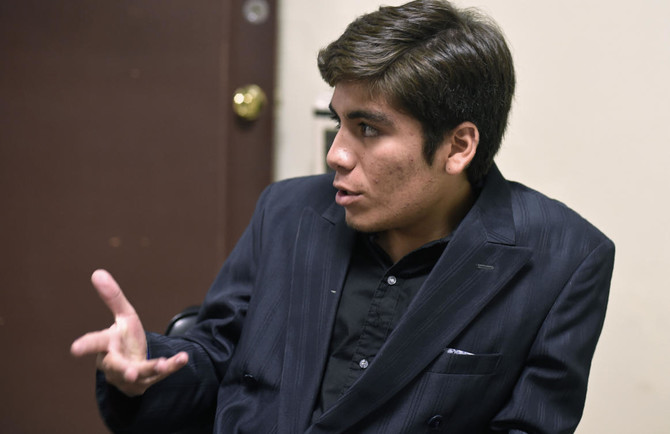
Mexican journalism student Angel Antunez, 18, speaks with AFP during an interview at the Carlos Septien Journalism School in Mexico City, on August 22, 2017. More than 100 journalists have been murdered since 2006 in Mexico, one of the deadliest countries in the world for the profession, according to the watchdog group Reporters Without Borders. More than 90 percent of the killings remain unpunished. (AFP)
Updated 24 August 2017
Follow

In violent Mexico, it is a deadly job to be a journalist

VERACRUZ, Mexico:When Mexican student Carlos David Chavez told his father he wanted to be a journalist, the reaction was dramatic: “They’re going to murder you!” he said.
It is an understandable response.
Mexico is one of the most dangerous countries in the world for journalists, with more than 100 murdered since 2006.
The most recent killing was Tuesday, when a small-town investigative reporter named Candido Rios was gunned down with two other victims in the violent state of Veracruz.
The eastern state, which has a nasty history of drug cartel wars and corrupt politics, is the deadliest for journalists: at least 20 have been murdered here since 2010.
Asking questions about multi-billion-dollar mafias or government graft can be a deadly job in Mexico.
That, together with salaries as low as $300 a month and scarce job opportunities, has made journalism an unpopular career.
“The appetite to be a real reporter, the kind that goes into the field to chase down information, has diminished enormously. Especially for crime reporting,” said Marco Malpica, head of the communications department at Veracruz University.
Just 20 percent of his 200 students want to be actual journalists.
“And most of those want to cover sports or finance or be TV anchors,” he said.
The university’s 63-year-old journalism school has the oldest public program in Mexico, and has seen applications fall by 35 percent in the past five years.
The country’s premier private journalism school, Carlos Septien Garcia, in Mexico City, has seen enrolment drop by nearly 32 percent in the past decade.
It is the same trend at Latin America’s largest university, the National Autonomous University of Mexico.
“Young people are going more for marketing, production and television directing. They want to be on TV,” said Victor Manuel Juarez, spokesman for the university’s department of political and social sciences.
The declining number of journalists will have a damaging long-term effect on Mexico’s development as a democracy, warns the media watchdog Article 19.
“The absence of a new generation of journalists will leave a void in our history. Official truths will no longer be challenged by other truths,” said Ana Ruelas, the group’s Mexico director.
“That will perpetuate censorship,” she told AFP.
Estefani Gamez, an 18-year-old photography student in Veracruz, is one of those enrolled in the state university’s communications department. But the last thing she wants to be is a photojournalist.
“I’d end up in a pit, in some mass grave,” she said, explaining why she has opted for art photography instead.
Carlos David Chavez, the 22-year-old whose father cringed when he said he wanted to be a journalist, soothed his dad’s fears by announcing he would specialize in organizational communications, not street reporting.
In a country where journalists who don’t end up dead are sometimes on the payrolls of drug cartels or corrupt politicians, the profession has lost its allure, he said.
“Some media organizations have lost all ethics,” he said.
Others are still willing to take the risk to chase the truth, give a voice to the voiceless and hold the powerful to account.
Angel Antunez, 18, comes from the Pacific resort town of Acapulco, which has become one of the most violent in Mexico.
He recently arrived at Carlos Septien Garcia Journalism School, dreaming of having his own TV news show some day — despite the risk in his hometown.
“It’s just the way it is. It’s like asking a doctor if he’s afraid of having a patient die. It eases a bit with experience,” he said.
“But, obviously, there will always be some fear.”


Trump is threatening to block a new bridge between Detroit and Canada from opening

Updated 10 sec ago
Follow

Trump is threatening to block a new bridge between Detroit and Canada from opening

  • Trump’s threat comes as the relationship between the US and Canada increasingly sours during the US president’s second term

WASHINGTON: President Donald Trump on Monday threatened to block the opening of a new Canadian-built bridge across the Detroit River, demanding that Canada turn over at least half of the ownership of the bridge and agree to other unspecified demands in his latest salvo over cross-border trade issues.
“We will start negotiations, IMMEDIATELY. With all that we have given them, we should own, perhaps, at least one half of this asset,” Trump said in a lengthy social media post, complaining that the United States would get nothing from the bridge and that Canada did not use US steel to built it.
The Gordie Howe International Bridge, named after a Canadian hockey star who played for the Detroit Red Wings for 25 seasons, had been expected to open in early 2026, according to information on the project’s website. The project was negotiated by former Michigan Gov. Rick Snyder — a Republican — and paid for by the Canadian government to help ease congestion over the existing Ambassador Bridge and Detroit-Windsor tunnel. Work has been underway since 2018.
It’s unclear how Trump would seek to block the bridge from being opened, and the White House did not immediately return a request for comment on more details. The Canadian Embassy in Washington also did not immediately return a request for comment.
Trump’s threat comes as the relationship between the US and Canada increasingly sours during the US president’s second term. The United States-Mexico-Canada trade agreement is up for review this year, and Trump has been taking a hard-line position ahead of those talks, including by issuing new tariff threats.
Canadian Prime Minister Mark Carney, meanwhile, has spoken out on the world stage against economic coercion by the United States.
Sen. Elissa Slotkin, D-Michigan, said the Canadian-funded project is a “huge boon” to her state and its economic future. “You’ll be able to move cargo from Montreal to Miami without ever stopping at a street light,” Slotkin told The Associated Press.
“So to shoot yourself in the foot and threaten the Gordie Howe Bridge means that this guy has completely lost the plot on what’s good for us versus just what’s spite against the Canadians,” Slotkin said.
Michigan, a swing state that Trump carried in both 2016 and 2024, has so far largely avoided the brunt of his second-term crackdown, which has targeted blue states with aggressive immigration raids and cuts to federal funding for major infrastructure projects.
Trump and Democratic Gov. Gretchen Whitmer have also maintained an unusually cordial relationship, with the president publicly praising her during an Oval Office appearance last April. The two also shared a hug last year ahead of Trump’s announcement of a new fighter jet mission for an Air National Guard base in Michigan.
While Canada paid for the project, the bridge will be operated under a joint ownership agreement between Michigan and Canada, said Stacey LaRouche, press secretary to Whitmer.
“This is the busiest trade crossing in North America,” LaRouche said, saying the bridge was “good for Michigan workers and it’s good for Michigan’s auto industry” as well as being a good example of bipartisan and international cooperation.
“It’s going to open one way or another, and the governor looks forward to attending the ribbon-cutting,” LaRouche said.
Rep. Shri Thanedar, the Democratic House representative of Detroit, said blocking the bridge would be “crazy” and said Trump’s attacks on Canada weren’t good for business or jobs. “The bridge is going to help Michigan’s economy. There’s so much commerce between Michigan and Canada. They’re one of our biggest partners,” Thanedar said.
Democratic Rep. Debbie Dingell of Ann Arbor brushed aside the president’s threat, saying she’s looking forward to the bridge’s opening later in the spring. “And I’ll be there,” Dingell said.
“That bridge is the biggest crossing in this country on the northern border. It’s jobs. It’s about protecting our economy. It was built with union jobs on both sides,” said Dingell. “It’s going to open. Canada is our ally.”