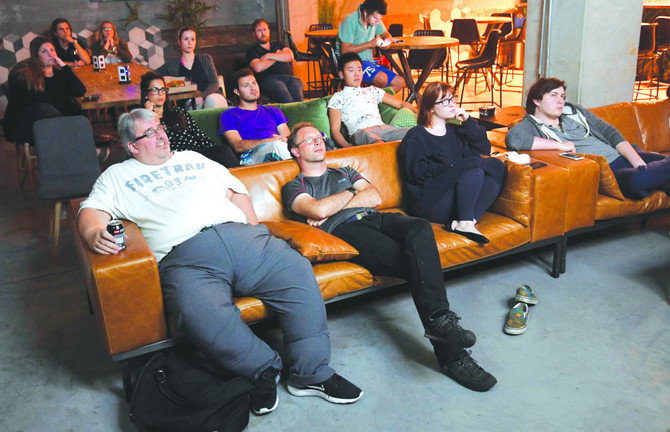
LONDON: Millennials priced out of London’s traditional housing market are opting to rent tiny apartments in so-called “co-living” developments, a fast-growing area that private investors and venture capital are eager to tap into.
Investors have put more than £1 billion ($1.28 billion) into “microflats,” where residents share facilities such as dining areas, lounges, work spaces, laundry rooms and gyms, and the investors are looking to do more.
The Collective, a property company founded in 2010, is one of London’s major co-living developers. Its Old Oak co-living apartment building in west London is the world’s largest, with 546 people living across 10 floors, according to its website.
Reza Merchant, chief executive of The Collective, said: “There’s a complete lack of affordable and good quality accommodation for young working people.”
Merchant said The Collective was looking to secure more sites across London as well as in other major global cities.
Microflats — which typically range from 200 square feet (about 20 square meters) to 350 square feet for a studio apartment — are already being built across the world, from Hong Kong to New York.
The Collective says tenants at Old Oak have a median age of 28 and a median income of £32,000 per year. They pay £230 to £360 per week, including bills.
“For people at certain stages of their career ... it definitely makes a lot of sense,” Ivan Soto-Wright, a 27-year-old resident of The Collective Old Oak, told Reuters.
The co-living microflats market now accounts for 5 to 10 percent of Britain’s £25 billion build-to-rent private rental sector, made up of institutionally-backed blocks of flats built for families to rent, James Mannix, head of residential capital markets at property group Knight Frank, said.
Investors say the micro-units create more attractive income streams as the more efficient use of space means the rent per square foot in each flat is 10-15 percent more than for traditional rentals.
“This strategy will provide us with an investment that has long-term, defensive characteristics,” said Arron Taggart of hedge fund Cheyne Capital Management, which has invested in one of The Collective’s schemes.
Although investors say they expect demand for microflats to grow, planning restrictions could become an issue because specific local authority permission is needed for new builds.
Native Finance, backed by venture capital firm Passion Capital, is seeking to get London’s local authorities on board. Native’s co-founder Prasanna Kannan said by working with local authorities it can be possible to build more of these innovative schemes.
But large property investors in Britain’s private rental market have tended to focus instead on developing more traditional apartment blocks designed for families to rent.
And others in the industry see limits to co-living developments as an investment class.
“While it is hugely socially encompassing, it does have its drawbacks from an operational perspective. You might have high voids, it costs a lot to run,” Toby Nicholson, a director in property company Colliers’ private rental sector team, said.
“It is going to be relevant, but it’s not going to overtake or outweigh the traditional approach to residential in terms of studios, one and two bedroom regular flats,” Nicholson said.
In central London, small apartments now make up a big chunk of the rental market. In the year to July 31, 42 percent of the flats let in prime central London have been studios and one bedroom units, as single people and couples opt for location over size, property investment fund London Central Portfolio said.
Residents like Soto-Wright said the benefits of micro-flats outweighed any drawbacks.
“As an entrepreneur you really want to bootstrap and be smart around your expenses.”
“On the micro-sites ... people are starting to rethink how small should they be going,” Roger Southam, a director in Savills’ property management team, said. People do not want to stay in another format of student accommodation when they are starting their journey into business life, he added.
In terms of yield, microflats have a net initial yield of 50-100 basis points above a traditional build-to-rent private rental sector project, Adam Challis, head of UK residential research at property consultant JLL, said.
Property group Savills said a traditional build-to-rent private development in London has a 3.5-4 percent net yield. Knight Frank puts comparable prime central London yields at 3-3.25 percent.
A litmus test of institutional interest will come with the outcome of the sale of The Collective’s Old Oak scheme, property consultants said. The development was put on the market earlier this year.
— REUTERS

London microflats attract investor cash as millennials embrace co-living
How lifestyle-led real estate is reshaping Saudi Arabia’s urban future
- Government spending, regulatory changes, and incentives for foreign investors are fueling development
RIYADH: Saudi Arabia’s real estate sector is entering a new phase, one defined by lifestyle, experience, and quality of life rather than sheer housing volume.
Driven by Vision 2030, lifestyle-focused developments are set to outperform traditional residential projects, reshaping how people live, work, and connect across the Kingdom.
Government spending, regulatory changes, and incentives for foreign investors are also fueling development. Rising demand across residential, commercial, and logistics sectors, along with the push for smart cities and sustainability, is reshaping the market.
Saudi Arabia’s real estate market was valued at $77.2 billion in 2025 and is projected to grow to $137.8 billion by 2034, with a compound annual growth rate of 6.7 percent from 2026 to 2034, according to IMARC Group.
Lifestyle-focused real estate market
Saudi Arabia’s real estate landscape has evolved beyond conventional housing. Guided by Vision 2030, it now plays a key role in enhancing quality of life, boosting tourism, and driving economic diversification.
According to Sally Menassa, partner at Arthur D. Little, what stands out today is a clear shift from volume-driven residential supply to lifestyle-led, experience-based development.
“As a result, the lifestyle-focused segment is expected to outperform conventional residential real estate, growing at around 8 percent annually over the next five years. This growth is being driven by changing consumer expectations, population growth, rising incomes, and the scale of public investment shaping new urban environments,” Menassa said.
She added that demand in the Kingdom’s real estate is rising across four key segments: mixed-use districts near urban hubs such as King Salman Park; wellness-focused communities prioritizing walkability and services; coastal living along the Red Sea with branded residences; and heritage-driven districts like Diriyah and Al Balad that blend culture, hospitality, and long-term value.
“Overall, this marks a fundamental shift in the Kingdom. Real estate is no longer an end in itself and about delivering buildings; it is becoming a platform for place-making, economic diversification, and sustained value creation,” the ADL partner explained.
From another perspective, Houssem Jemili, senior partner at Bain and Co. Middle East said: “Saudi’s real estate market is forecast at roughly 7–8 percent CAGR to 2030; ‘lifestyle’ demand is being pulled most by amenity-led mixed-use communities plus higher-spec, greener and wellness-leaning homes.”
A report from PwC Middle East released in 2025 focused on the future of sustainable real estate in Saudi Arabia, and showed that the sector is shifting toward livability-focused, high-quality urban developments. Giga-projects are driving demand for mixed-use, wellness-focused, and socially connected communities that enhance quality of life.
Imad Shahrouri, cities sector lead partner, consulting, in Riyadh at PwC Middle East said: “By placing livability and human experience at the foundation of its urban agenda, Saudi Arabia is shaping a market where lifestyle-led developments will play an increasingly influential role in driving demand and investment.”
Core lifestyle elements developers are prioritizing
Saudi developers are shifting from the traditional “build and sell” model to creating integrated lifestyle communities focused on long-term value and everyday living.
Menassa from ADL highlighted that the shift centers on enhancing public spaces — with walkable areas, parks, and wellness facilities — to promote healthier, more social lifestyles, especially for a younger, health-focused population.
“Convenience is also playing a bigger role in shaping residential districts. Schools, childcare centers, clinics, co-working spaces and a wide range of food and beverage options are increasingly located within walking distance of homes, reducing commuting time and making everyday life more efficient and connected,” she said.
The partner added: “Equally important is the role of culture and social activity. Many developments now incorporate cultural venues, entertainment spaces and destination dining, ensuring that neighborhoods remain active throughout the day and week rather than becoming dormant outside working hours.”
Menassa went on to stress that real estate in Saudi Arabia is evolving into a strategic tool for quality of life, tourism, and talent attraction. Driven by Vision 2030, developments now integrate smart infrastructure and global lifestyle standards, while staying rooted in local culture to meet the needs of a young, urban population.
FASTFACT
Driven by Vision 2030, lifestyle-focused developments are set to outperform traditional residential projects, reshaping how people live, work, and connect across the Kingdom.
From Bain’s lens, Jemili said: “Developers are prioritizing livable neighborhoods. Walkability, parks and sport, culture and entertainment access, and everyday convenience, shaped by Vision 2030’s Quality of Life agenda and the 70 percent homeownership-by-2030 push.”
Shahrouri from PwC shed light on how developers in the Kingdom prioritizing livability, wellbeing, and inclusive, community-focused spaces are, aligning with Vision 2030’s push to enhance daily life and promote social integration while reflecting local identity.
“As a result, lifestyle-led elements such as walkable neighborhoods, activated public spaces and integrated community facilities are becoming central to new destinations, ensuring future developments foster more connected, resilient and experience-rich ways of living,” he said.
Regions, cities key hubs for experiential development
Several Saudi cities are emerging as prominent centers for lifestyle-focused, experiential development, each defined by its unique urban and economic character.
From ADL’s perspective, Riyadh is leading this shift as it positions itself as a global capital. The city is seeing strong demand for integrated, mixed-use districts that support live-work-play lifestyles.
“Developments such as KAFD, Diriyah, and areas surrounding King Salman Park reflect a growing preference for urban living that combines employment, culture, green space, and entertainment in close proximity,” Menassa said.
“Jeddah’s appeal is different, but equally compelling. Its strength lies in its coastal character, historic fabric, and more relaxed urban rhythm. Waterfront regeneration and heritage-led districts, particularly around Al Balad, are driving interest in developments that blend walkability, culture, and sea-facing lifestyles — attracting residents, investors, and tourists alike,” she added.
The partner continued to underline that destination developments along the Red Sea coast focus on sustainable, low-density communities blending hospitality, nature, and residential living, promoting wellness and eco-tourism.
Menassa noted that secondary cities like Abha and AlUla are emerging as hubs for outdoor living, culture, and heritage, supported by government policies and investments.
These lifestyle-driven districts appeal to residents for livability and job access, and to investors for scale and stability, offering resilience through everyday services and cultural experiences.
From Bain’s side, Jemili explained that Riyadh and Jeddah stand out as the main hubs because they combine jobs, population growth, liquidity and are where “integrated community” formats scale fastest.
“We’re seeing the same in Makkah and Madinah; the focus is shifting from delivering more units to delivering higher-quality development and standards,” he said.
From PwC’s perspective, Shahrouri noted that regions across Saudi Arabia are becoming hubs for lifestyle-driven development, with large-scale regeneration creating sustainable, well-designed environments that enhance urban living and attract global investment.
“Flagship projects are reshaping their surroundings by focusing on the character and feel of place, bringing together community elements, environmental responsibility, and integrated urban design.”
Their growing appeal comes from the balance they strike between modern infrastructure and a human-centered approach to planning, creating destinations where daily life feels more seamless and connected,” he said.
Next phase of Saudi real estate evolution
The next phase of Saudi Arabia’s real estate evolution is likely to be defined by integration, intelligence, and regeneration.
From ADL’s lens, Menassa explained that Riyadh is set to feature highly vertical, dense urban environments designed for land efficiency and sustainability, with fully integrated live-work-play ecosystems that reduce commuting, boost productivity, and enhance social cohesion.
“The real shift, however, is toward AI-enabled and data-driven communities, where energy, mobility, and services are actively managed rather than passively consumed. Real estate will increasingly be judged not by how much is sold, but by how well places perform — in terms of livability, productivity, and environmental outcomes,” she said.
The partner noted that Saudi Arabia is boosting private sector involvement, public-private partnerships, and institutional investments to develop public spaces and social infrastructure. The focus is shifting from just constructing cities to designing lifestyles, using real estate as a key driver for economic growth and social transformation.
Jemili from Bain said: “The next phase is more about operating districts like platforms, digital twins, and real-time data to optimize energy, maintenance, mobility, and resident experience, creating tighter live-work-play loops. Rather than ‘building more.’”
From PwC’s side, Saudi Arabia is building a strong foundation for future cities by focusing on resilient, resource-efficient developments and adaptable infrastructure, paving the way for smart, connected urban models like vertical districts and digital neighborhoods.
“These emerging environments are set to respond more naturally to the needs of their communities. As the quality and experience of urban life continue to rise, our cities are poised to become more intelligent, enriching and future ready, evolving with their residents and reflecting the ambition of a nation transforming at pace,” Shahrouri concluded.